Pages
Monday, February 27, 2012
Playing with Ngram: Noticing Philosophical Trends
Here Plato is in red and Aristotle is in blue. There are a few interesting things here. Before about 1790 Aristotle is hardly mentioned at all until his precipitous climb to popularity. I immediately wondered if this was an effect of the books they were using or if writers really didn't talk about Aristotle before the 1790's. Perhaps they referred to him by a different name, I know Thomas Aquinas simply called him "The Philosopher" (any insights from those readers who have more than a BS degree in Philosophy?). Maybe the English just didn't talk about him. But after about 1805 the two are almost inseparable, until about 1865 where Plato just seems to go off and have a party by himself, and Aristotle just tags along. They come back together around the end of WWI (this sounds like a bad soap opera), but then in 1960 Aristotle has his thing and Plato has never caught back up.
I also noticed that there was a striking drop in the popularity of both philosophers starting in about 1965 (with a strong revival 20 years later). I wondered if this effect could be seen in other philosophers. Behold the result:
Here I have included Aquinas, Aristotle, Plato, Nietzsche, Hume, Kant and Wittgenstein. David Hume died in 1776 (and we became a free country, coincidence? I think not! Definitely some causation there...sorry philosophy joke), so he was talked about even before he died. Kant died in 1804, but interest in in his stuff only slowly picked up until his first big peak in the 1880's. Nietzsche died in 1900, and had his first big showing during WWI. Wittgenstein died in 1951, which is when he started to get talked about (Lesson for today: If you want people to talk about you just have to die.).
I noticed that the decline of the 1960's was present in all philosophers except Nietzsche who had his second big bump (Wittgenstein did not drop but his upward progress was slowed). So now the big question, is this just an effect of how Google gets and processes the data, or did people really stop talking about all those philosophers in the 1960's? And what drove the revival in the late 80's and throughout the 90's, and now why have they all dropped off, including Nietzsche? Also, it seems that the period between 1860 and 1920 was more Platonic but since 1960 we have been more focused on Aristotle (Atlas Shrugged was published in 1957, which is almost exactly when Aristotle and Plato diverge. Coincidence? Probably not. And that is not a joke.). What effect has that had on us? A whole host of interesting questions.
Wednesday, September 8, 2010
My Hat Goes Off To Google's Engineers.
Here is a company that has found a way to bring information from across the entire world to you as fast as your fingers can explain what you are looking for on the keyboard. My hat really goes off to these engineers! Here's to a company who can on one hand can find a business model allowing them to give away their services to free and at the same time produces mind-blowing products!
Friday, May 7, 2010
Google Sky Map
It is pretty cool. For instance, I looked up the Crab Nebula and it showed me it's current position in the sky.
Google is awesome!
Monday, February 8, 2010
Google's Super Bowl Ad.
Seriously guys, admit it: Google has become an important tool for you to stay productive.
That said, I thought I would showcase Google's ad in tribute for how much this free service does for me:
Wednesday, February 3, 2010
Famous for My Face?
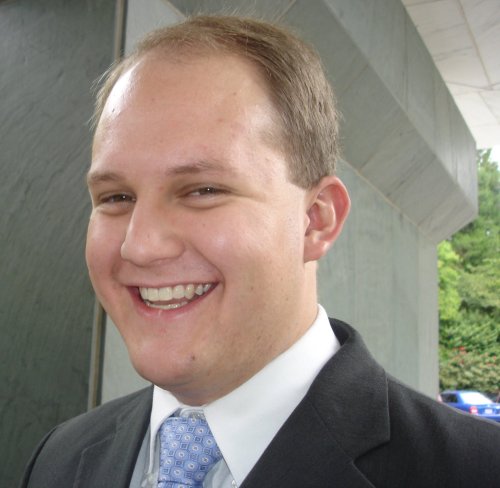
That's right. The most famous thing about me is my face. In fact, the #1 image result for "Nicholas Nelson" is this image.
So if I leave no other imprint on this planet, at least the world seems to like my face.
Tuesday, December 8, 2009
Google Chrome Is Really Fast.
There's lot of things I could highlight in comparison with other web browsers but let's just say this: Google Chrome is fast, very fast.
I've heard this from other sources, but seeing it in person was impressive enough to still amaze me.
Wednesday, November 11, 2009
The Go Programing Language?
It appears Google has created a very interesting programming language. Here are the highlights I care about:- Has array slicing. (This is the only advantage Fortran has to C in my opinion. Slicing makes some mathematical routines soooo much easier to code as well as vectorize.)
- Google claims it runs essentially as fast as C/C++ code.
- It compiles much faster than C/C++.
- Has garbage collection.
- It was built from the ground up to be a parallel language. The "Go routines" run concurrently.
- In addition to slicing, it has a lot of Python features like dictionary type objects. (You all know, other than speed, Python is the greatest language on earth.)
- In addition to 6, it was designed to feel like a dynamic language like Python but again have the speed of C.
- It claims it is very memory safe and has built in features to prevent stack overflows.
- It's open source.
- It's Google!
Here is a video showing how fast it compiles code. (This is scary fast. I wonder how they engineered this given how much time and effort is to making good C compilers.)
Wednesday, July 29, 2009
One More Believer in Google Voice
Tuesday, July 21, 2009
Google Voice Is Real And Works Great!
Yesterday I received my invite to use Google Voice. Everything about it seems to work great, and now I need to start rethinking phone/cell phone plans given Google connects you for free.One really cool feature is every call, text message and voice mail gets logged in a conversation format like Gmail. (All free.) Also, all voice mails you receive can be played back at any time, or read since Google's voice translator converts them to text in addition to sound.
So now I have a new phone number for life, and I decide which phone it rings depending on who is calling. (Let's just say I don't want everyone I know to be able to get a hold of me on my cell phone.) Furthermore, some people just need to be redirected to my voice mail every time. :)
It even has spam filtering!
By the way, this isn't just like some free "talk over your computer" deal. You tell it what phone you want to use for the call you are making and it calls both your phone and the phone of the person you are calling. So you proceed to talk over real telephones for free.
Here is an NY Times article on Google Voice entitled One Number to Ring Them All.
Monday, July 20, 2009
Googling Us
That got me thinking, how easy am I to find online? I have been told that when applying for post-docs or faculty positions you should try to have some link to your research come up within the first ten hits when you search for your name (or your name + "physics") on Google. I decided to try us all out and here are the results, in order of Google rank):
1 (tie): Jared - Jared's blogger profile is the #1 result when Google looks for Jared Greenwalds. Interestingly, that beats out a British meteorologist's reseach page.
1 (tie): Ryan - Searching for Ryan Tanner is a lost cause but "Ryan Tanner physics" brings up Ryan's smiling face on the very out-of-date BYU physics theory page as the top result.
1 (tie): Laren - The first result for Laren is his spring 2008 office hours schedule.
4: Joe - Joe's other blog comes in at #2 when I search for Joseph Smidt.
5: Me - The #8 result for "Nicholas Nelson" is a poster I presented at the Kavli Institute for Theoretical Physics at UC-Santa Barbara last summer.
6: Bill - Neither "Bill Evans" or "Bill Evans physics" produces a result related to Bill in the first 10 hits. Better luck next time.
Friday, July 10, 2009
Are Google Apps Adequate?
Now I want to speculate onto whether their applications are adequate to power an entire OS running on top of Linux. Here are the main Google applications:
- Gmail: Good enough. Many people use it's web interface exclusively already.
- Docs: Has come a long way so maybe. A year ago I would have said no way. But recently I've given docs another try and have been impressed. Finally you have fixed page view and print preview. Also, docs gives a way to collaborate that other office clients can't.
- Calendar: Good, same as Gmail.
- Picasa for Photos: Good, same as Gmail.
- Media Player: ? I don't know what Google has up their sleeves for this. You have Youtube, but what if people want to watch a DVD for instance. I don't know of a Google App for that.
- Reader: Same as Gmail.
- Voice and Video: You guys have to check this out.
- Viewing arbitrary files: ? Some files will be easy like .pdf files. Like the media player, I don't know how Google will handle the wide range of file formats that exist.
- Google Labs: I could keep going on but I think by now you get the point.
However, someone like me still needs a terminal and numerical software so I don't if this Chrome OS will work for me. We will have to see. I always have a free Linux alternative in Ubuntu.
Tuesday, July 7, 2009
Update: Google OS Will Be Linux Based
Google Chrome OS is an open source, lightweight operating system that will initially be targeted at netbooks. Later this year we will open-source its code, and netbooks running Google Chrome OS will be available for consumers in the second half of 2010. Because we're already talking to partners about the project, and we'll soon be working with the open source community, we wanted to share our vision now so everyone understands what we are trying to achieve.One interesting thing, if you read the whole post and know anything about Ubuntu's future goals, Google and Ubuntu basically have the same goals over the next sic months. The main features and users thay are targeting are the same: Fast boot time, netbook and ARM support, very web-centric, and very light weight. In fact, one of Ubuntu's main goals is to port Google's Android. Hmmm.
The software architecture is simple — Google Chrome running within a new windowing system on top of a Linux kernel...
We have a lot of work to do, and we're definitely going to need a lot of help from the open source community to accomplish this vision.
Maybe there is nothing to this but I wonder if part of the "open source community" Google hopes to work with includes Ubuntu.
Google Will Announce Operating System Tomorrow
In a direct challenge to Microsoft, Google announced late Tuesday that it is developing an operating system for PCs based on its Chrome Web browser...I don't know the details yet, I don't know that almost anyone does, but the reality is Google appears to be finally introducing an open source operating system and their tradition has been to support Linux. Intel is also developing their own Linux based operating system called Moblin. (It can boot up in ~5 seconds and looks really cool.)In a post on its company blog, Google said the operating system would initially be aimed at netbooks, the compact, low-cost computers that have turned the PC world on its head. It said the open-source software, called Chrome OS, would be available in the second half of next year.
“Speed, simplicity and security are the key aspects of Google Chrome OS,” the blog post said. “We’re designing the OS to be fast and lightweight, to start up and get you onto the Web in a few seconds.”...
In an unusual move, Intel, the world’s largest chip maker, has worked on developing a Linux-based operating system called Moblin as well.
Just don't be surprised, between Ubuntu, Red Hat, Intel and Google, if Linux really starts taking off in the next year or so. Furthermore, don't be surprised if the future is an open sourced one, with Linux leading the way.
Can Google Save Politics?
We've all seen various things like studies, polls, "Jaywalking" and other things that scream out how uninformed the public is about political candidates and where they stand on the issues. Google may finally fix that with Google in quotes.Now you can pick your favorite candidates and compare where they stand on which ever issues you choose. For example, I'll select Barack Obama and Mitt Romney since there is a good chance I may actually have to choose between them one day. Let's see where they stand:
1. Iraq
Obama:
“I have some news for John McCain,” Obama said. “There was no such thing as al Qaeda in Iraq until George Bush and John McCain decided to invade Iraq.”Romney:
“Had there not been a surge, had Barack Obama been running the country instead, al-Qaeda would now have a safe haven in Iraq, which would have made Afghanistan's safe haven look like child's play.2. Sports
Obama:
“You have all these mementos of Abraham Lincoln, but you have this flat screen TV in there,” Obama told the crowd at the outdoor event. “I thought to myself, Now, who stays in the Lincoln Bedroom and watches sports Center?'Romney:
Romney, who was off by one year - 87 instead of 86 - on the length of the Red Sox World Series drought, replied: “Like most Americans, we love our sports teams and hate the Yankees.”3. Idaho
Obama:
“They told me there weren't any Democrats in idaho,” Obama said, after arriving to wild cheering and rock music. “I did not believe them.”Romney:
“Certainly, it was his decision to make. It was between himself and his conscience and his fellow citizens in idaho. He made the decision he thought was best. And I support his decision,” said Romney.Well, there you go, a few more of these and we will be ready to vote! Well informed America here we come!
Thursday, June 4, 2009
Google Wave
I'll let you watch the video yourself. You will have to wait until you have an hour and a half, although just the first half an hour should impress you. At least watch until they show their next generation spell checker. I was very impressed.
Oh yeah, did I mention that Google will open source the code? :)
Friday, April 17, 2009
The Pirate Bay: Picking On The Little Guy?
The Pirate Bay is a Swedish file sharing site. The site does not actually give away copyrighted material, but links to computers containing copyrighted through torrents from which people can download copyrighted material.
Recently, the people who run the site have been fined 3 million dollars and sentenced to a year in prison. (However, they are appealing.)
As this article from Forbes points out, there isn't anything The Pirate Bay is doing that isn't almost identical to what Google and Yahoo have been doing for years. I can, almost just as easily too, use either Google or Yahoo to locate places on the web housing copyrighted material waiting to be downloaded. In fact, I bet more copyrighted material is discovered, then downloaded, from people using Google and Yahoo then all the file sharing sites combined.
So, end the end, music/movie/law enforcement agencies attack small time crooks but are unwilling to go after the big boys. In many ways they are, almost by definition, bullies.
Piracy isn't right, but making a public spectacle of going after college kids running servers in their basement and ignoring the big time players assisting people locate copyrighted material is pretty cowardly.
Friday, February 13, 2009
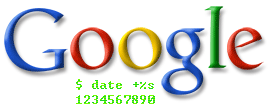
The Date Is: 1234567890

If you know what it means, it means this: Today we came across the date 1234567890 in Unix Time. If you typed the command "date +%s" inside a terminal today at the right time you would have seen it.
Why does Google care? Let's just say Google, and most of it's employees use an operating system that starts with an "L".
PS. Our Mac friends experienced this system time too. (Mac==Unix)
Monday, November 5, 2007
Google Phone Plans Unveiled!
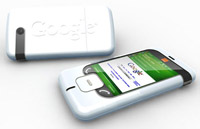
Google finally announced what the Google Phone rumors are all about. Get the full article from The New York Times:1. The Google Phone Software will be based off of Linux. (Watch the support for Linux rise. :) :) :) )
Mr. Rubin, who is 44 years old and is a veteran Silicon Valley designer, said the software system that Google has designed is based on the Linux operating system and Sun Microsystems’ Java language. It is designed so programmers can easily build applications that connect to independent Web services.
2. The Google Phone Software will be open sourced to give others the ability to contribute. :)
In contrast to the existing competitors, Google’s software will be offered freely under “open source” licensing terms, meaning that handset manufacturers will be able to use it at no cost and be free to add new features to differentiate their products.3. This announcement was not that there is a phone yet, but that Google has partnered with several major telephone companies with over 1000 developers to create the first cellphone that was built in an open source way. The code will be Linux based, free and mostly open sourced and companies around the world will contribute until a product is produced going on sell second half of next year.
“We are not building a GPhone; we are enabling 1,000 people to build a GPhone,” said Andy Rubin, Google’s director of mobile platforms, who led the effort to develop the software.
Mr. Rubin said the open-source strategy would encourage rapid innovation and lower the bar to entry in the highly competitive handset market, where software accounts for an increasing share of the cost of making a phone.
Thursday, September 13, 2007
Google To Send Rover To The Moon?
This from Slashdot:chroma writes
"It's been a long time since anyone has explored the surface of the moon. But now Google has teamed up with the X PRIZE Foundation to offer a $30,000,000 bounty to the first privately funded organization to land a robotic rover on the moon. Google, of course, has offered the free Google Moon mapping service for a few years now. Looks like the other search engines have some catching up to do in the space exploration department."
Friday, August 3, 2007
Apple=Unix, Microsoft Open Sourced, Free Google Phone!
I have a grab bag of interesting technology updates:1. Apple has now certified Leopard, their new OS X , as an official version of UNIX. Before it was "based on UNIX," and now it can say it is a version of UNIX. (See here)
2. Microsoft is more and more opening up to open source. They have developed three new licenses that they have shipped to be approved by the Open Source Initiative Whatever products they license under these licenses will by bona fide "Microsoft open source software." (See here)
3. Google is developing an "iPhone killer" which people are calling the GPhone. It looks like Google wants to offer the device to the public for free through advertising just as all Google services are free. From the Washington Post:
Google has developed a prototype cell phone that could reach markets within a year, and plans to offer consumers free subscriptions by bundling advertisements... But Google's product would draw its revenue from a sharply different source, relying on commercial advertising dollars instead of the sticker price of at least $499 for an iPhone and $60 per month for the AT&T service plan.