Oh, I’m a big believer in “technology over politics”. I don’t care who it comes from, as long as there are solid reasons for the code, and as long as we don’t have to worry about licensing etc issues.
In fact, to some degree, I’d be more likely to include it because it’s from a new member of the community rather than less (again, I’d like to point out that drivers are special. They don’t impact other things, so they get merged much more easily than some core changes).
I may make jokes about Microsoft at times, but at the same time, I think the Microsoft hatred is a disease. I believe in open development, and that very much involves not just making the source open, but also not shutting other
people and companies out.
There are ‘extremists’ in the free software world, but that’s one major reason why I don’t call what I do ‘free software’ any more. I don’t want to be associated with the people for whom it’s about exclusion and hatred...
I agree that it’s driven by selfish reasons, but that’s how all open source code gets written! We all “scratch our own itches”. It’s why I started Linux, it’s why I started git, and it’s why I am still involved. It’s the reason for everybody to end up in open source, to some degree.
So complaining about the fact that Microsoft picked a selfish area to work on is just silly. Of course they picked an area that helps them. That’s the point of open source - the ability to make the code better for your particular needs, whoever the ‘your’ in question happens to be.
Does anybody complain when hardware companies write drivers for the hardware they produce? No. That would be crazy. Does anybody complain when IBM funds all the POWER development, and works on enterprise features because they sell into the enterprise? No. That would be insane.
So the people who complain about Microsoft writing drivers for their own virtualization model should take a long look in the mirror and ask themselves why they are being so hypocritical.
Showing posts with label Open Source. Show all posts
Showing posts with label Open Source. Show all posts
Thursday, July 23, 2009
Microsoft Contributes To Linux Kernel
Microsoft... has announced that they will be submitting some 20,000 lines of code to the Linux kernel. Here is what Linus Torvalds has to say about it: (You should know who Linus is)


Saturday, July 18, 2009
Public Health Car Plan Is Self Financing.
In response to a comment I want to just say the public health care plan being introduced is self financing. This means it will not be subsidized by taxes:
I just do not feel sorry for the private sector if it can't compete with a self-financing government sponsored plan.
I'm not endorsing the whole health care bill, as there is a lot of problems with it. But I will endorse a self financing program that beats the free market options.Proposed healthcare reform legislation, including its public option, has provoked intense debate. I therefore visited the actual text of the House bill as proposed by the chairmen of the three committees with jurisdiction over reform legislation - see
http://edlabor.house.gov/documents/111/pdf/publications/AAHCA-BillText-071409.pdf.
The following conclusions can be extracted from that text, and below them, I've cited relevant text sections as documentation. I thought that readers discussing the topic might be interested in what is actually proposed, as opposed to second hand reports and circulating myths.
1. The proposed public option is non-profit and self-financing (i.e., paid for by the premiums it collects). Its non-profit character permits it to be a strong competitive force to drive down insurance costs. Its self-financing mechanism means that it does not add to federal expenditures - i.e., it is not a part of the costs of reform that are currently debated.
2. The public option can negotiate with drug companies to reduce costs of drugs not already the subject of Medicare negotiated prices..
3. The public option can also negotiate with providers to increase the efficiency of health care.
4. The proposed surtax on high income earners is designed to cover the entire program, but not to subsidize the public option.
I just do not feel sorry for the private sector if it can't compete with a self-financing government sponsored plan.
Tuesday, July 7, 2009
VLC 1.0.0 Is Out.
 For those of you who don't know VLC is an open source video player that plays more video formats, often in higher quality, than anything else coming out of Apple or Microsoft etc... If you don't believe me, check it out, it's free and completely cross platform and therefore works for Mac and Windows in addition to Linux.
The video is finally ready for the big 1.0 release. Only about 250 million people downloaded the development versions along the way so it has really been tested. For those using the last 0.9 release here is the changes since 0.9:
* Independent of systems codecs to support most video types
* Live recording
* Instant pausing and Frame-by-Frame support
* Finer speed controls
* New HD codecs (AES3, Dolby Digital Plus, TrueHD, Blu-Ray Linear PCM, Real Video 3.0 and 4.0, ...)
* New formats (Raw Dirac, M2TS, ...) and major improvements in many formats...
* New Dirac encoder and MP3 fixed-point encoder
* Video scaling in fullscreen
* RTSP Trickplay support
* Zipped file playback
* Customizable toolbars
* Easier encoding GUI in Qt interface
* Better integration in Gtk environments
* MTP devices on linux
* AirTunes streaming
* New skin for the skins2 interface
Esther and I were successful listening to BYU Football games over internet radio and watching Conference over the internet using VLC and it all worked great. This in addition to all the DVDs, and any other media I ever wanted to watch/play. Now, with it finally reaching it's "stable" 1.0 status, it should work eve better. Enjoy! :)
Wednesday, June 3, 2009
Online Videos Really May Go Open Source
Right now the vast majority of video content on the web is written in Flash, a proprietary format created by Adobe.
However, starting with Firefox 3.5, between the new HTML 5 + Vorbis + formats, flash-like videos can be created in a completely open source way. You don't need any proprietary codecs to watch these videos, just Firefox 3.5.
The Wikipedia and Daily Motion are converting over to this new format. Daily motion has 55 million users a month and 16000 new videos uploaded every day and the Wikipedia is used by almost everyone.
Furthermore, since one bedrock principle of open source is the ability to modify and redistribute content, Daily Motion will be able to do things with videos that can't be done if the video is in a proprietary format. They have a demo gallery showing this off.
If this becomes popular enough, and someone like YouTube follows suite, it could be the death nail to proprietary formats like flash.
Tuesday, March 31, 2009
Open Source Is The Pinnacle Of The Free Market
Though I am not going to advocate Laissez-faire economics, I do want to point out that the open source world is as close as you can get to a pure free market. The reason is because if you make a product in the open source world, anybody is able to study it, modify it, redistribute it and even sell it without many restrictions.
If person A delivers a great product, but person B is able to study the product and make it better in a cheaper way, the free market has done its job. This can happen in the open source world but has a hard time happening in the proprietary one.
Current Patent Laws Prevent True Market Freedom
Take the iPod. Steve Jobs admits the iPod has been fully patented through and through. If somebody has the ability to deliver the same product, just better and cheaper, his/her hands are tied.
We will never know if Apple is the company who delivers the iPod at the greatest value for customers since nobody is legally allowed to try.
Proves Red Hat Is The Best
This is not true of Red Hat. Red Hat makes billions, and if someone was able to take Red Hat, make it better and cheaper in a way that pleases customers there is nothing stopping them.
Guess what, Oracle recently tried and failed. Despite the open possibility, nobody can deliver Red Hat software with as great of value as Red Hat can. This proves Red Hat is truly the best at what they do.
If You Really Provided Your Product At The Best Value You Wouldn't Need Patent/Proprietary Protection
Look again at Red Hat. They don't need them. They still make billions. I have a feeling Apple and Microsoft would run scared stiff if you took their patents and proprietary licenses from them for the risk of someone doing it better and cheaper would be extremely high.
Thursday, March 26, 2009
Open Source Robustness
Lest any people scoff at the ability the open source model has in making money, again look to Red Hat.
When the market was going up, they made money. Even with the market is tumbling they are making money. In fact, they are doing better than anyone. While just about every other tech company is making layoffs or hiring freezes, Red Hat hasn't slowed one bit. From Internet News:
OSBC2009 - Welcome Video from Matt Asay on Vimeo.
When the market was going up, they made money. Even with the market is tumbling they are making money. In fact, they are doing better than anyone. While just about every other tech company is making layoffs or hiring freezes, Red Hat hasn't slowed one bit. From Internet News:
While the wider economy is in a slowdown, Linux vendor Red Hat (NYSE: RHT) is bucking the trend with its year-end fiscal 2009 financial results, showing strong revenue gains and adding 40,000 new customers during the year...
For its fourth quarter ending Feb. 28, Red Hat reported revenues of $166.2 million, which is an 18 percent increase over its fourth quarter 2008 tally. For the full year, Red Hat reported a 25 percent gain over fiscal 2008, with total revenue of $652.6 million.
Earnings before charges totaled 22 cents per share, beating Wall Street forecast of 20 cents, according to Reuters Estimates.
So, I'm going to argue that not only is the open source model the best for innovation, it is the most robust model in good times and in bad. (Below is a corny video that was recently made.)
OSBC2009 - Welcome Video from Matt Asay on Vimeo.
Some People Get It (Like MIT)
The real power of open source is the power to spur innovation. There are some people, usually those who have bought into conventional wisdom, who just can't see this. They just don't get it.
The entire faculty at MIT unanimously gets it. The entire faculty have unanimously voted to make all MIT publications open access. From Ars Technica:
MIT has always been a pioneer in understanding how open access/source is vital to innovation. There's Opencourseware and if you know your open source history you will know MIT has been vital in its development.
The entire faculty at MIT unanimously gets it. The entire faculty have unanimously voted to make all MIT publications open access. From Ars Technica:
How many readers of this blog know that open access to scientific material has enhanced their productivity and ability to contribute to greater science? How can you possibly think the software world could be any different?If there were any doubt that open access publishing was setting off a bit of a power struggle, a decision made last week by the MIT faculty should put it to rest. Although most commercial academic publishers require that the authors of the works they publish sign all copyrights over to the journal, Congress recently mandated that all researchers funded by the National Institutes of Health retain the right to freely distribute their works one year after publication ... Now, in a move that will undoubtedly redraw the battle lines, the faculty of MIT have unanimously voted to make any publications they produce open access.
MIT has always been a pioneer in understanding how open access/source is vital to innovation. There's Opencourseware and if you know your open source history you will know MIT has been vital in its development.
Thursday, January 22, 2009
You Can Make Money With Open Source: Red Hat Will Surpass Sun
Last post on open source for awhile. (I hope)
Sun Microsystems, creator of Java and many other major CS advances, is about to be overcome by Red Hat in terms of capitalization. Linux can, is and will continue to make major economic gains in the market. (Should I make the analogy of the stone cut out without hands? Maybe not. :) )From Slashdot:
Sun Microsystems, creator of Java and many other major CS advances, is about to be overcome by Red Hat in terms of capitalization. Linux can, is and will continue to make major economic gains in the market. (Should I make the analogy of the stone cut out without hands? Maybe not. :) )From Slashdot:
"In what may come to be seen as a deeply symbolic moment in the history of operating systems, Red Hat is on the verge of surpassing Sun Microsystems' market capitalization for the first time. Sun, perhaps unfairly, represents a fading Unix market. Red Hat, for its part, represents the rising Linux market. Given enough time for its open-source strategy to play out, Sun's market capitalization will likely recover and outpace Red Hat's."
Wednesday, July 30, 2008
The Future of Computing - Super or Otherwise
 This week I am in the very beautiful and uncomfortably hot and humid capitol of the Lonestar state - Austin, Texas. Austin is home to the Texas Advanced Computing Center (TACC), the newest big player in the academic supercomputing world. TACC got the first "track 2" machine in the NSF's push for a petascale supercomputer. For more on the track 2 machine, known as Ranger (shown on the right), see one of my other posts here.
The essential problem is that modern supercomputers are moving into the realm of multicore processors. Ranger uses quad-core processors with 16 cores and one network connection per node. Ranger has a total of 3,840 nodes, giving it effectively 61,440 processors. For codes like ASH (used for simulating the interior of the sun) that require global communication (every processor needs to talk with every other processor at every time step), the cost of standard global communication scales as the number of processors squared when you use MPI. MPI is the current standard for communication between processors and it works by each processor sending and receiving messages from the other processors. MPI works just fine with 256 or 512 processors and there are some systems (such as the BigBen system as the Pittsburgh Supercomputing Center) where our code can effectively use up to 2048 processors. However, that N^2 scaling really starts to wipe us out at the high processors counts on systems like Ranger.
Here at TACC, I'm leaning about one possible solution to this problem - OpenMP. MPI treats every core on a system like Ranger as an independent processor with it's own independent memory. However, if you think about how your dual-core desktop system works, it's not two processors with their own memory. Instead, both of your cores share the same memory. If your cores are careful and play nicely with each other, they can share the memory without chopping it up into two pieces. For example, core 1 can load an array into memory, core 2 can add 3 to each entry, and then core 1 can divide each element of the array by the next element. This is known as a shared memory paradigm and the standard for shared memory programming in known as OpenMP. And yes Joe, the "Open" in the name does stand for open source.
On a system like Ranger, each node is a shared memory system, so instead of passing messages between processors on a node, the processors simply have access to the memory of the other processors. There is still a cost for this communication, but it is far, far less than the cost of bouncing messages around the network. The real benefit of using OpenMP, however, is that instead of our communication cost scaling as N^2, using shared memory on each node would cause (N/16)^2 scaling. That means that when we were limited to 512 processors before, we could now theoretically use 131,072 processors for the same communication cost.
The benefits of OpenMP, however, go well beyond the scientific supercomputing community. Since most desktops and laptops are now multicore shared memory systems, OpenMP is becoming the standard in consumer multi-core programming as well. So as core counts expand (Intel now has a working 256 core prototype), OpenMP will probably be the key to being able to effectively use all of those cores.
Saturday, June 14, 2008
Download New Firefox. Set world record.

Firefox 3 is being released in 3 days on June 17, 2008. They hope to achieve the record for most downloads for a piece of software in one day. Even if you don't care about being a part of a record, still download it in 3 days so that you can have the latest version of the best web browser on earth. :)

Thursday, February 21, 2008
Major Microsoft/Open Source News
The day after I said I will change my blogging style, major news struck. (I said I would cover major news.)
Microsoft just made several huge announcements:
I guess the European Union is skeptical, but I will give Microsoft the benefit of the doubt.
Read about it in the Washington Post, New York Times, or Cnet.
Microsoft just made several huge announcements:
- They are going to know open up all their API's for their major software. This means no more reversed-engineered second rate Linux software to work with Microsoft products! The API's tell developers exactly how to work with a program. This was all secret before. Microsoft is releasing 30,000 pages of online documentation now and will release more over the next several months.
- There will be an initiative to get formats, like document formats to work with open source software.
- They are setting up labs and technical communities to help open source companies make open source software work with Microsoft products and formats.
- They have finally said they will not sue open source developers who incorporate these "Microsoft secrets" into the open source code as long as they do it for non-commercial purposes.
I guess the European Union is skeptical, but I will give Microsoft the benefit of the doubt.
Read about it in the Washington Post, New York Times, or Cnet.
Saturday, February 16, 2008
Is Microsoft Planning Some Open Source Breakthrough?
February 27, 2007. Mark your calendars. It's the date supposedly Microsoft will unleash something on their open source website, so remarkable it will "change your world and the world of your children." (A paraphrase take from here.)
So what is it? Well, this website tells you that you have to wait until Febuary 27. So it's a secret that is so amazing, the above author said when he saw it, it made him cry.
I'll I can say is this: I applaud Microsoft making their next breakthrough open source. (That's why it's on the open source website right?)
I should say however the same author updated his blog to say people are taking his excitement to far. Still, I'm interested to see what it is.
Monday, February 11, 2008
Red Hat, Ubuntu top vendor's usage study
Okay, I am going to take a break from political posts for a while since I have probably been over the top again. I really am sorry. I will remove any post I am asked to.
I other news, Ubuntu is catching up with Red Hat. From the Washington Post:
Ubuntu has been only around for a few years, and may have already surpassed Novell's Suse in the Enterprise sector! To me, this is amazing. I would have never guessed it would happen so quickly! Not too long ago, like 6 months ago, all the experts were saying things like: "sure Ubuntu is nice for installing on a home PC, but it will never be on the same footing as Red Hat/Novell for Enterprise use."
Well my friends, think again! Ubuntu is taking the Linux world by storm. I still predict it is a couple years away before it will begin to take the rest of computing by storm. But in a couple years, watch out. Things won't turn upsidedown over night, but I think Microsoft and Apple will be a little surprised by the future competition as the years go on.
I other news, Ubuntu is catching up with Red Hat. From the Washington Post:
Among Linux operating systems, usage of Ubuntu and Red Hat stood at 35 percent and 23 percent, respectively, according to the survey... Suse Enterprise collectively garnered 13 percent.The reason this is such news is the above study was done for Enterprise usage. For several years, Red Hat and Novell's Suse have dominated Enterprise computing. But companies, using open source software, bring in hundreds of millions in revenue each year.
Ubuntu has been only around for a few years, and may have already surpassed Novell's Suse in the Enterprise sector! To me, this is amazing. I would have never guessed it would happen so quickly! Not too long ago, like 6 months ago, all the experts were saying things like: "sure Ubuntu is nice for installing on a home PC, but it will never be on the same footing as Red Hat/Novell for Enterprise use."
Well my friends, think again! Ubuntu is taking the Linux world by storm. I still predict it is a couple years away before it will begin to take the rest of computing by storm. But in a couple years, watch out. Things won't turn upsidedown over night, but I think Microsoft and Apple will be a little surprised by the future competition as the years go on.
Wednesday, February 6, 2008
Forbes names Red Hat America's 11th fastest-growing company
I enjoy hearing various business pundits claim the open source model is flawed and can't bring in revenue. Pundits, explain these two facts about Red Hat, a company with an open source model:
- Buisness 2.0 named Red Hat the second fastest growing tech company in 2006, ahead of apple, Microsoft etc...
- Forbes has just named Red Hat the 11th fastest growing tech company in America.
I wouldn't mind being in a list with companies like Google and Salesforce.com, which is precisely the company Red Hat is keeping in its continued growth trajectory. Forbes just named Red Hat the 11th fastest-growing company in the United States. Red Hat's sales have grown 41 percent over the past five years.
Not too shabby.
It's particularly impressive when you consider the hurdles a company has to overcome just to be considered for the list:
Our focus is on sales growth--we require at least 10% annualized sales gains over the past five years--but candidates for our list must be profitable over the past 12 months and have Thomson IBES consensus earnings forecasts of at least 10% annualized earnings growth over the next three to five years.
Monday, September 24, 2007
What Direction Do You Take Linux?
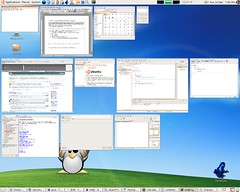 Recently, without going into all the details, there has been a big debate about which direction to take Linux. (One article likened it to a civil war, another to Republican/Democrat gridlock, including all the big guns)
The debate is where to take Linux. On one hand, some like and Red Hat, want Linux to stay an "Enterprise OS" which appeals to businesses, server centers, and national labs. They point out that Linux controls the enterprise/server/supercomputer market: Linux is used by almost 80% of the top 500 supercomputers, at least 8 of the top 10 most reliable web hosting servers as well as the only mainstream OS that has the top government security rating. (Check out netcraft.com above. Google, uses Linux, Los Almos uses Linux, Yahoo uses Freebsd which is another open source version of UNIX and BYU ports Microsoft server to run on top of Linux?!?! What is going on there BYU?)
Linux dominates the enterprise market since Linux(or at least the right version) beats Windows and Mac OSX in three areas: stability, speed, and security. The enterprise side of the argument goes like this: Linux has found its niche and dominates in that niche. Desktop users want lots of the latest features and that's fine, but throwing all the latest features on an OS bloats it, slows it down, makes it less secure and stable. The reason is: it takes a long time for a piece of software to be well tested and mature enough to be highly stable, fast and secure. Let's focus on that, not adding a million buggy, immature and insecure features just because desktop users want them. They have Windows and Mac OSX for that.
The other side sits those of Ubuntu or other community distributions who want to provide everyone a Linux OS with all the latest features. Because of this, as I know from experience, these distros are more buggy and slow than what is running on your local supercomputer. However, these people have a good point: general people want lots of new features with some bugs over completely bug-free years old software. They point to the fact that Linux would be better off gaining the market share Microsoft has and using that market share to take Linux to heights it could not go. They say this will not only make the desktop better but the enterprise side of things better for Linux too.
The trouble is literally billions of dollars and tens of thousands of programmers are being used on Linux but in completely different directions. Red Hat spends hundreds of millions each year to go one way, and Novell and Ubuntu go off another, half the time duplicating a lot of work. All Microsoft's and Apple's money, time and energy go to their one OS. Furthermore, Linux doesn't get a lot of help from outside vendors and software writers since nobody knows which Linux distribution to support. Intel makes there compilers work with Red Hat and Novell, Dell supports Ubuntu, Levono now supports Novell and HP now is selling Red Hat!!! If you are a software programmer, which version do you write your application for?
Where do I stand? I would love to see the community distributions like Ubuntu take a huge mass of the market share, but perhaps Linux is best suited for the enterprise market and should stay that way. Trying to go in so many directions is pulling Linux apart. There is even been talk to fork the Linux kernel! Linux is in a state like unto Republican/Democrat gridlock. I only hope, unlike Washington, that Linux could come to a clear majority consensus about what to do. Until then it will be being pulled in too many directions.
(Let me be clear tough, open source will be the future of all markets. Linux is just is is going about it in a less consensus way than anybody would like.)
Thursday, September 13, 2007
A Firefox Must: AdBlock Plus
 How would you like to get rid of all those pop-up *and* banner ads that appear on websites? How about essentially all ads on websites?
Go get yourself Adblock Plus. It's a Firefox extension and works great. Seems not everyone likes this extension however. :)
As the New York Times article above states:
Well, since all the websites I enjoy allow Firefox, I am still good to go. All praise open source and its capabilities. There is ***no way on this earth*** Microsoft would code up such a feature or support and encourage it.For now, the opposition to Adblock Plus has been led by small Web sites who want all Firefox users blocked from Internet sites in retaliation. One such advocacy site, whyfirefoxisblocked.com, taunts a Firefox user with the headline, “You’ve reached this page because the site you were trying to visit now blocks the Firefox browser.”
The page includes the following argument: “While blanket ad blocking in general is still theft, the real problem is Adblock Plus’s unwillingness to allow individual site owners the freedom to block people using their plug-in. Blocking Firefox is the only alternative.”
Tuesday, August 7, 2007
Somewhere Might Have Just Frozen Over. (Though I knew it had to happen.)
Microsoft is well, doing the inevitable, officially releasing an open source strategy. See for yourself on their own webpage.
Friday, August 3, 2007
Apple=Unix, Microsoft Open Sourced, Free Google Phone!
 I have a grab bag of interesting technology updates:
1. Apple has now certified Leopard, their new OS X , as an official version of UNIX. Before it was "based on UNIX," and now it can say it is a version of UNIX. (See here)
2. Microsoft is more and more opening up to open source. They have developed three new licenses that they have shipped to be approved by the Open Source Initiative Whatever products they license under these licenses will by bona fide "Microsoft open source software." (See here)
3. Google is developing an "iPhone killer" which people are calling the GPhone. It looks like Google wants to offer the device to the public for free through advertising just as all Google services are free. From the Washington Post:
Google has developed a prototype cell phone that could reach markets within a year, and plans to offer consumers free subscriptions by bundling advertisements... But Google's product would draw its revenue from a sharply different source, relying on commercial advertising dollars instead of the sticker price of at least $499 for an iPhone and $60 per month for the AT&T service plan.
Monday, July 30, 2007
Wikipedia To Challenge Google/Yahoo Open Source Style
 Google and Yahoo are the search engine champions of the world, so far. Both are proprietary in that the Google/Yahoo code is secret and nobody except Google/Yahoo can change it or improve it.
The Wikipedia is as about open source as you get. Anyone can use and modify about anything. They want to now rival Google and Yahoo with their own search engine that will be open source. (The open source details are not yet worked out. For example, they will want to have some commercial ties for things like advertising.) Again, if this works it could be millions of Wikipedia coders around the world vs. Google and Yahoo. The goal: who can provide the best search engine? Let the games begin.
More here and here.
Subscribe to:
Posts (Atom)