Pages

Showing posts with label Religion. Show all posts

Tuesday, March 22, 2011

Conway's Game of Life, God, Science, and "The Lawgiver".


This is not going to be a rigorous scientific post. (Sorry about that) But it is in response to my fellow scientists who keep trying to prove to me things like Dr. Conway's Game of Life implies God isn't needed.   Or the line of reasoning of Sean Carroll which states that if the laws of the universe are able to explain everything we observe, the intelligent thing to do is to get rid of God.  My conclusion is that such scientists are falling victim to issues discussed here plus more I discuss below.

Now, I'm not going to try and prove God is exists, but only show that Conway's Game of Life may actually demonstrate the opposite of what atheists are hoping for.

Watch the video above.  Dr. Conway decided to see if diverse complexity can arise from simple rules.  He decides to program a computer game with simple rules and see what pops out.  Interestingly, he gets exactly what he was hoping for: complex creatures that appear lifelike.  (Watch the video).

To the game: So let's assume it took Dr. Conway ~6 days to come up with his simple set of laws, and on the seventh he rested from his rule making labors and decided to now let the game run and do it's thing.  :)   This is what would happen:
  1. As more and more time goes by, more and more complex creatures would form.
  2. Some creatures may become so complex they exhibit intelligence.
  3. Some of these intelligent creatures may be so intelligent they realize that through science they can uncover what all the laws of the universe must be.
  4. Some creatures may develop further hubris and claim: "Through science we can discover all the laws, and from these laws the universe and all its complexity we observe can be sufficiently explained by the laws alone.  And therefore, it is pointless to think an external sentient being was needed because the laws are good enough, and the only creatures that think an external sentient being is needed are deluded, brainwashed weak-minded creatures.  I mean, we can measure the laws, and know they are real, and they can explain everything we observe so a belief in an external sentient being is both unneeded and absurd!"
  5. And yet others may conclude that the elegance and rationality of the laws may hint at a sentient source.  They might say: "I admit science is awesome and has helped us uncover all the laws one by one and the laws are really magnificent and can form galaxies, create complexity, etc... on their own.  True.  But shouldn't the existence of such rational and magnificent laws imply a rational and magnificent lawgiver?"
  6.  I'm sure there are other conclusions to be drawn but I will stick to #4 and #5. (You can come up with your own conclusions in the comments.)
In this case, #5 would have to base their belief solely on faith and aesthetics but the interesting thing is (in this case) #5 are the creatures that are correct!

Conclusion: None of this proves God exists!  That's not my intent. But I hope this shows two things:
  1. Just because the laws we uncover with science can explain everything observed, and therefore are "good enough" in this sense, does not imply a sentient lawgiver is an unintelligent thing to believe in.  In fact, in the very example the atheists use when discussing Conway's Game of Life, a sentient lawgiver is the correct conclusion.
  2. The fact that there are such laws in our own universe: rational, elegant and having the richness to create all of the magnificent complexity we see should allow us to wonder (without too much ridicule): Could such laws really exist without a Lawgiver with similar qualities: rationality, elegance Who through small and simple means (simple laws) bring about great things (complexity)?  Do the laws really just coincidentally exist this way (end of story) or are we allowed to think that perhaps there is more?  
Anyways, I am not going to sit here and say atheists are obviously wrong.   I admit living in such a Dr. Conway world, #4 may seem like a very tempting conclusion.  However, I also think that people who ridicule the #5 creatures walking the earth today are very pre-mature and presumptuous in their ridicule.  (In Dr. Conway's world, the #5 creature are right!)

So, I think there are intelligent reasons to believe the elegant and rational nature of the laws, that I and my scientist colleagues uncover each day, in fact hint at a very elegant and rational source.  

Sunday, February 20, 2011

Everyday Philosophy: Epistemological Realism vs. Epistemological Idealism

Due to some of the comments on a previous post I thought I could help lay a foundation for discussion by giving a crash course in everyday philosophy (kind of like a crash course in everyday physics, but for ideas instead of physics). The actual debate is much more complex, but for our purposes we can use the simplified form of the debate. This might be a little long, but bear with me. To understand some of what I am talking about it may be necessary to read the post and comments that prompted this post. It may be a bit of a read, but it may make reading this a little easier to understand what I am talking about.

Part of the reason why the previous post elicited so many comments was that it, unintentionally, hit on a major philosophical debate, that of the distinction between epistemological realism and epistemological idealism, which has also been classed as a difference between objectivism and subjectivism, and is related to the debate between empiricism and rationalism.

First I will explain what I mean by 'epistemological'. Epistemology is the study of how we know things. That's it, very simple. So 'epistemological' indicates a way in which we know something, either through realism or idealism. Now I will explain the difference between, and related ideas of, epistemological realism and epistemological idealism. After that I will discuss why the distinction is important and how it comes up in everyday conversations using examples from the comments in the previously mentioned post.

In the simplest sense epistemological realism is the idea that observable characteristics exist in the observed object, independent of the observer. Likewise epistemological idealism is the idea that the characteristics exist in the mind of the observer independent of the object. So why is this difference important and where does it come up?

You may have heard (haha) the example of "If a tree falls in a forest does it make a sound?" Someone who is a strict epistemological idealist will say, no, because no one is there to observe the tree falling to interpret what happened as making a sound and thus it cannot create a "sound". But someone who is a strict epistemological realist will say, yes, because sound is just pressure waves in the air and there does not have to be an observer in order to make a "sound". The reason why this simple example presents a problem to many people is because they are not strict realists or strict idealists. Because they personally have a mixture of views they usually settle on the conclusion, "Well it depends." or "I can see how it could be either way." or "Stop bothering me with stupid questions." (as a side note, the people who respond, "It depends on what you are talking about. If you when you say "sound" you mean the mental process that recognizes it as such, then no there was no sound. But if you mean pressure waves in the air when you say "sound" then, yes there was a sound made." The people that respond like this are called Pragmatists.) But a strict realist or a strict idealist will give a definitive yes or no answer to the question (I am, for the most part, a strict realist, with a tempering of pragmatism, as are many scientists. I will discuss this further down.).

Furthermore, epistemological realism, also called objectivism (not to be confused with Objectivism, which is the philosophy taught by Ayn Rand, though they are definitely related), is dominated by two schools of thought, that of Platonic objectivism (other wise known as the Theory of Forms) and Aristotelian objectivism (of which Ayn Rand's Objectivism is a modern adaptation of). Platonic objectivism assumes that the highest form of reality is that of the Forms, which cannot be accessed through our senses, but only through reason and rational thought. Thus objective reality is grounded in our rational thoughts. This way of thinking (or the objections to it) has dominated Western Philosophy and has been the basis of the philosophical systems of St. Augustine, Descartes, Kant and many more philosophers. This dominance has been so complete that it prompted Alfred North Whitehead to say,
The safest general characterization of the European philosophical tradition is that it consists of a series of footnotes to Plato. I do not mean the systematic scheme of thought which scholars have doubtfully extracted from his writings. I allude to the wealth of general ideas scattered through them.
This dominance of Platonic thought worked its way into Christianity through St. Augustine, who explicitly stated that in matters where the Bible was silent, an appeal to philosophers (Plato) could be used. This union is generally referred to as the Hellenization of Christianity. This brought many of the Platonic ideas of God into Christianity, including things like God has neither body, parts nor passions, among many other ideas regarding the omnipotence and omniscience of God.

To recap, the major distinctions here include epistemological idealism, which holds that any characteristics that can be known of an object exist only in the mind of the observer. Epistemological realism holds that what is knowable exists in the thing being observed and is independent of the observer. Epistemological realism can roughly be sub-divided into two categories, namely Platonic rationalism and Aristotelian empiricism, the former being that the objective reality can only be accessed by the mind, but it is still objective, and that what is learned by the senses is dependent on the rational thought of the observer. The latter holds that the senses have primacy in determining the objectivity of reality, with our rational thoughts being subject to our experience.

The question is now, is there an application beyond simple (or silly) philosophical brain teasers and esoteric debates between old dead guys? Yes! there is. As it turns out, these very ideas are what prompted Nick's post and the string of comments afterwards. Let us take a look at some of the comments and find out what ideas are kinking around. Keep in mind that it is very rare for one person to be a strict realist (meaning they only express realist ideas) or a strict idealist. Usually people express some combination of the two. A number of people are idealists when it comes to God (both believers and atheists alike) but are strict realists when they have to go to the store and buy milk. Also as a note, science is strongly in the camp of epistemological realism, with a mixture of Platonic rationalism and Aristotelian empiricism, though usually with a strong emphasis on the empiricism.

First, "advocacy of an unverified and unverifiable hypothesis such as God of any book is myopic." (link) The fundamental assumption here is that God, as an unverified and unverifiable hypothesis, is only known through the experience of an individual. Thus this is a statement that God is known through epistemological idealism. Because "God" is a personal thing, it is not something that can be transfered from person to person, and hence is "unverifiable", i.e. not objective. This viewpoint is actually fairly common among believers (or the faithful). As one grad student I know once told me, his experience with God was a personal experience that he had had and readily recognized that he could no more prove his belief and knowledge of God to another person than he could prove the existence of his own thoughts.

One of the results of this way of thinking is that when confronted with the dilemma of having God known through idealism, but science largely through realism, the standard response is to say that there are limits to knowledge through epistemological realism and that the knowledge of that which pertains to God is of a different realm or level. Thus the statement, "How do we describe our “limits of knowledge”? By beliefs!" (link) This expresses the idea that all that can be known through epistemological realism (i.e. science in general) is limited in some way and when we reach that limit we declare that then begins our faith, and we move into the realm of epistemological idealism.

The main criticism of this approach is that "religious "apologists" ... frame a "hypothetical" god in such a way to render it unprovable by modern methods." (link) Because the belief in God retreats into the realm of epistemological  idealism, it is assumed that "God" has become unverifiable and unprovable, and many people of faith will admit this. Those that find this approach towards God to be unacceptable insist that "the existence of god is a question that can, in principle, be answered scientifically." (link) This statement is an assertion that all things, God included, are subject to epistemological realism and must therefore satisfy the demands of an objective reality.

The difficulty here is that the usual approach of Christianity is to use Platonic rationalism. So while Christian theologians and apologists (here the term apologist is a very apt term, because (quoting Wikipedia) "Apologetics (from Greek απολογία, "speaking in defense") is the discipline of defending a position (usually religious) through the systematic use of reason.") such as C. S. Lewis, St. Augustine and many others are very good at rationally explaining their faith, they are subject to all the debates and problems of Platonic philosophy.

Previously I mentioned that when believers reach the limit of epistemological realism they then move into epistemological idealism and make God a subjective reality. But for those of us who stay firmly rooted in epistemological realism and insist on God being an objective reality, we run into the problem of the limits of Platonic rationalism and this usually prompts statements like this, "I admittedly can *never* prove [God] exists as much as give reasons to believe He is a viable option." (link) This is a classic example of recognizing the limits of Platonic rationalism, while still insisting on an epistemological realism in regards to God. Thus, by saying this Joe is keeping within the realm of realism without reverting to a idealist argument. The reason why statements like this are still scientifically consistent (i.e. still epistemologically realist) is because of things like Gödel's incompleteness theorem, and Wittgenstein's private language argument. These arguments are summed up in statements like this, "The Venn diagram of *true* things is larger than the Venn diagram of things that can be proven or refuted using science." and "A worldview restricted only to science is limiting." (link). This particular approach still relies on the "different realms" argument for science and theology, but insists on God being objective, even if He falls outside the realms of logic.

To sum up, I find that most common explanations and arguments about God assume that He falls within the realm of epistemological idealism as a personal experience, which results in the criticism that God is unverifiable and unprovable because He is a subjective experience. Which leads to the assertion that belief and faith are a private thing and must be kept private. Hence the statement, "Here is the crux of the problem: Priest can pray to his heart content; he can not ask others to join him, if he wants to be a scientist." (link) Because faith is a private (subjective, idealistic) thing then to insist that others share the same experience (be objective about it) is rightly thought of as a logical inconsistency (hence the, "So he is a oxymoron.").

But for those of us who consider God to be within the realm of epistemological realism, then it is not logically inconsistent to be a religious scientist. The debate then moves into the realm of whether or not it is rational to believe in God as an objective reality. The common criticisms at this point are either a rational (philosophical) attempt to disprove the existence of God (a number of serious arguments against God are of this type. See, Ayn Rand, Nietzsche, Dawkins and other well known atheists), or rely on a more agnostic argument insisting that they have never had an experience with God and therefore cannot rationally accept His existence, which I admit makes perfect sense.

I hope this explanation helps the conversation and gives us a basis for discussion. I also hope that those that read this can see how this seemingly highfalutin explanation actually relates to everyday things. While the point of this post was not to convince anyone one way or the other, I hope it will help people have a better grasp on what is going on and understand why people respond the way they do.

Keep in mind that many people use a combination of realism and idealism in their lives and in how they understand the world and do not strictly hold to one or the other. Also, even for the realists they use a combination of rationalism and empiricism, and usually do not take the time to set a clear distinction. Thus it is a rare thing that all these ideas can be brought together in a single conversation, which is why I took the time to point them out and write this post.

For those that are interested in my own personal views: I am a epistemological realist of the Aristotelian empiricism persuasion. This means that I firmly know that God can be known objectively, but that logical or rational arguments are insufficient (but not useless) in communicating knowledge about God. This means that knowledge of God must first be gained independently and personally, but after that knowledge is gained it is subject to the system of objective checks and balances, meaning before I can claim experience with God in a rational way, it must be independently verified by the personal experiences of others. This verification happens through a rational, logical discourse, which of necessity cannot happen until those involved have had similar experiences on which to base their conversation. This does not mean a conversation cannot take place, but full knowledge will only come through personal experience.

Thursday, February 17, 2011

There Really Are Religious Scientists

When scientists make the news for something they say about religion, it often comes across as if all scientists are atheists or at least committed agnostics.  Stephen Hawking made waves when he stated that God isn't needed to explain the universe, and Richard Dawkins seems to constantly be in the news spouting off about the evils of religion and the glories of atheistic science.  From my department's roughly 50 graduate students I have heard maybe a dozen  disdainful tirades against religion but only two people (one of which was myself) openly profess any sort of religious affiliation.  It can seem, at times, that serious research science is a religion-free zone.

That's why I was fascinated to learn about a fellow named Eric Priest (holding the sun to the right).  Dr. Priest is an emeritus professor of mathematics at St. Andrews University in Scotland, a solar physicist, a winner of prizes from the American Astronomical Society and the Institute of Physics, a fellow of the Royal Society, and an honorary lecturer at Harvard, the University of Oslo, and a number of other places around the globe.  He's a serious scientist who has had a long and productive career at the forefront of his field.  He's also quite religious.

From a sermon he delivered at University Chapel at St. Andrews:
So should we trust science or God?  My answer is clearly both – but in different ways.  Science & Religion are much closer in approach than perhaps you realised.  We all need Science to learn more of nature God’s universe and to tackle problems of 21st century.  we are each on a journey of discovery in this life, in company of the communities of which we are part and with the guidance & support right at core of reality of  a God whose Holy Spirit cares for each one of us. 
So let us pray: 
Lord Jesus, we pray that you will continue to guide and inspire us, as we learn more of the nature of your incredible universe, and as we seek to follow you in our journeying all the days of our lives.  Amen
It warmed my heart to read that, not only for the sentiments but for the source.

Tuesday, January 4, 2011

Should Being Religious Deny You A Job As A Scientist?

A very interesting article appeared in the Journal Science recently where a scientist, Martin Gaskell, was denied a job at the University of Kentucky (UK) "because he is an evangelical Christian".

From the Science article:
During the search process, a UK committee member discovered an article on Gaskell's personal Web site titled “Modern Astronomy, the Bible, and Creation.” The article, based on talks Gaskell had given, “appeared to blend science and religion,” according to a brief filed by the university.
And further:
In an e-mail to Science, Gaskell called himself an “old earth theistic evolutionist,” a label that deems evolution a tool God used to develop life. In his deposition and his e-mail, Gaskell says he is not a creationist or a subscriber to intelligent design, both of which, to varying degrees, discount natural selection. However, his lecture notes cite work by astronomer Hugh Ross, who embraces an old Earth, as geologists do, but rejects evolution as the guiding principle for life.
Now, all this has been taken to court so we will yet see how this plays out:
“It's a rather intriguing case,” says Ehrich Koch, an attorney in Minneapolis... “It appears as though what the court is saying is both sides have arguments, and they may be able to prove their case.”
The trial is scheduled to begin on 8 February. On 1 March, Gaskell begins work as a professor at the University of Valparaiso in Chile.

Now what are my views?  First of all, I do think someone who is unable/unwilling to teach, defend and research mainstream science is someone who universities should avoid hiring.  That said, it would be unfortunate if you were denied a scientific job purely because you happen to be associated with a religion.


This story hits home, not because I share fanatical religious views about science with fundamentalist Christians, but because I would never want to be denied a job because it was discovered... brace yourself...  I was LDS.   I have always defended (and believe!!!) good mainstream science from evolution to the big bang to, etc...  In fact, I have now over a dozen journal articles as a graduate student, or soon to be journal articles, on physics related to the big bang and believe and advocate every word of it.  Furthermore, on this blog I have always tried to defend good, mainstream science.  But, there is always the worry that some committee won't care and will just tag me as some "crazy Mormon" whom they would like to not have as a new hire.


And: from Newton who "wrote more on religion than he did on natural science" to today with prestigious members of the National Academy like Francisco Ayala or the human genome's Francis Collins, one thing history has shown is: religious people can make some darn good scientists!

And I for one intend to be a darn good scientist myself.

So what are your thoughts, both on this specific case, and in general on whether being religious should be grounds to not hire a scientist?

Monday, September 20, 2010

The Religions of Control Engineers

I recently attended the American Institute of Aeronautics and Astronautics (AIAA) Guidance, Navigation, and Control (GNC) conference. I've been to this conference before and I really enjoy it. It's not the top-of-the-line academic performance, but there's a lot of great papers, and most of the top engineers attend. Plus, at least for aerospace engineering in dynamics and controls, in particular, it is probably the flagship conference.

This year I noticed something interesting. But first a bit of background. During the time of WWII, a lot of important advancements were made in signal processing, control, ans stochastic processes. Obtaining optimal solutions (particularly stochastically, in a MMSE sense) were very important. Norbert Weiner had discovered the MMSE filter, but it was not easily applicable to problems of a sequential nature (which all control systems are). Rudolf Kalman, and Richard Bucy had developed a sequentialized version of the Weiner filter, which revolutionized the signal processing, and more particularly the controls industry.

Thus the Kalman filter was born. It has some major limitations, most notably in that it only works for linear time-invariant (LTI) systems. As everyone knows, most systems aren't linear. But it turns out that with some rough approximations (and a helping of the central limit theorem) most systems are almost linear, and the Kalman filter has been applied to many many systems and been surprisingly, and somewhat remarkably good. Extensions to the Kalman filter have been numerous: the extended Kalman filter (EKF, attempts to handle non-linear systems), the unscented Kalman filter (UKF, also attempts to handle non-linear systems more elegantly than the EKF), the consider Kalman filter, iterated extended kalman filter (IEKF), and the list goes on and on. But even with all the advances, the ability to truly handle complex non-linear systems has been a challenge to the controls community for a long time.

As computers became faster, monte carlo methods have become an important tool in signal processing and controls as they can solve problems for ANY system, even highly non-linear ones. In particular, the particle filter (PF) is a sequential monte carlo method that has found a great deal of success in this area. It runs very quickly, and can produce near optimal results (though for the PF there is no guarantee of true optimality like there is for a KF).

In the controls community, KFs, PFs, EKFs, and UKFs have obtained a sort of notoriety for attracting people. In fact, if a paper uses one of these filters, or otherwise pontificates on the strengths or weaknesses of these filters, it is sure to attract a room-busting audience.

Sometimes this gets ridiculous, even to the point of approaching a religion. I attended one paper presentation in which a PF, EKF, and UKF were compared in filtering a particular non-linear system for an Unmanned Air Vehicle (UAV). After the presentation, the discussion bordered on absurd. One guy is quick to point out that the authors missed a technical detail on their implementation of the PF and should have gotten better results for the PF. Another guy points out the theoretical superiority of the UKF and insists that they must have done something wrong since it was not clearly the winner. And on and on it goes each setting forth the reasoning for why his favorite filter is superior. By the end, all I could think was "look people, it's just a filter!"

It reminds me of the dreaded Windows vs. Linux vs. Mac debate that plagues the pages of Slashdot and Engadget. Each filter, like each operating system, has its strength and weaknesses. Rather than viewing it as some competition of optimality in which one gets the nod of academicians while the others get a hairy eyeball, I view each as a tool in my toolbox to be selected with prudence and wisdom in applying a control algorithm to my system. But despite my confusion people will continue to justify, validate, and argue for their filter of choice as if the filters cared about our loyalty to them. Who says scientitst and engineers are above religious arguments anyway? Seems to me they just have different religious arguments. Seriously people, it's just a filter!

Thursday, September 2, 2010

Despite Hawking, Universe Existence/Origin Is Still A Mystery.

As you may have heard, Stephen Hawking says universe is not created by God because, in a nutshell, gravity exists:  "Because there is a law such as gravity, the universe can and will create itself from nothing".  Moreover, he believes M-Theory can fully explain our universe and therefore God is no longer needed.

At first I was going to stay out of this discussion since, as I said before, I believe the argument over science versus religion is often unfruitful.  But after reading some interesting comments by fellow cosmologist Peter Coles, whom also has written some good books on cosmology shown above, I decided to comment.  First, from Coles: (by the way, I've coauthored 4 papers with this guy.  Small world!)
It’s interesting that such a fatuous statement managed to become a lead item on the radio news and a headline in all the national newspapers despite being so obviously devoid of any meaning whatsoever. How can the Universe be “a consequence” of the theories that we invented to describe it? To me that’s just like saying that the Lake District is a consequence of an Ordnance Survey map. And where did the Laws of Physics come from, if not from God?
Stephen Hawking is undoubtedly a very brilliant theoretical physicist. However, something I’ve noticed about theoretical physicists over the years is that if you get them talking on subjects outside physics they are generally likely to say things just as daft as some drunk bloke down the pub. I’m afraid this is a case in point.
I agree.  Moreover, I find it funny that when Hawking and others find physical theories that can completely describe our universe, they seem to forget that certain questions about the universe still remain a mystery such that, as far as I can tell, can only be solved using tools beyond science.  For example, I am interested if science can ever understand these basic questions about the universe:

1. Why does the universe obey laws at all?  I've read several papers and textbooks written by physicists where they admit it seems unexplainable to know why the universe obeys laws.  Science may demonstrate which laws are being explained and how, but can science ever explain why? Furthermore, why do these laws happen to be mathematical in nature?

2. Why, of all possible physical theories, has the universe chosen to follow string theory?  First off, I must say my first reaction to Hawking's claim was: "So he feels comfortable replacing God with a highly speculative  theory. :)"  But given I believe string theory has a good chance of being the true "theory of everything", and for sake of argument I will assume that it is.  Fine, but can science ever show that it is impossible for a universe to exist without string theory being true?  If so, why did our universe select string theory of all theories to follow?  People will say: "It has to because it is composed of strings."  Fine, but then why is it, of all things, composed of strings?

3.  Why does the universe even exist in the first place? So that we can exist?  So that ...?  Hawkings says it is natural because gravity exists.  Fine, but that just kicks the can down the road.  Why does gravity exist in the first place? Etc...

4.  If the answers to these questions are always philosophical in nature, why bash religion? I admit that I have heard potential answers to these questions but they all have one thing in common: they are philosophical answers!  Or they say such questions are pointless which is again just a subjective belief.  But that's just it!  On one hand scientists have their own philosophical answers/subjective beliefs concerning these types of questions that bring confort to their minds but then go on to attack religion as being unscientific.  It's as if their unprovable philosophical beliefs concerning deep mysteries of the universe are okay but religious explanations for such questions are not to be tolerated.

So in a nutshell:  First, I do believe something like string theory is probably a true physical theory.  Second, I know from experience such theories can explain the existence of the universe "naturally".   But, why the universe happens to obey laws at all and why of all theories string theory was selected is, and I am sure will always be, a mystery to me.  As far as I can tell, such why mysteries will always be beyond the scope of science and can only be explained philosophically.  So if you are going to answer such deep questions about the universe with unscientific philosophy, why be so intolerant of "unscientific" religious explanations to the same questions?

Monday, June 14, 2010

Thoughts On New Atheism. (Yet More Pet Peeves.)

Time for another post for my pet peeves series. I would like to address this new atheism that seems to be promoted by more and more.

I will not be blogging much about this as I think promoting the literacy and the love for science is helpful, whereas the science vs. religion debate is fruitless. Those who spend all their time engaging it completely have their priorities mixed up. (Like any extremist-minded person does.) People: spend some time promoting good science and not always attacking things science says nothing about!

Seriously!

1. Firstly, I Don't Take Issue With Them Being Atheist.

Let me start out with saying I do not take offense that they are atheist. I actually understand where many are coming from. They see that many traditional claims made by religious people seem untrue (like the world being only 7000 years old) and see many religious people rejecting basic science like evolution. Furthermore, they think a world with no God fits the data better than one that does. They just don't see evidence for God in nature so they have a hard time believing God is there.

Fine. I'm not going to discuss this here. In am not attacking atheists in general but these new atheists who not only oppose religion but for whatever reason seem obsessed with it.

*Also, I apologize in advance if I appear to be stereotyping all atheists.* They are not all like this... but some are.

2. They're Being Hypocritical When They Make Claims Without Applying Basic Scientific Rigor.

A quote:
They trot out tired, half-truthful stereotypes, and they cherry-pick historical examples of religious wrongdoing while ignoring the innumerable instances in which the faithful have performed great acts of decency and charity.
I will make this simple for them to understand: They can't get their claims published in established, reputable, peer reviewed journals.

They will claim how important it is to use evidence, good intellectual rigor and tout how believable claims should be strong enough to stand the peer review process. And yet their new atheist claims usually are not! (And they hope we accept their unpublished claims!)

Where has Dawkins published a paper in a reputable journal demonstrating religion is more harmful than good? (As he claims.) Where are the articles showing religious people fall into the stereotypes they glean from cherry picking history? (As any good scientist knows not to do.) They reality is, when it comes to scientific rigor, new atheist are hypocrites. (Or show me their own peer reviewed journal articles backing such claims!)

Seriously!

3. Many Have Become Fundamentalists Themselves. (Often Belittling Scientists Who Are Better Scientists Then They Could Ever Dream Of.)

Some new atheists have become as fundamentalist minded as the very people they deride. They live in a world where everything is black and white with no grey. I personally know of many who can't stand someone is a great scientist... if they happen to even be understanding of religious people.

Even if I won a Nobel Prize for physics (which won't happen by the way) all they would see is the fact that I am LDS and wrote a post like this. For example, take the Templeton Prize winners. Many of these people are better scientists than the vast majority of all these new atheists will ever be and yet they are often derided and treated with ridicule.

Once you have crossed the line to demeaning scientists who are 10 times the scientist you will ever be because they find meaning in something beyond the realm of science... you have officially become an extremist.


Seriously!


4. Many Hide Behind Science To Promote Their Pet Agendas.

New atheists are no different than than politicians who use the the politicization of science to promote their pet agenda! The fact is: science neither confirms nor denies the existence of God and these people try to hide behind pseudo-scientific arguments to do just that. Anyone who tries to to use science to prove God does or does not exist is wasting everybody's time and is being just as disingenuous as the above politicians.

Science cannot prove the existence of God, the Easter Bunny or for that matter the existence of good, love, beauty, morality, etc... And yet they are so quick to write volumes on how foolish people are for finding meaning in the former entities and yet not the later ones. There is definitely a biased agenda at play here.

Seriously!

5. What They Should Do.

If you are an atheist who is concerned with the horrible level of science literacy in the world, fine. I'm not attacking that. What I am attacking is a hypocritical, non-rigorous, fundamentalist agenda some have taken up pretending it is somehow backed by good science!

What these people need to do is get their priorities in order:
  1. Demonstrate the wonders and benefits from accepting good science.
  2. Demonstrate how much progress has been achieved from humans using science at their disposal.
  3. Stick to claims that can be backed by the peer reviewed literature and avoid pet agendas that have nothing to do with science.

Edit:

Since I wrote the above I wanted to add this for reference:

6.  Atheism Causes You To Be Unproductive And Unsuccessful In Life.


Look at the above two images.  This study clearly shows that while atheists have a higher IQ on average, they also end up with less money than other people on average.  Obviously atheism causes you to be unproductive, unsuccessful and live largely below your potential.  How many politicians, generals, famous actors and actresses or successful businessmen are atheist?  Basically if you are smart but don't want to amount to much in life, studies that you should take up atheism.

Obviously this is a joke, but one made to prove a point.  There are probably 100 reasons besides atheism to explain why atheists have above average IQs and yet cannot figure out how to make as much money as the average person or hold political office, etc...  I recognize this.  It would be dumb of me to jump to such conclusions from such a non-rigorous interpretation of data such as.

I just wish some atheists would give religious people the same courtesy.   I wish they would pause and ask themselves if they have sufficiently gone through the 100 reasons, other than religion, to explain the data they like to flaunt?  For a people with such high IQs, I must say it seems like such an intellectually stupid thing to do.

Please just stick to promoting good science!  Blanket lumping together and attacking religion in general is often done unscientifically, is unproductive and a waste of time. (It is as unproductive and intellectually disingenuous as me writing books on how atheists are just unsuccessful eggheads.) But then perhaps people prone to atheism are naturally good at being inefficient and unproductive and so I just have to realize that trying to tell such people to do something helpful with their lives won't work. Again, joke. :)

Wednesday, March 17, 2010

Platonic vs. Aristotelian World Views

[Editorial Note: Sorry I did not post this sooner, but I have been busy and I have also been thinking about this for a few weeks. But several people have asked what I meant by Platonic and Aristotelian world views. This is an attempt at an explanation.]

Previously I posted on the "conflict" between science and religion. A critical distinction that I made in that post was the difference between the Platonic and Aristotelian world views. At the time I did not offer an in depth explanation of what constituted a Platonic or Aristotelian world view partly because they are rather difficult (i.e. would take several books) to explain. But not to leave those who are interested with absolutely no explanation I will attempt to give a brief explanation of the fundamentals of both. [Editorial Note: When I am giving an explanation I will often include another word in parentheses after a word which has a technical philosophical definition. The word in parentheses is a more colloquial (common) word used in the same context. Both words are interchangeable but I felt that more than one word was needed to get an idea across while still using the "correct" philosophical language (words). If you find it annoying, sorry. I can't think of a better way of doing it.]

On a basic level a Platonic world view carries with it a fundamental distrust of the material (observable) world. An Aristotelian world view fundamentally assumes that all knowledge comes from the observable world (universe). Note that these ideas are not opposite nor are they even mutually exclusive. But they are two approaches to the same thing, how we know and interact with the world.

In my previous post I implied that the Platonic world view was the root of many problems, and while it is, I should qualify that with an explanation. If not considered rightly a Platonic world view can lead to many philosophical (intellectual) problems. By way of explanation I will use a simple analogy, specifically tailored to my assumed audience, those who read this blog. This analogy will not work for everyone.

When we are first learning physics the standard approach is to learn physics with a heavy emphasis on the algebra involved. This means that the equations are given to us in a standard form, from which we work problems and (hopefully) come to an understanding of the physical principles involved. When we have passed this step and we have achieved a certain level of understanding, generally one then returns to the basic physical principles, and relearns them but now with an emphasis on deriving the equations and solving more complex problems using calculus instead of algebra. This allows us to solve problems and answer questions that were impossible before. Problems such as including wind resistance in projectile motion problems. The underlying physical principles have not changed, just our approach to the problem.

This different approach fundamentally assumes that the world is not as "simple" and "easy" to deal with as is usually presented in introductory physics classes (i.e. the world is not made up of spherical cows). While things may be more difficult, and require more training and experience, the outcome allows more understanding and insight.

For all simple cases there is no difference between an algebra based approached to physics and a calculus based approach. As a matter of fact if we tried to solve every basic physics problem by first writing down the Lagrangian for the system and then finding the equations of motion we would never have time to finish solving all of the simplest problems. So in some cases it may even be advantageous to use an algebra based approach than to use a calculus based approach. But if we do this we must realize that we are using a simplification and to not get bogged down in the potential shortcomings of the purely algebra based approach.

Now relating this back to the Platonic and Aristotelian world views, the Platonic approach recognizes that the world is very messy and is not "ideal", meaning that it cannot easily be reduced down to simple, easily solvable problems. There is no problem with this, as this is also the view taken by an Aristotelian world view. But the problem arises when someone who holds to a Platonic world view begins to think that the universe is actually made up of spherical cows (i.e. atoms are "hard" and perfectly spherical, all things can be considered to be point particles, forces behave exactly like 1/r^2 laws etc.). So the problem is not that spherical cows (simplifications) are used to solve (comprehend) problems (reality) but when we begin to actually think that the universe is made up of spherical cows (ideal, according to our understanding) we run in to intellectual (philosophical) problems (mistakes).

You may be thinking, "What in the world is he talking about? How does this relate to anything important? And does this have any bearing on how the world, and our society works?" Well to answer those questions let me give a few examples.

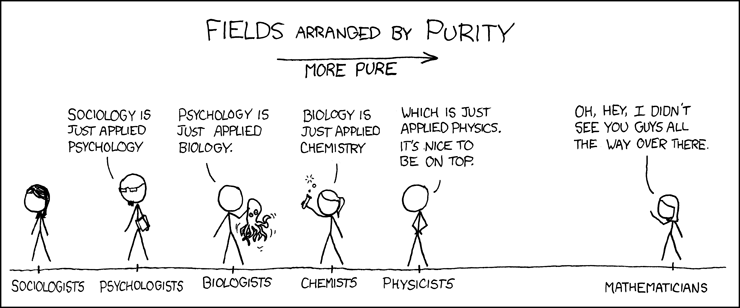
First, recently there was a post on this blog that included this comic:


Without knowing it (or maybe he did) by posting this comic Joe was showcasing the Platonic world view (and one of the problems with it). Essentially the XKCD comic expresses the idea that the further away from reality we move, the more "ideal" or "pure" we are getting. Implicit in this argument is the assumption that in order to understand the world we must move away from all the "messy" stuff and move in the the realm of pure thought. Only then can we begin to understand anything. It is interesting to note that in seven short comments attached to that post the Platonic world view was debated, debunked and rejected in favor of the Aristotelian world view (and Clark Goble even managed to include both Heidegger's and Wittgenstein's arguments against the Platonic nature of language, impressive. And Bill, John Locke and John Stuart Mill would be proud, though many philosophers would try to lynch you for it).

So other than comics where does any of this show up? Again I need to emphasise that the basis for the Platonic world view is a fundamental distrust of reality (observation, sensations). This fundamental distrust of reality leads to all kinds of weird wacky things, like this gem that my wife came across one day. On a basic level the Platonic (or Platonic like) world view leads people to assume that in order to learn anything "real" or of value, they must disassociate themselves with reality (the physical world). This was the motivation behind the drive to use "experimental drugs", such as LSD, in order to experience things that could not be "experienced" in the physical world (this was explained to me by a philosophy student who "had friends that did drugs").

There are other implications to this but to sum up it, is enough to say that even though the Platonic and Aristotelian approaches to the world both consider the physical world to be "messy" at first, the Platonic approach feels that the "messiness" prevents the discovery of the world and thus in the ideal case we must remove the influences of all the "messy" stuff from reality, including our senses and anything that has to do with our "physical" bodies. The Aristotelian approach recognizes that the world is difficult, and while simplifications (math, equations, words, language) can be used to make it easier, the simplifications are just that, a simplification and not an ideal. Thus a Platonic approach demands that new knowledge comes from the ideal world (Plato's world of Forms), while on the other hand the Aristotelian approach assumes that knowledge comes from observation (sensation) of the physical world, and is verified again by observation. All knowledge according to the Platonic approach, by definition, is not verifiable in the Aristotelian sense, but is entirely determined by whether or not one can "think correctly" about it.

So how does this relate to the original motivation for this post involving the "conflict" between science and religion? On a fundamental level science takes an Aristotelian approach to how we learn and find out things about the universe. It asks, "What do we observe and how can we explain what we observe?" While science (and physics in particular) takes an Aristotelian approach, it is not exclusive. We still see a substantial amount of Platonic thought in science, but it is not as common as it is in other fields of research (Math is one that is substantially Platonic).

Perhaps the most prominent place Platonic thought shows up is in religion. I should emphasize that there is nothing about religion that demands Platonic thought, but at times it does seem rather conducive to Platonic thought as it mostly deals with things that are not (obviously) related to the five senses (I put the "obviously" in there because I disagree with that assertion). But if we are working under a Platonic world view then it makes sense that if one considers the mental or the abstract (the Platonic Forms) to be the most pure and perfect then that is where one would consider their God to be. This leads to the argument that God does not partake of the physical world and does not have any part in it other than being the unmoved mover (important note, there is an important distinction here between having an unmoved mover, as was Aristotle's concept, and thinking of God as the unmoved mover). In the end religion (and other "intellectual" fields, such as philosophy and math) became dominated by Platonic thought, while Aristotelian thought dominated science. Again this was not an exclusive domination (nor even correct) but that is the way it stands today in our society.

This causes problems when the question is asked, "Can you prove that God exists?" A Platonist would respond with a philosophical argument for the existence of God, an Aristotelian would respond with a demonstration of the existence of God. In the first case scientists (who are largely Aristotelian in their approach to knowledge) would reject the arguments as invalid because in order to "prove" anything according to science it must be demonstrated (mathematical proof does not count, it has to be demonstrated by experiment, see string theory). Thus the requirements for "proof" are fundamentally different for the Platonic approach and the Aristotelian approach, and because 80-90% of religion takes a Platonic approach, the tendency of scientists is to reject religion as invalid. Unfortunately this rejection first assumes that religion is fundamentally Platonic, and that any approach to it must first be Platonic (including a "scientific" approach).

This difficulty goes away if an Aristotelian approach is taken with respect to both science and religion. In other words it must be assumed that the same modes of knowing can be used for both, which depending on your views of religion (or science, or both) may be an issue. But if the same method is used for both then all apparent difficulties go away (interesting note: it works both ways, if a Platonic approach is taken in both cases then there is no conflict, but as long as a different approach is taken for either science or religion then there will be a conflict).

So now after this long explanation I will return to what I started out by saying:

On a basic level a Platonic world view carries with it a fundamental distrust of the material (observable) world. An Aristotelian world view fundamentally assumes that all knowledge comes from the observable world (universe). Note that these ideas are not opposite nor are they even mutually exclusive. But they are two approaches to the same thing, how we know and interact with the world.

The problem comes when we take the Platonic distrust of the material world to the point that we think that the material world inhibits our understanding. This is in opposition to the Aristotelian view, which is that even though the observable world may be difficult to understand it is the basis of our knowledge and our understanding and we cannot reject it as the fundamental source of knowledge.

Thursday, February 18, 2010

The "Conflict" Between Science and Religion

On a previous post Stan left a comment about the "anti-science undercurrent in our society". In a broader sense this observation of the "anti-science undercurrent" is related to what many people know as the "Conflict" between science and religion. But the very real and important questions here are, "Where did this conflict come from?" and "Does this conflict represent a fundamental disagreement between science and religion that can never be reconciled?"

In terms of the second question this is a rather important point because the implication is that if there is a fundamental disagreement between science and religion then the obvious conclusion must be that one or the other must ultimately be rejected as false. This is of course assuming that the two can never be reconciled, which is itself an assumption about the nature and relation of science and religion. But we cannot deny that there exists, at least on some level a disparity between the world views of science and religion, which results in a real, or at least a perceived, conflict between the two. Which leads us back to our first question, "Where did this conflict come from?"

A common accusation leveled against religion, and especially the Christian religion, is that it is inherently anti-scientific. While this may be sufficient for some people to prove the irrationality of Christianity, it is not a very good argument, nor does it address the issue of why it is (or perceived to be) anti-scientific. The counter argument most commonly used against this approach is to point out the inherent short-comings of science that any scientist would readily acknowledge and embrace and an integral part of science. Essentially this argument boils down to "Scientists don't know everything, so therefore there may be something you don't know about and that thing that you don't know about is the mystery of God."

These arguments can and do continue ad nauseum, but will not bring us any close to understanding the nature or the source of the conflict. So again we approach the question, "Where did this conflict come from?"

To start out let me introduce a line from an editorial piece that I read in The Daily Tar Heel. In addressing the conflict between Atheists and Theists the author offered this piece of advice to the Theists, "Theological honesty is needed. Admit that there are some aspects to Christianity that cannot be proven or even explained and must be taken on faith." (The author also had words of advice for Atheists as well, so it was not a one sided argument.) I found this line rather interesting because I felt that it is directly contrary to how I relate to my Religion. I put emphasis on my Religion, because obviously this statement must apply to someone's religion or it would never have been included in the editorial piece. But here in this statement we have potentially uncovered the root cause, or at least something that will lead us to the root cause, of the conflict between science and religion.

So let us consider this statement. First off it states that in Christianity there are things "that cannot be proven or even explained", and it is these unproven, unexplained, or even unknown, things that form the foundation of "faith". This way of thinking leads to a belief or an understanding of a God that is wholly other, unapproachable, unknowable and is outside the realm of science. Which leads directly to the conclusion that religion deals with things that cannot fall under the purview of science. With this understanding it is easy to see where this can result in conflict. If religion deals with things that are not or cannot be covered by science, then if science expands and attempts to explain the former "mysteries of God", such as creation, then those who hold to this understanding of God will naturally feel that science is impinging on "God's territory". They will view it as a kind of turf war and will view it "as if it were a threat to [their] beliefs!"

So how did we get to this point where most religious (and non-religious) people view the Christian God as having exclusive rights to, or even in the extreme case is based solely in, the realm of the Unknown, and science as pertaining to the realm of the known (and provable)?

That very important question I will leave as an exercise for the interested reader, but not to leave you with no answers (like most philosophers), so I will offer this observation by way of insight, but I will present it without proof (again an exercise for the interested reader).

In learning about this topic I have noticed that those who generally hold to the view of Christianity expressed above, where the basis of faith is something unknowable (that's unknowable as opposed to unknown), have as the basis of their world view a Platonic Philosophy. It is this group of people, both religious and non-religious alike, that consider there to be an inherent conflict between science and religion. The Platonic world view is not the exclusive domain of the non-scientific but it is a view held by the scientific an non-scientific alike. But even though the same world-view is held by both groups, different conclusions are reached, and thus results in the conflict that we know of as the conflict between science and religion.

But there is a way out of this irreconcilable debate, and again I have noticed that those who find no inherent conflict between science and religion hold to an Aristotelian world view. This means that there is a fundamental difference in the way that some people approach the world, and how they view and gain knowledge and understanding about the world. In the case of the Platonic world view there are certain assumptions about knowledge (epistemology) that affect how we view and/or know God, which results in the conflict. But the Aristotelian world view does not make the same assumptions about how we know and approach the world, and this subtle difference means that those who hold to this world view do not see an inherent conflict between science and religion.

This observation would be nothing more than an interesting philosophical footnote, if it were not for the fact that in Western societies approximately 80% of the people hold to a Platonic world view. This overwhelming majority of people that operate with the Platonic world view creates ample opportunity for conflict and for the collection of people into groups of similar beliefs and conclusions about the world. Hence you have people dividing into groups of Theists and Atheists, that perpetually seem at odds with each other. It also leads to a division of knowledge (epistemology) into the realms of the known (dominated by science, and indirectly by Atheists) and the unknowable (dominated by religion). Thus for those who hold to one side or the other, when they are presented with anything that they associate with the other side they react to it as a direct assault on their beliefs.

This makes things difficult for those of us who do not have a Platonic world view, as we are constantly finding ourselves on both sides of the debate and we are constantly asked "Which side are you on?" or "How do you reconcile you faith with what you study?" But for those who have an Aristotelian world view, or something very similar, then these types of questions make no sense and we are left confused and wondering why they are even asking those questions.

Now we can finally come to the most important question, "Now that we have this understanding, how do we share this with others so that they too can understand it and not be bogged down with the "conflict" between science and religion?" That is the hard question, and the real question that we must answer, and in a way, I think that is the purpose of The Eternal Universe.

Monday, October 5, 2009

A Tribute To My Jewish Friends

I am not Jewish, but that I have have many Jewish friends and feel a desire to pay their society a tribute.  The Jews have arguably been treated worse than any group of people, and yet, in so many ways they are a people that deserving of our praise.

First off, they are a very naturally talented people. The famous study by Helmuth Nyborg, (you know the one which famously determines that atheists have on average 5.89 IQ points higher than people who believe in literal religion), actually finds that Jews outdo us all when it comes to intelligence.  One third of their society have IQ scores in the 90 percentile. (See table below)


This should come as no surprise.  Go through the history books.  Almost every other Nobel Prize winner, like Einstein, Feynmann and Gell-Mann was Jewish.  In fact, can you name very many famous physicists not on this list?  It is shocking how brilliant these people are.

Next, they are incredibly industrious.  The measure I will use, from the same study, is average household income.  You may say brains should correlate with income but I will point out that our smart atheist friends are on the bottom half of this table. (See below.) At the top are again the Jews.  These people are not only smart but very hard workers.


Furthermore, as I have already stated, these people may have been treated harsher than any other group of people.  Nevertheless, they have developed an amazing ability to stay strong.  Almost anywhere a Jew goes, there is a wonderful Jewish community ready to greet them.  My point is: they really have found a way to grasp that community spirit that humanity needs in the toughest of times.

I could go on, but these are my three main observations about the Jewish people I wish to praise: They are smart, they are industrious and they have mastered a community spirit that has helped them get through the best of times and the worst of times.  In addition they have always been very kind and generous to me.  I really admire them a lot.

Plus, they have Tevye:

Tuesday, June 23, 2009

Being a Mormon Scientist

It's an interesting thing being a person of faith in a PhD program in a basic science. Physics departments are probably some of the only places in the world where atheists make up the majority. In some sense, as a Mormon that grew up in Oregon, I've been used to being in the religious minority most of my life, but at least most people I associated with shared a belief in God on some level. Most of the time one's views on the existence of God don't come up when discussing solar magnetic fields, but every now and then I get in a religious discussion. I imagine that many of you have had similar experiences.

I recently read "Mormon Scientist", a biography of Henry Eyring (the father of Henry B. Eyring). I recommend the book, both as good career advice on balancing top notch science and family, and as an exploration of a modern faith-filled scholar. He was a physical chemist that revolutionized the way that the rates of chemical reactions are calculated by being one of the first chemists to apply quantum mechanics to chemistry. He was president of the American Association for the Advancement of Science and the American Chemical Society. Many people believe he should have won a Noble Prize. Basically, he was an excellent scientist.

He was also a devout member of the LDS church and a popular speaker on the compatibility of science and religion. He summarized my feelings on integrating science and religion beautifully when he said:
"Is there any conflict between science and religion? There is no conflict in the mind of God, but often there is conflict in the minds of men."

Personally, I agree with Henry. I don't see the supposed conflict. Certainly my understanding of science and of religion don't always mesh, but the problem is with me, not science or religion. In fact, I find that the scientific method works very nicely when applied to religious faith. I have never known anyone who has sincerely and persistently taken God up on His offer that "if any man will do [God's] will, he will know of the doctrine, whether it be of God" (John 7:17) without coming to know that God lives. It turns out that humanity has about 6 billion detectors capable of measuring God. These are called people. He designed us specifically with that feature.

Saying that because we cannot currently understand how God works he must not exist is giving modern science far too much credit. If I had walked around half a century ago claiming that baryonic matter made up about 5% of the mass-energy in the universe, I would have been regarded as insane. We don't have things figured out yet. We're not even close. We won't be close anytime soon. When we do see how it all works, I'm confident that God will be quite pleased with our efforts.

Sunday, August 17, 2008

State Constitutional Amendments

For those of you in California you may have heard about this or even had the First Presidency letter read in your ward, but for those of you who don’t know, in California, Arizona and Florida there are constitutional amendments that are going to be voted on sometime soon to ban homosexual marriage. The Church is stepping up efforts to support the passing of the amendments and is actively trying to get the members to do the same. Here is a link to the Church commentary on it on the Church website.

If you want to read a technical legal interpretation of what is going on in Arizona and California my dad has a blog where he is commenting on this (if you want to comment on his site you can, his site is open for comments and he would enjoy it). He give a good legal explanation of the legal precedent used by the California Supreme Court in support of homosexual marriage and also the legal precedent used by the Arizona Supreme Court against homosexual marriage.

What it comes down to is that in California the Supreme Court ruled that the rights of the individual are the foundation of society and that the family, and marriage, is something in addition to the individual and that marriage and family have no legal status above and beyond that given to things such as jobs, contracts and clubs. Thus in California rights belong only to the individual and the individual has no inherent duty or obligation to society other than their own self-interest.

In Arizona on the other hand, the Supreme Court has ruled that the family and marriage between a man and a woman is not a legal entity and does not and is not subject to the same legal parameters as a contract or any other type of legal arrangement, because the family is the fundamental and basic unit of society. Thus the courts and the law do not have jurisdiction to change the status of marriage, but the government does have the obligation and the interest to preserve the family. My dad included a quote from the case in Arizona that I found very interesting.

“Nevertheless, the state is also vitally concerned with the establishment of marriages because marriage is a relationship in which "the public is deeply interested, for it is the foundation of the family and of society, without which there would be neither civilization nor progress." Nelson, 604 F.Supp. at 593 (quoting Maynard v. Hill, 125 U.S. 190, 211, 8 S.Ct. 723, 729, 31 L.Ed. 654 (1888)).” Moran v. Moran, 188 Ariz. 139, 933 P.2d 1207 (App. 1997)

So if you want to look over any of the legal arguments used in California and/or Arizona you can consult my dad’s site. He has all the info and links there if you want to read over it. I think that this would help put things in perspective and if you want to know what is going on with the debate the Church links and my dad's blog can help with all the info and commentary.

Monday, February 4, 2008

New First Presidency

You may have already heard but President Monson was set apart as the new Church President with President Eyring as first counselor and President Uchtdorf as second counselor. Below is the news conference announcing the change and the questions from reporters that followed.

Adblock

Thursday, December 6, 2007

Beauty of Opinions and Religious Politics

More and more I love reading the opinion sections in the main newspapers of this country. I will give a link to a Washington Post opinion and will print one by the Wall Street Journal:(Dear Wall street journal, I'd read more of your opinions if you would offer them for free ;) )

Washington Post: Un-Mormon and Unchristian

Wall Street Journal: What Iowans Should Know About Mormons

Yesterday, at the end of Mitt Romney's speech, he told a story from the early days of the First Continental Congress, whose members were meeting in Philadelphia in 1774: "With Boston occupied by British troops . . . and fears of an impending war . . . someone suggested they pray." But because of the variety of religious denominations represented, there were objections. "Then Sam Adams rose and said he would hear a prayer from anyone of piety and good character, as long as they were a patriot."

Were Adams alive today, he most certainly would hear a prayer from a Mormon. It is hard to imagine a group more patriotic than the modern Church of Jesus Christ of Latter-day Saints. But there is reason to believe that voters in Iowa and elsewhere will not accept Mr. Romney's invitation -- put forward implicitly in his remarks yesterday at the George Bush Library -- to ignore religious differences and embrace him simply as a man of character who loves his country.

A recent Pew poll shows that only 53% of Americans have a favorable opinion of Mormons. That's roughly the same percentage who feel that way toward Muslims. By contrast, more than three-quarters of Americans have a favorable opinion of Jews and Catholics. Whatever the validity of such judgments, one has to wonder: Why does a faith professed by the 9/11 hijackers rank alongside that of a peaceful, productive, highly educated religious group founded within our own borders?

Many evangelicals in the GOP view Mormonism as "a cult," or at least not a Christian faith. One Southern Baptist leader recently called it the "fourth Abrahamic religion." I remember, a couple of years ago, sitting in on an apologetics class at a Christian high school in Colorado Springs, Colo., and hearing the teacher describe a critical moment in the history of the Muslim faith, when the rock that now sits under the Dome of the Rock in Jerusalem tried to fly to heaven and had to be restrained by Mohammad. Acknowledging that it sounded a little wacky, the teacher added: "Well, it's no stranger than that guy who found golden tablets in upstate New York." The students laughed uproariously at the reference to the Mormons' founding father, Joseph Smith.

Six years ago, I probably could have counted on one finger the number of Mormons I had met. Having lived most my life in the Northeast, my situation was hardly unique. Then, while researching a book on religious colleges, I decided to spend some time at Brigham Young University in Provo, Utah. In preparation, I picked up "Mormon America: The Power and the Promise" by religion reporters Richard and Joan Ostling. The Ostlings offer a comprehensive account of the church's history and theology, as well as helpful descriptions of the Mormons' cultural and political outlook. "The onetime believers in plural marriage, considered a dire threat to Victorian probity and the entire nation," the authors write, "have become the exemplars of conservative monogamous family values."

It is hard to disagree. Mormons marry young and have large families. They don't drink, smoke or gamble. The church does not condone homosexuality. Members give at least 10% of their income to the church and often volunteer more than 20 hours a week in some religious capacity. With no professional clergy, the survival of congregations (or "stakes") is entirely dependent on lay participation. All young Mormon men and many women spend two years as missionaries, their travels funded by their own families. The church stocks soup kitchens across the country and internationally (both its own and those of other faiths) with food from its farms and warehouses.

Rather than behaving like an insular cult, members are integrated into the society around them, sending their kids to public schools and assuming leadership positions locally and nationally. Once Mormons complete their missionary service, they are not obliged to proselytize, so having Mormons as neighbors doesn't mean a constant bombardment with invitations to join up.

But many Americans, unless they've actually had a Mormon neighbor, might find all these rosy facts meaningless, feeling deeply uneasy with some of Mormonism's tenets. A lot of what we call religious tolerance depends on social contact, not theological understanding, and there are only about six million LDS members in the U.S., mostly concentrated in the Western states (though increasingly less so). If you press Baptists, they will acknowledge finding Catholics' belief in transubstantiation implausible at best; Jews like me have a little trouble getting over the virgin birth. But we all get along, for the most part, because we know each other and live similar lives as Americans, whatever faith we profess.

But most Iowans will not meet a Mormon in the next six weeks unless Mr. Romney comes to call -- Mormons make up less than one half of 1% of the state's population. So let me offer a brief snapshot, not in the hope that Iowans will vote for Mr. Romney but in the hope that, if they don't vote for him, their decision won't have anything to do with his religion.

The young men and women at Brigham Young University are among the smartest, hardest-working and most pleasant college kids you will find anywhere. (For better or worse, I have visited dozens of college campuses.) The student body lives by the Mormon principle: "The glory of God is intelligence." Most reside off campus without adult supervision, yet they adhere strictly to curfews, rules about contact with the opposite sex and every other church directive. They are purposeful but seem to enjoy themselves, spending their free time hiking in the sprawling desert. And BYU has America's largest ROTC program outside of our military schools.

This last fact is one I had occasion to think about on my trip. I left for BYU on Sept. 7, 2001, and returned home a week later. On 9/11, the students gathered for a campuswide devotional. The university president tried to comfort the students with "the eternal perspective." My eternal perspective is not the same as theirs, of course. But hearing more than 20,000 young people around me reciting the Pledge of Allegiance made me realize that our temporal perspective is the same. I'm sure Sam Adams would have agreed.

Wednesday, October 17, 2007

Religion and Science

I was reading an article in Physics Today by Pervez Hoodbhoy entitled "Science and the Islamic world" (which can be found here) that discusses why Islamic nations since about 1300 A.D. have generally not been a part of the on-going quest for scientific knowledge. The article is a very well-reasoned approach to the issue and I would recommend it to anyone who wonders why Islamic nations don't seem to embrace science the way Europe, Asia, and the Americas have. However, in that article, Dr. Hoodbhoy make the following statement:
"Science finds every soil barren in which miracles are taken literally and seriously and revelation is considered to provide authentic knowledge of the physical world."
That statement immediately made me cringe. I would consider myself one who takes miracles literally and seriously and I believe that revelation does provide the most authentic knowledge of the physical world available to humanity - yet I aspire to be a scientist. Moreover, I think most Latter-day Saint scientists feel the same way. To us, belief in miracles and revelation are not enemies of science but compatible means to truth.

Upon further review of Dr. Hoodbhoy's quote, you can grant a little wiggle room for faith in miracles and revelation in his statement. For example, I don't believe that when God sent manna from heaven in the book of Exodus that He did so violating natural laws. I think that instead of violating natural laws, He, through perfect planning and the use of physical laws we may not understand at the moment, fed the children of Israel in a way that could be explained scientifically given the proper knowledge. I also believe that some of the Biblical miracles (and those in other traditions' scriptures) may not be accurately described due to errors by the writers, compilers, and translators of the text over time.

The big issue, however, is not the nuances of my faith or his statement, but rather the very common opinion in scientific circles that religious faith is bad for science. I, personally, have known of too many good scientists who were religious (Issac Newton, for example) to believe that science is damaged when one believes that miracles that science cannot currently explain and revelation that may go against current scientific understanding are authentic. In fact, I feel that science is at its best when it is practiced by one who believes that science doesn't have all the answers. Shakespeare put my view on science in more eloquent language when he wrote, "There are more things in heaven and earth, Horatio, than are dreamed of in your philosophy".

Tuesday, March 27, 2007

Warren Jeffs Not A Prophet: I'm not surprised.

According to KSL and Deseret News Warren Jeffs admitted in jail that he is not a prophet and worked his way to the top. Furthermore, he planned to give the announcement to his following but has since held back. This conversation in jail has been officially recorded and is now permissible as evidence in court.

I've always wondered what will happen to a religion when the head leaders spill the beans that their beliefs are false and that all those "testimony meetings" and "spiritual confirmations" were bogus, despite how appealing the testimonies of their most trusted associates like mom dad and grandma were. It looks like now I may find out.

And the really sad thing is: how many people have been dooped? How many have been forced into polygamous marriages, forced to be deprived of an education, forced to hate people not like them since "only their church members are the truly righteous," forced to miss out on what the world has to offer and forced to live in a way the leaders prescribe, even when the leaders know it is false. These were human beings with as much right to live an autonomous life as anyone else and they have had all their rights striped from them and told: "If you don't believe it is because you don't have the spirit in you life, and you wouldn't have the spirit only if you were not worthy of it." Warren Jeffs is *NOT* on my good list.