Pages

Showing posts with label evolution. Show all posts

Tuesday, March 22, 2011

Conway's Game of Life, God, Science, and "The Lawgiver".


This is not going to be a rigorous scientific post. (Sorry about that) But it is in response to my fellow scientists who keep trying to prove to me things like Dr. Conway's Game of Life implies God isn't needed.   Or the line of reasoning of Sean Carroll which states that if the laws of the universe are able to explain everything we observe, the intelligent thing to do is to get rid of God.  My conclusion is that such scientists are falling victim to issues discussed here plus more I discuss below.

Now, I'm not going to try and prove God is exists, but only show that Conway's Game of Life may actually demonstrate the opposite of what atheists are hoping for.

Watch the video above.  Dr. Conway decided to see if diverse complexity can arise from simple rules.  He decides to program a computer game with simple rules and see what pops out.  Interestingly, he gets exactly what he was hoping for: complex creatures that appear lifelike.  (Watch the video).

To the game: So let's assume it took Dr. Conway ~6 days to come up with his simple set of laws, and on the seventh he rested from his rule making labors and decided to now let the game run and do it's thing.  :)   This is what would happen:
  1. As more and more time goes by, more and more complex creatures would form.
  2. Some creatures may become so complex they exhibit intelligence.
  3. Some of these intelligent creatures may be so intelligent they realize that through science they can uncover what all the laws of the universe must be.
  4. Some creatures may develop further hubris and claim: "Through science we can discover all the laws, and from these laws the universe and all its complexity we observe can be sufficiently explained by the laws alone.  And therefore, it is pointless to think an external sentient being was needed because the laws are good enough, and the only creatures that think an external sentient being is needed are deluded, brainwashed weak-minded creatures.  I mean, we can measure the laws, and know they are real, and they can explain everything we observe so a belief in an external sentient being is both unneeded and absurd!"
  5. And yet others may conclude that the elegance and rationality of the laws may hint at a sentient source.  They might say: "I admit science is awesome and has helped us uncover all the laws one by one and the laws are really magnificent and can form galaxies, create complexity, etc... on their own.  True.  But shouldn't the existence of such rational and magnificent laws imply a rational and magnificent lawgiver?"
  6.  I'm sure there are other conclusions to be drawn but I will stick to #4 and #5. (You can come up with your own conclusions in the comments.)
In this case, #5 would have to base their belief solely on faith and aesthetics but the interesting thing is (in this case) #5 are the creatures that are correct!

Conclusion: None of this proves God exists!  That's not my intent. But I hope this shows two things:
  1. Just because the laws we uncover with science can explain everything observed, and therefore are "good enough" in this sense, does not imply a sentient lawgiver is an unintelligent thing to believe in.  In fact, in the very example the atheists use when discussing Conway's Game of Life, a sentient lawgiver is the correct conclusion.
  2. The fact that there are such laws in our own universe: rational, elegant and having the richness to create all of the magnificent complexity we see should allow us to wonder (without too much ridicule): Could such laws really exist without a Lawgiver with similar qualities: rationality, elegance Who through small and simple means (simple laws) bring about great things (complexity)?  Do the laws really just coincidentally exist this way (end of story) or are we allowed to think that perhaps there is more?  
Anyways, I am not going to sit here and say atheists are obviously wrong.   I admit living in such a Dr. Conway world, #4 may seem like a very tempting conclusion.  However, I also think that people who ridicule the #5 creatures walking the earth today are very pre-mature and presumptuous in their ridicule.  (In Dr. Conway's world, the #5 creature are right!)

So, I think there are intelligent reasons to believe the elegant and rational nature of the laws, that I and my scientist colleagues uncover each day, in fact hint at a very elegant and rational source.  

Tuesday, July 20, 2010

Common Descent.

From Abstruse Goose:

Saturday, May 22, 2010

Were The First Languages Based On Gestures?


It is still not very well understood how languages evolved in humans. (But they obviously did.)

Therefore, I found it interesting to read in a recent Science article:
Pity poor Viki the chimpanzee. During the 1950s, two psychologists raised Viki in their own home like a human child and tried to teach her to speak. Viki managed a rough approximation of only four words: mama, papa, cup, and (maybe) up. The following decade, researchers had much better luck with a chimp named Washoe when they tried to teach him American Sign Language. But few scientists think Washoe's impressive efforts represent true language (Science, 2 April, p. 38).
Such evidence that apes are poor at vocalizing, but fairly good at gesturing, has bolstered the so-called gestural theory for language origins. According to this model, the first human language consisted of signing, and articulate speech came later. In recent years, the gestural theory has gained the upper hand in many scientific journals and meetings. "Apes are much better at controlling their hands" than at vocalizing, says Fitch. "Their gestures are more intentional and more under control."
It is hard to teach monkeys to speak vocally but not so hard to have them speak through hand gestures.  If this was true about out common ancestors than perhaps we were able to communicate with gestures long before we could with words?

I also find this interesting as I keep hearing so many claims that infants can learn sign language easier than vocal language.  Could this because speaking with gestures is somehow more instinctive? (Been in our genes longer?)

Thoughts?

Monday, May 17, 2010

Quantum Darwinism. (Darwin Solves Schrödinger's Cat?)

We've discussed in this post and in its comments section that Schrödinger's Cat seems to be a paradox but only if you treat the system classically.  If you throw in quantum interactions, the paradox goes away.

I would like to discuss the (probably) best supportive case for how this happens. (Has experimental evidence as well.)  It is a recently proposed idea called Quantum Darwinism.  (See peer reviewed papers in Nature and PRL.)  This is how it works:

  1. A system begins "quantumly" in a superposition of states. (Like Schrödinger's Cat)
  2. After the system begins to interact with its environment, only certain states in the superposition remain stable. (Don't become destroyed.)  This is called decoherence.
  3. A measurement by an intelligent observer also is an interaction (Example, if you look at it you hit it with a photon).
  4. Of the initial stable states that survive, further interactions continue to destroy "unfit" states.
  5. As this process continues, the surviving states actually become parent states to even more states who sometimes resemble the parent.
  6. This is a form of replication.
  7. Thus you have a bona fide survival of the fittest situation with certain states (and their offspring) becoming favored over others.
  8. These different stable states become "orthogonal" to each other so there is no more superposition-like quantum interactions that happen anymore.
  9. What emerges is a classical system.  Ie.. one where it appears the wave function has collapsed. 
This is a lot like ideas expressed in Dawkins' The Selfish Gene. (For those who have read it.)  In that book he describes how some molecule configurations are stable and some furthermore have the added ability that they can replicate. (Make copies of itself.)  Over many many years, those with the best ability to "survive" (in both the stable and able-to-replicate sense) evolve into the complex structures we see today.

This is identically the same story with Quantum Darwinism.  After interactions with the environment are taken into account, only certain states are stable.  Furthermore, some of these states can influence what states are created and destroyed as we run the clock forward. (They are parent states.)  Those states that are best equipped for "survival" contribute to the collapsed classical structure we see today.

The PRL mentioned above cites experimental evidence for the idea.  They created systems where there would be preferred stable states (after taking decoherence into account) and showed that as time when on the stable states began to replicate and a classical state emerged.  See the picture.

So, Darwinian ideas may be solution to the measurement problem in quantum mechanics and therefore explain Schrödinger's Cat.  Stable quantum states after interactions and "survival of the fittest" is factored in determine if the cat dies or stays alive.

Sunday, May 16, 2010

Thoughts On Intelligent Design. (More Pet Peeves)


I recently posted on my pet peeves with evolution, now I will take a crack at intelligent design.

1. First off, some scientists need to get a life!!!

I swear some scientists seem to spend the vast majority of their "public discourse" attacking intelligent design.  To me this is a sign of having nothing better to contribute. (On the research front especially!)  With all the amazing science going on in every field and you are going to waist the majority of your public discourse on some political issue?  Seriously!

However, I believe it is the duty of every scientist to spend some energy putting down potentially problematic ideas.  Here is my contribution.

2.  Intelligent Design Halts Scientific Progression.

I visited Old Faithful a few years ago and while there I was told that for thousands of years native americans believed that the geyser spoutings where caused by their gods.  Because they were content with this answer, they never bothered digging deeper.  Had they have done so, they might have discovered how geo-thermal processes work centuries before their peers.

Let's pretend we have some physical process we don't understand.  History shows that societies often say "we don't know why other the god made it this way" and move on learning nothing further in the process.  Fortunately, modern day scientists don't accept this as the final answer.  Because of this we do dig deeper and inevitably find there is much more to the story and often learn a treasure trove of helpful science along the way.

3.  Intelligent Design Isn't Science.

People like playing philosophical games with defining what science is, but at the end of the day a good scientific theory is one that makes testable predictions.  There is safety requiring a scientific theory meet this criteria.  Else, how are we to choose between competing theories?

People come up with different theories about all kinds of things all the time.  Fortunately, by requiring good theories make testable predictions, we can quickly figure out what theories are right and which are wrong:

  • We can test out what medications and medical practices work, and which do not.
  • We can test out what material is best for designing a bridge, and which is not.
  • We can test out... the list goes on and and if we stick to scientific theories.

Intelligent design on the other hand makes no testable predictions.  (Someone can correct me if I'm wrong).  There is no way to know what about the theory is right and what is wrong.  How do we derive what medications work from such untestable theories?  How do we know what materials to build bridges out of if we stick with untestable theories, etc...

4.  Not claiming there is no god or value to religion. (Where scientists often drop rigor).

Saying intelligent design is not a good scientific theory is not the same and saying there is no god or value to religion.  (Some people get confused here.)  This is another discussion entirely and would take me off topic.

However, I will point out one thing: if scientists are going to throw a hissy fit claiming there is no god, it would be nice if they applied the same level of rigor to such statements as they do to get a paper through the peer review process.  The reality is, saying there is no God is just as untestable as saying there is one.  Hence, people who reject God are being just as unscientific as those who don't. (It's no more than unscientific opinion.)

Monday, May 3, 2010

Pet Peeves About Evolution. (Seriously!)

There are a few pet peeves I have with various claims about evolution:

1. Some claim evolution is not a predictive science.

How can this possibly be justified! (I've even heard people with biological backgrounds claim this!)

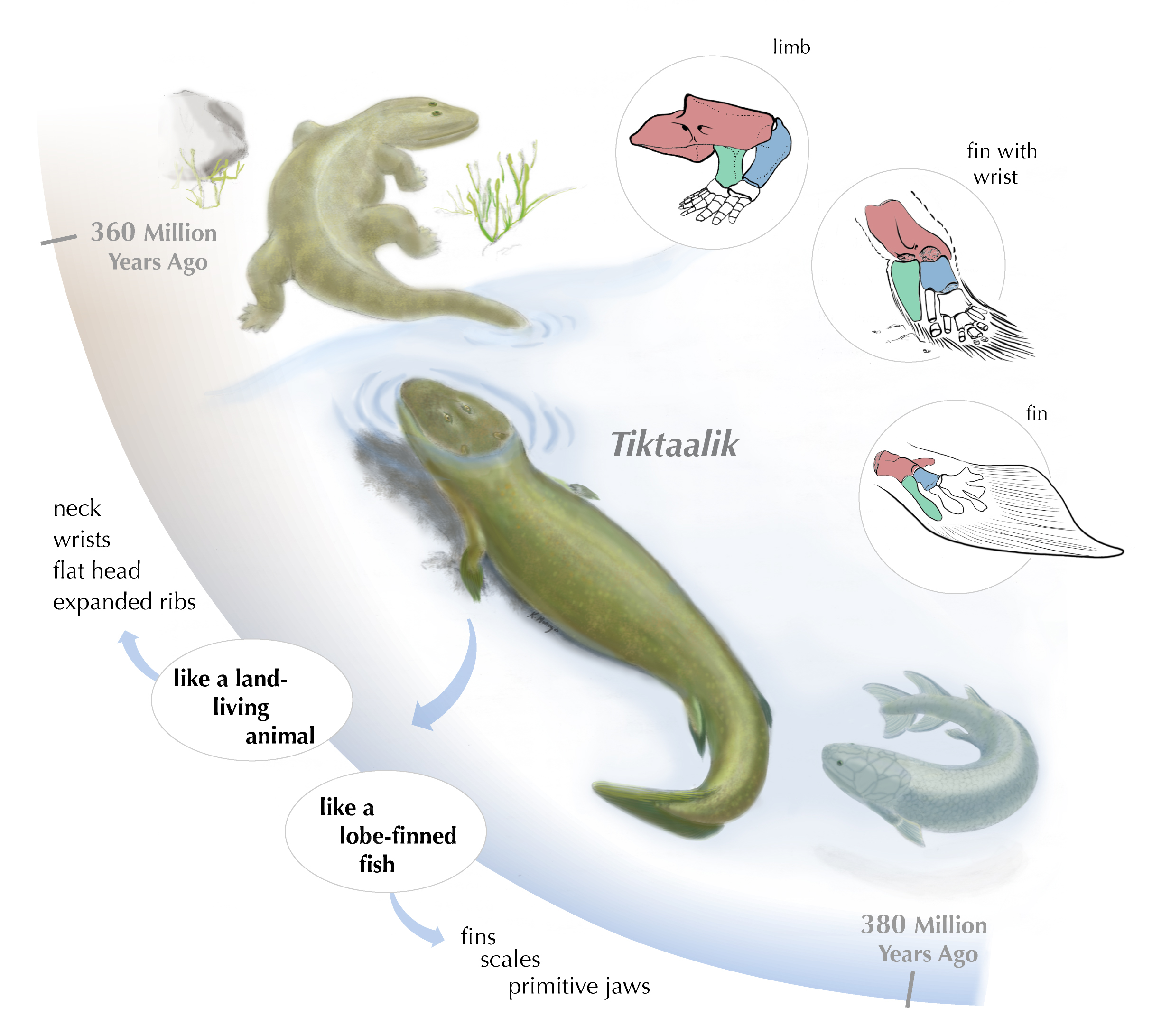
I'll give one example and move on.  I was just reading a passage from the book Your Inner Fish.  To, paraphrase: before 380 million years ago, there were no known living animals on land.   Then, at 360 million years ago, there was extensive evidence that animals were on land.

The author then states he then predicted that there must be a missing link between sea and land animals in rocks of ages between 360 and 380 million years ago.  Guess what.  He found rocks of this right age and found the missing link. (See picture above).

Can someone explain to me how this, and countless examples like it, doesn't qualify evolution as being considered a predictive science?  Seriously!

2. Some claim that microevolution is true but macroevolution is not.

How can someone read the above example and still believe this?

Is there an explanation why, if one assumes #2, that we continue to find missing links between two different species when we look at time periods between when the two different species existed?

Think about it!  Take the types of mammals that roamed the earth 10 million years ago and look at ourselves today. Now reject macroevolution. Can anyone give me one intelligent reason why you would expect "missing link" species to be discovered if we go exploring the 5 million years ago era?  And yet such missing links are discovered, not just with humans, but between all species living in different time periods.

Can #2 believers explain the existence of missing links (intermediate species)? How can you explain the existence of missing links between species if you reject macroevolution? Seriously!

Facts:
1.  Evolution is a predictive science. 
2.  Macroevolution is the only framework consistant with the data. (Else, explain to me how it is possible to reject macroevolution and still have a theory that predicts the existence of intermediate species we continue to discover time and time again.)
Seriously!

Tuesday, September 8, 2009

An Interesting Example Of Evolution Among Dogs.

The blog 80beats pointed out a study in Science that compliments a comment made on my strawman post.

For those who don't know, dogs and wolves share a common ancestor:  They evolved from the same animal.   However, man domesticated some of these Grey Wolves many years ago and the modern differences between dogs and wolves are the results of evolution.

From the above linked article:
Ten-month-old infants persistently search for a hidden object at its initial hiding place even after observing it being hidden at another location. Recent evidence suggests that communicative cues from the experimenter contribute to the emergence of this perseverative search error. We replicated these results with dogs (Canis familiaris), who also commit more search errors in ostensive-communicative (in 75% of the total trials) than in noncommunicative (39%) or nonsocial (17%) hiding contexts. However, comparative investigations suggest that communicative signals serve different functions for dogs and infants, whereas human-reared wolves (Canis lupus) do not show doglike context-dependent differences of search errors. We propose that shared sensitivity to human communicative signals stems from convergent social evolution of the Homo and the Canis genera.
In a nutshell, (you can read 80beats above for more information), these researchers found that dogs think like ten-month old infants in certain respects and wolves don't.

However, there's always the nature versus nurture problem: is this biological or the result of how the animals were raised?  To overcome this problem, the researchers only used wolves raised by humans.  The study thus removes any nurture bias in the conclusions.  What is left is nature.

Therefore, this study is a clear example a real biological difference between dogs and wolves.  A difference that did not exist many years ago when these two creatures were the same animal. 

But now for the important question of the post: What about domestication would cause this particular biological change in dogs?  Your thoughts are welcome.

Friday, September 4, 2009

A Favorite Anti-Science Argument: The Strawman.

I hope readers of this blog become convinced this is the proper way to do science:
  1. Come up with a theory about nature.
  2. Work out the testable predictions of this theory. (Sometimes this takes time ...string theory...)
  3. Verify the testable predictions falsify your theory if found incorrect.
  4. Test the actual predictions.
  5. If the theory fails the tests, reject the theory. (Or the part that fails.)
  6. If the theory passes all tests, and there isn't a more sensible explanation, be willing to defend the theory as probably being correct.
Notice I emphasized the word actual in number three.  This takes me to my point.  I recently read a comment given as proof evolution isn't true:
Nowhere has the watchful eye of science observed horses give birth to a non-horse.
This "proof" against evolution is what they call a strawman argument. They set up something that looks like a real prediction, (but isn't) knock it down and say: "Ha, no evolution."

Nobody is benefited by these tactics. If people were successful in proving or disproving scientific theories based on strawman arguments science would be completely un-beneficial to mankind.  There is always someone clever enough to build a strawman that "disproves" anything: classical physics, modern physics, chemistry, biology, and you name it. Not only do such tactics have no place in science, they are dangerous.


Population thinking.  What evolution actually predicts is:  organisms do not live independently of other organisms but rather in large populations.  No large changes happen to a single organism.  Instead, small changes spread gradually throughout populations over many generations.  The actual prediction becomes: given enough time and other factors, steady gene changes cause different sectors of populations to slowly diverge until they have become different species.

This prediction is confirmed in every place you look: the fossil record, genetics, comparative anatomy, geographical distribution, etc...  These are the types of predictions evolution stands or falls on.  (As it should be since these are the real predictions.)

In short, though strawmans sound clever, the world would not be better off if we used them to prove or disprove scientific theories.  The time-tested prescription that is beneficial is the outline I made at the beginning of the post.  Stick to it, avoid strawmans, and we might actually make some progress.

Tuesday, August 4, 2009

Will Humans View The Apolcalyse?

Okay, I am going to speak as a scientist. (In response to the last post.) I am well aware of what various scriptures say, but scientifically this quote by Martin Reese is correct and makes you wonder if humans will actually be around to observe the "real" apocalypse:
The sun has been shining for four and a half billion years, but it'll be another six billion years before its fuel runs out. On that schematic picture, a sort of timeless picture, we're halfway. And it'll be another six billion before that happens, and any remaining life on Earth is vaporized. There's an unthinking tendency to imagine that humans will be there, experiencing the sun's demise, but any life and intelligence that exists then will be as different from us as we are from bacteria.
It is crazy to think of, but is true none the less. The difference between us and the simplest bacteria is the product of no more than ~4 billion years of evolution.

Given that there is ~6 Billion years for life to evolve on earth before the sun takes it out, it is very possible that the creatures on earth then will be as different from us as we are from bacteria. (If not more!)

Slate needs to add that scenario.

Sunday, August 2, 2009

Aquantic Ape Theory

Here is a uniquely interesting TED talk: Elaine Morgan says we evolved from aquatic apes.

My reaction to this talk went through 4 stages:
  1. I laughed at the idea that some old lady wanted to give such a talk. I was excited to watch it to enjoy some comic relief.
  2. I soon realized this "old lady" is actually very smart and raised some interesting points I have never considered. Interesting enough that I think they do deserve some serious contemplation.
  3. I then reverted to my "the science community isn't a conspiracy. If there was really something to a theory mainstream science wouldn't ignore it."
  4. I still feel like #3, but also admit this lady has me wanting to learn more about what is going on here.

Anyways, I think you will find this "old lady" to in fact be very interesting regardless of whether her theory holds any weight.

Friday, June 5, 2009

Warfare Made Us Altruistic?

Despite the naive guess that something like evolution would force all species to be "social Darwinists", humans are very altruistic. There are several interesting evolutionary explanations for this and the odds are it is a combination of many such ideas. However, here is a new one I have never heard before: (War made us willing to sacrifice for each other?)

One of the defining characteristics of being human is the supreme act of personal sacrifice needed to lay down one's life for the good of the group – but could such altruism be hard-wired in our genes as a result of Darwinian evolution?

Biologists have argued for decades about the evolution of altruism and long ago came to the conclusion that Darwinian natural selection cannot explain acts of supreme personal sacrifice except those directly connected with helping the survival of close blood relatives who share similar genes.

But now a study has suggested that altruism in prehistoric human societies may after all have resulted from a form of natural selection caused by a state of near-continual warfare between competing tribes of hunter gatherers, an idea that Charles Darwin himself first suggested in his 1873 book The Descent of Man.

A scientist has suggested that because so many of the 200,000 years of human history were spent during our hunter-gatherer phase, before the invention of agriculture, less than 10,000 years ago, this long period in our evolutionary history shaped our social behaviour. Moreover, he believes that altruism may have evolved directly as a result of tribal warfare because personal sacrifice was the key that enabled one group to be victorious over another.

Friday, June 6, 2008

National Academy of Sciences: Evolution/Creationism

I recently made the comment that I would take peer reviewed academics over dishonesty any day: referring to one of "the sleaziest documentaries to arrive in a very long time." (This statement is not meant to offend anyone who likes the movie, it is to raise awareness.)

A good question to raise in response to my statement would be: How does this statement help the layman? It is a little hard for the layman, or any non-biologist, to gain an opinion of evolution from the peer reviewed literature. It is so easy for scientists to make claims then hide behind technical literature while insisting everyone believe them.

If you want a good review of our current understanding of evolution the best comes from the National Academy of Sciences itself. For those who don't know, this is the most prestigious scientific organization in the world. (Probably at least.) Also, the best and only the best scientists in every field are members.

They have an official publication on evolution and creationism called: Science, Evolution, and Creationism. The team that authored the book was led by Francisco J. Ayala of UC Irvine so you know it is good. :)

Seriously, this book provides the most honest assessment of our understanding of evolution. Furthermore, it is written at the level of the layman. Moreover, you can read it free online, download the pdf, or order a hardback copy if you like it that much.

Every literate human should read this book. (And if you are illiterate, have someone read it to you.) After reading this book you will be in a position to adequately judge evolution for what it is as of 2008. I think you will be shocked at how much of a pro-religious tone it has.

Thursday, May 29, 2008

Why My Dad Likes Intellegent Design

Several months ago I posted a little piece I titled "Ben Stein and Intelligent Design" in which I expressed my feelings for a movie called "Expelled" about intelligent design. My father saw "Expelled" last week and called to discuss the movie with me. Basically, he thought it was great and wanted to know from me if I thought the scientific establishment was really repressing intelligent design because they are a bunch of liberal atheists or if there was some other reason that such a beautiful idea was being resisted so much by most scientists. In that discussion, I had a minor epiphany about the way most people - even a well educated engineer like my father - view science and why he likes intelligent design.

The reason many people like intelligent design is that it is a technical explanation of the origin of human life that meshes well with most people's religious explanation of the origin of human life. This, however, is where the fundamental problem lies. Science is not a method for technically explaining past events. Science is predictive, not explanatory.

However, to a non-scientist and even many scientists, science is a way of explaining how things happen. Evolution, for example, is not seen a way to predict future changes but rather a way of understanding past changes. This is where intelligent design fails - it makes no predictions - but intelligent design does attempt to explain past events.

This misconception of science is extremely common and, to be honest, is perpetuated by many of the things that go in science classes. When I do science demos, I generally do something and then ask "why did that happen". This gives people the idea that science is about explaining. What I really should be doing is beforehand asking "what will happen". True science only tries to explain past events in order to find physical laws - patterns in nature that will help predict future events.

So when my dad compares intelligent design with evolution, he asks why shouldn't intelligent design be taught in schools. To him and millions of others, intelligent design is science because it explains past events in a technical way. To most people, science is about technical explanations, not technical predictions.

Friday, February 15, 2008

Ben Stein and Intelligent Design

Just when you thought the intelligent design debate was dying down...

The next chapter in the intelligent design drama is a new documentary starring Ben Stein titled "Expelled: No Intelligence Allowed". You can find the movie's website here. "Expelled" chronicles Ben Stein's discovery of "an elitist scientific establishment that punishes the scientific proponents of Intelligent Design because they reject some of the claims of Darwin’s theory of evolution". From what I can tell, "Expelled" is essentially half "intelligent design is right and here's why" and half "the Scientific Establishment is anti-Christian" pity party. I can hardly wait!

Before I go any farther, I have two confessions to make. First, does it annoy anyone else that proponents of intelligent design always capitalize it? It drives me nuts. I don't insist on capitalizing Gravity, so they shouldn't insist on capitalizing Intelligent Design. Secondly, I will always hold special place in my heart for Ben Stein because of his incredible performance in the classic movie "Ferris Bueller's Day Off". For those of you who haven't seen it or those who just want to re-live the excitement, I've included one of the classic scene's below. Enjoy!


Now that I've confessed my biases, back to the subject at hand: intelligent design. On a personal level, I find intelligent design a difficult issue. On the one hand, to my knowledge, intelligent design has no scientific merit whatsoever. Science is about describing the natural world and, as far as I know, intelligent design makes no testable predictions and does not even attempt to fit most existing data on the observed history of biological organisms on our planet into some kind of elegant theoretical framework. If intelligent design could predict how bacteria become resistant to antibiotics or why a monkey's immune system can fight of the AIDs virus but a human immune system cannot, then I'd be interested. But I have not seen intelligent design do anything except claim that certain problem areas for evolution are proof that evolution must be either wrong or in need of a director. This is not science.

On the other hand, I do think a number of concerns expressed by the intelligent design community are valid. The "scientific establishment" does have some strong political and idealogical biases. University professors are overwhelmingly liberal and many are devout atheists, so I can see why the conservative Christians behind intelligent design are concerned about being treated fairly. Also, as much as we might dislike the thought, academia can be very elitist. We tend to think that because we understand concepts that very few understand we are somehow the supreme arbiters of truth. In short, we often focus too much on how much we know and too little on much we don't know.

The bottom line, however, is that despite the draw of seeing Ben Stein and my concerns about the "scientific establishment", intelligent design is still at best philosophy. Therefore, I won't be waiting in line to see "Expelled" when it opens this coming spring.

Thursday, June 21, 2007

AIDS: It's Evolution's Fault

Usually, being more evolved than something else is a compliment. In the case of the HIV virus, it turns out evolution really left us hanging.

It has been known for some time primates have much greater resistance to HIV than humans. The disease is serious to primates, but it's more like the measles to them, whereas to humans, HIV is nearly 100% incurable and the human body is almost completely unable to mount any defense against the disease. Researchers from the Fred Hutchinson Cancer Research Center have announced they may know why.

HIV is a retrovirus, meaning that it injects it's DNA into healthy cells, the viral DNA hijacks the cells and turns it into a virus factory. In the process, pieces of viral DNA can become embedded in the normal DNA of the host. Over millions of years, the viral DNA can actually become a part of the host's normal DNA. When researchers sequenced chimp DNA several years ago, they found that one of the major differences between chimp and human DNA is that chimp DNA contains pieces of viral DNA, probably from an ancient retro-virus. A team of "paleoviroligists" put the pieces of the ancient virus' DNA back together and then tested the million-year-old plague on chimp tissue. As expected, the chimp tissue was highly susceptible to the virus.

The researchers also tried the virus out on cat tissue that had been infused with several important sections of human DNA that control the immune system and differ from the chimp immune system. The human genes prevented the virus from doing much of anything, providing almost total immunity from the ancient virus. This confirmed the hypothesis that humans developed an immunity to the ancient virus, while primates did not.

What was really surprising, however, was what happened when they put HIV into the human-esque tissues. The HIV ran rampant in the human tissues, until they switched the human gene for the primate one, which caused the tissue to fight HIV in the same way that primate tissues do.

So what does this mean? Besides being very interesting for people who study early human evolution, it means that humans today are susceptible to HIV because we evolved our way out of another virus millions of years ago. It also means that researchers have found exactly why monkeys' immune systems work so much better than ours when it comes to HIV.

We may have used evolution to dodge a bullet a couple million years ago, but it seems that even evolution can't save us from everything. You can read more about this at Scientific American or ScienceDaily.

Also, this is just one more piece of evidence that evolution isn't your friend and will turn on you if you give it the chance. If you don't want evolution to "naturally select" you for certain doom, I'd suggest checking out the new Creation Museum in Cincinnati, Ohio that shows you haw easy it is to find people who believe that humans and dinosaurs co-existed and other alternate theories to evolution. Good luck!

Sunday, April 29, 2007

Evolution and Adaption

I think that in talking about evolution we must separate evolution into two distinct categories: One, evolution dealing with the adaptation of single organisms or species to a change in the environment (hereafter referred to as adaptation) and; Two, the process which life came to be on this planet through traditional ideas of natural selection (hereafter referred to as evolution). (Note the careful distinction that I make. I will make use of these definitions through out.)

Adaptation is a proven fact and has been well documented and studied by biologist, bacteriologists and pharmacologists all over the world. A problem arises when people observe adaptation and assume that it instantly proves or at least infers evolution. They argue that if species can adapt to changing situations then over time preferable arrangements of chemicals gave rise to life and life adapted and evolved until it reached its present state. Of course people who hold to creationism reject the conclusion and because they reject the conclusion they are “forced” to reject the evidence. The problem with inferring evolution from adaptation is that you run into the very real possibility of having a fallacious argument. In logic this type of fallacy can fall into two different categories, either “Proof by Example” or “Affirming the Consequent” (note: don’t get the idea that these are two names for the same thing, they are two very different fallacies, but the argument can fall under both fallacies). It is left as an exercise to the reader to figure out how these two fallacies apply (hey, I can’t give all the answers). I should point out that even when an argument is fallacious it may still be true (there are some technicalities involved here).

Also from a purely empirical viewpoint, the question has to be asked “Did you actually sit there and observe evolution?” The answer is obviously “No.” So by the basic tenants underpinning all the assumptions of science you cannot argue for evolution, until you actually observe it. Adaptation on the other had is indisputable.

I should at this point, point out that there are some rather convincing arguments founded on good science for the earth being the age they claim it to be (several billion years old). Having actually (meaning personally) measured the half life of elements and successfully calculated the half life with close agreement to the measurements I have to admit from personal observation that the dating of certain objects is based on good science that it cannot rationally be disputed. On the other hand, trying to understand the whole history of the earth and trying to conclude that life came about through evolution, just by looking at a small (yes small, despite the fact that some will say “Huge! Ginormous!”) collection of fossils is like trying to infer the structure and organization of the bureaucracy of the East India Trading Company by looking at a cup of tea.

So where do I personally stand? I am a very strong empiricist and it makes absolutely no sense to “explain” something that has not been observed. Does that bother me (that I can’t explain it)? No. (If that bothers you, then try understanding strict empiricism first and then talk to me about it.)

Saturday, April 28, 2007

The Real Problem With Being Anti-Evolution

As you know there are many people who spend a lot of time and effort trying to prevent people being educated about evolution. Many religious people even go so far as saying the Lord will send you to hell if you start believing in evolutionary principles. Unfortunately there is at least one major area where this poses a significant problem: The medical industry.

I'll start this out talking about an experience I had today. I was working with a volunteer as I usually do and asked what he does. He says he does immunology research at BYU. I asked what is the main reason it is so hard fighting certain diseases and he said it is this:

Microorganisms evolve too quickly in some cases for effective treatments to stay effective. He said with some dangerous organisms he has seen that in as early as five generations there has been a mutation which allows the organisms to have evolved into something resistant to the treatment. (See The Above Comic)

So I asked him what would happen to research on treatments if evolution was not taught. He said all effective research would stop working if researchers did not do there research based on evolutionary principles.

So there you have it. Stop educating people about evolution, and kiss goodbye all drugs that are effective in stopping diseases caused by microorganisms.

Tuesday, January 30, 2007

Evolutionary Psychology and Friends

For those of you who don't know, I am writing a research paper on evolutionary psychology. I must say the subject is fascinating. Fascinating enough that it sometimes distracts me.

Nevertheless, it's time to choose my friends. According to studies, our brain developed to a size which allows us to maintain on average about 150 friends. The break down goes something like this: you have "room" for about 4-5 intimate friends, (not sexually intimate necessarily, just ones that you are close enough to that you feel comfortable revealing deep secrets and very personal feelings), about 12-15 close friends,(ones with whom you associate often and are your "buds") and up to 150 casual friends. (Ones that you know personally enough that you contact them fairly often and feel comfortable asking them for favors)

So who are going to be my top 5/12-15/150? Esther already gets to go in the first slot. I will leave it to the rest of you to duke it out over the other spots.

By the way, though there is supposed to be humor in this post, I will again say this field is fascinating. It is amazing how our brain developed to help us become the humans we are to day. We are as social as we are and have strong friendships thanks to these developments.

UPDATE: To prove evolution is currently going on, new human advances such as Myspace.com can allow you to maintain hundreds of friends online. Just look how far we have come.