Pages

Showing posts with label string theory. Show all posts

Saturday, August 20, 2011

Just a little update

Hello all!
It has been a long time since I posted and I figured that I should put something up; just as a little update.

As we are about to enter another school year, I, like many of you fellow Grad students, have just had to sit through hours of meetings concerning TA duties about which we are already familiar. Such is life! This year, I will be only teaching Astronomy labs. Our department isn't very big so being able to teach only one type of class is surprising. However, I will also be TAing the only Astronomy II Lab and for which I have been helping to develop curriculum.

A downside to a small department is the interval between when classes are offered, so here I am: a third year grad student taking QFT 1 and 2. I already took QFT 3 last year, but hey, I am just really taking them for fun! I just hope to glean some more cool physics knowledge along the journey. :)

As for research, I am still holding tightly to my GR roots by continuing some research where my Maple-based Tensor Calculating skills are useful and that is in the field of Horava-Lifshitz gravity. This is a fairly sensational area of research where the scaling between space and time is dynamic and energy scale dependent. Hence, it is a potential theory of quantum gravity. In our group we are looking at gravitational collapse and solar system tests all the while trying to constrain the theory.

The HL theory is my actually secondary area of research. My primary field requires a lot more brain-hurting: string phenomology. In general, my string theory group works on generating gauge models in free fermionic heterotic string theory. My particular focus is on superpotential flat direction analysis and the resulting phenomenology. It's all very interesting, if I could just understand any of it! I am much more interested on the phenomenology side of string pheno but that makes me a loner in my group. As of now, I am still working on converting some old Fortran code to C++ and then automating that code for use in calculating the important phenomological quantities (like mass hierarchies, VEVs etc...) for a given model. Of course we want the program to port well with the model generating program that our group has been working on over the past few years but I also will be making it as a stand-alone program. Over the next few years, I hope to continue to expand upon the program to do more exhaustive studies of the free fermionic portion of the landscape by increasing the number of phenomological parameters that can be searched/calculated.

And just like every other physics grad student, I hope to find something cool, new and maybe even somewhat useful!

Apart from physics, I am still leading a Karate group here on campus and will be traveling around a bit to be able to learn more about physics as it pertains to the body!

Wednesday, June 22, 2011

Scientific Consensus And/Or Turing Completeness?

(Below isn't the most correct use of Turing Complete but you get my point...)

Today I was reading Not Even Wrong who quotes Susskind on the Multiverse:
In 1974 I had an interesting experience about how scientific consensus forms. People were working on the as yet untested theory of hadrons [subatomic particles such as protons and neutrons], which is called quantum chromodynamics, or QCD. At a physics conference I asked, “You people, I want to know your belief about the probability that QCD is the right theory of hadrons.” I took a poll. Nobody gave it more than 5 percent. Then I asked, “What are you working on?” QCD, QCD, QCD. They were all working on QCD. The consensus was formed, but for some odd reason, people wanted to show their skeptical side. They wanted to be hard-nosed. There’s an element of the same thing around the multiverse idea. A lot of physicists don’t want to simply fess up and say, “Look, we don’t know any other alternative.
This then got me thinking along the lines of being "Turing Complete".  As many of you may know, if you want to solve a problem that can be solved algorithmically, any Turing Complete framework will do the job.

Now back to Susskind's quote.  He implies that people mostly didn't believe in QCD at first, but since everybody was working on it eventually it found the most success in physics.  Did QCD become successful because it is really *the* correct version of what is going on in particle physics or is it because it was the most worked on framework and so ultimately was cleverly engineered to model reality?

Now, QCD makes successful predictions and so it is more than a framework, it is a successful scientific theory.  However, part of me wonders if the physics community used a completely different approach to particle physics and if everyone worked on that alternative approach if eventually they would have found a completely different framework that not only explains particle physics but successfully makes predictions.

So how much of current physical theories are *exact* and *unique* versus how many have a "Turing Completeness" about them such that if the whole community works on them for decades, eventually they both fit the data and make successfully predictions?

So this becomes my question: Are the main theories in physics accepted because they are the unique theories that fit the data and make predictions or are they accepted because the community adopted them early on and cleverly molded them into models that fit the data and eventually make successful predictions?  If the later, are these theories really unique?  Is there a "Turing Complete" set of frameworks that can always describe the same underlying physics and coincidentally make successful predictions making them valid scientific thoeries?

And if this is all a set of "Turing Complete" frameworks, where one framework is favored by the community, can we ever know what is really happening versus what we have forced to work?

Thoughts?

Wednesday, January 26, 2011

String Theory Is False If There Are No Gravitons.


Is it possible to falsify string theory?  Luboš Motl has just listed a few ways to do so. Though I think some are too impractical to be helpful, I think it is important for string theorists to try to find legitimate was to falsify the theory so that we don't have some Russell's Teapot theory on our hands. IE... a theory that may be false but one that you can never really know.

That said, I would like to highlight one that may be semi-practical: (From Zwiebach linked to the right.)
String theorists sometimes say that string theory has already made at least one successful prediction: it predicted gravity!
But actually I think the prediction string theory makes is that gravity is mediated by a spin-2 particle called the graviton. Therefore, if there are no gravitons then string theory is false.

Now, why am I claiming this may be semi-practical? Because in principle we can construct theories where gravity is meditated by something other than a spin-2 particle. One example, which I admit is probably garbage, is that gravity could be just a consequence of entropy as proposed by Eric Verlinde. And there are and will continue to be even more non-graviton theories proposed until a graviton is discovered.

Now, if one of these alternative-to-the-spin2-graviton theories are ever experimentally verified... I guess we will have done more then disprove the existence of a spin-2 graviton.... We will have also disproven string theory at the same time!

In the meantime, my money is still on gravity being mediated by a graviton as that is the most reasonable thing to believe.

Monday, January 17, 2011

String Theory and Russell's Teapot


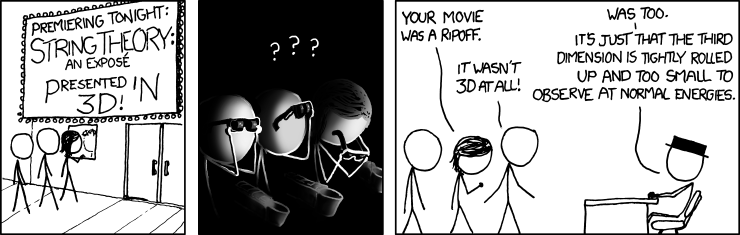
I don't want to be too hard on string theory because in reality I like the theory and hope it is correct.  That said, this cartoon by XKCD reminds me of the parallels between string theory and Russell's Teapot:
"The extra dimensions are really there we promise, they are just too small to observe...", "The supersymmetric partners that should exist for every particle are really there we promise, they are just at a high enough energy that they are out of our reach... ", "The 10^500 vacuum states leading to a multiverse...." etc...
I guess what I am worried about is that if string theory is not falsifiable in any practical way then you could never know if it is false or not.  Like Russell's Teapot.

Now, in defense of string theory, in principle these things may be able to be observed once we have built good enough detectors.  Therefore maybe it could somehow be falsified.

I guess another big difference is string theory employes hundreds if not thousands of physicists and the detection of Russell's Teapot doesn't. :)

Friday, January 7, 2011

The Scale Of The Universe and And It's "Best Theory".


Many of you have heard the phrase "use the right tool for the right job", and when it comes to physical theories the story is no different.  For example, I often hear that quantum mechanics is more fundamental and thus a better theory than Newtonian physics.  But is it always the better theory?  For example, does quantum mechanics describe the solar system better than Newtonian physics?  For all practical purposes the answer is a big "No Way!".

And, further, can Newtonian physics describe the large scale properties of the universe as well and general relativity?  Again the answer is no.

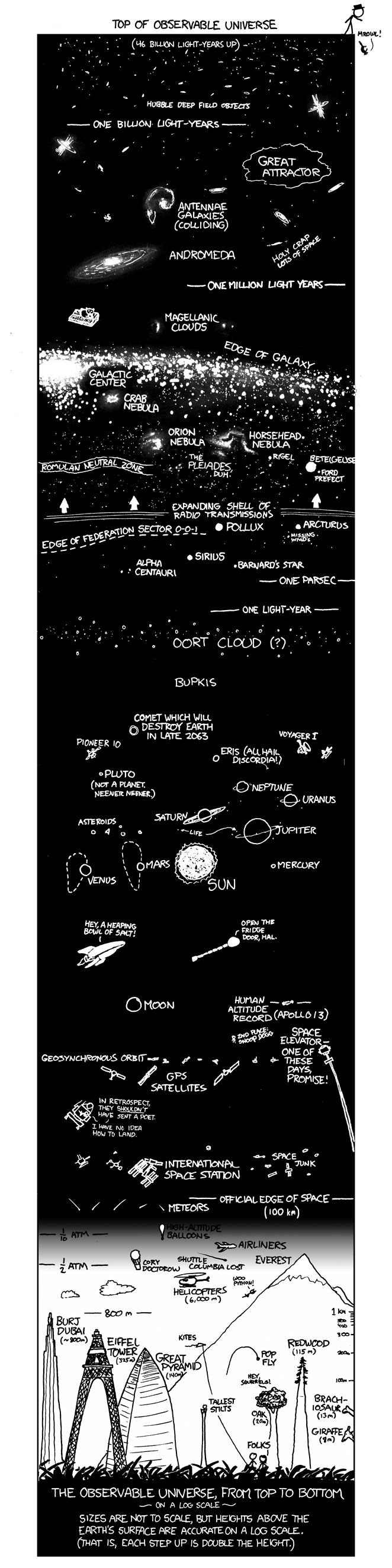
Look at the flash game above.  As you move the cursor back and forth, you see the universe at different scales.  And for each separate scale, a different physical theory becomes the best theory to use to describe that scale.  It really is the case that scientists are well advised, when describing the universe, to use "the right tool for the right job."

Question: But aren't the more fundamental theories are telling more about what is really going on?

Actually, it's hard to say!  For example, I've already posted on how some of the theoretical machinery going into our most fundamental theories of nature could just be clever mathematical models that just so happen to fit nature.  Not necessarily what is actually going on.   Furthermore: I'll give another example: is spacetime really curved, like general relativity says, or is something else going on like the interaction of a spin-2 graviton?  (Or something else entirely and yet the math just happens to work out making them clever models as opposed to the true reality!)

So, my advice to those who want to classify (and many do!) which physical theory is most superior or "most correct": I advise you to first ask what scale of the universe you are trying to describe.  Because, it turns out that each scale of the universe has it's own best theory.

A best theory for describing the cosmos at large... a different best theory for describing how a planes and rockets fly through the air or how bridges stand... a different best theory for describing how elementary particles interact... a different best theory etc...

Finally: It is this observation that allows cosmologists to think there may be a better theory than general relativity for describing scales larger then have been examined thus far.   Or: one reason why string theorists have good case for why there might be a better theory than standard quantum theories for describing the smallest of scales.

In short: the idea of a best theory is really scale dependent!

Click on the image to the right from XKCD.

Thursday, September 2, 2010

Despite Hawking, Universe Existence/Origin Is Still A Mystery.

As you may have heard, Stephen Hawking says universe is not created by God because, in a nutshell, gravity exists:  "Because there is a law such as gravity, the universe can and will create itself from nothing".  Moreover, he believes M-Theory can fully explain our universe and therefore God is no longer needed.

At first I was going to stay out of this discussion since, as I said before, I believe the argument over science versus religion is often unfruitful.  But after reading some interesting comments by fellow cosmologist Peter Coles, whom also has written some good books on cosmology shown above, I decided to comment.  First, from Coles: (by the way, I've coauthored 4 papers with this guy.  Small world!)
It’s interesting that such a fatuous statement managed to become a lead item on the radio news and a headline in all the national newspapers despite being so obviously devoid of any meaning whatsoever. How can the Universe be “a consequence” of the theories that we invented to describe it? To me that’s just like saying that the Lake District is a consequence of an Ordnance Survey map. And where did the Laws of Physics come from, if not from God?
Stephen Hawking is undoubtedly a very brilliant theoretical physicist. However, something I’ve noticed about theoretical physicists over the years is that if you get them talking on subjects outside physics they are generally likely to say things just as daft as some drunk bloke down the pub. I’m afraid this is a case in point.
I agree.  Moreover, I find it funny that when Hawking and others find physical theories that can completely describe our universe, they seem to forget that certain questions about the universe still remain a mystery such that, as far as I can tell, can only be solved using tools beyond science.  For example, I am interested if science can ever understand these basic questions about the universe:

1. Why does the universe obey laws at all?  I've read several papers and textbooks written by physicists where they admit it seems unexplainable to know why the universe obeys laws.  Science may demonstrate which laws are being explained and how, but can science ever explain why? Furthermore, why do these laws happen to be mathematical in nature?

2. Why, of all possible physical theories, has the universe chosen to follow string theory?  First off, I must say my first reaction to Hawking's claim was: "So he feels comfortable replacing God with a highly speculative  theory. :)"  But given I believe string theory has a good chance of being the true "theory of everything", and for sake of argument I will assume that it is.  Fine, but can science ever show that it is impossible for a universe to exist without string theory being true?  If so, why did our universe select string theory of all theories to follow?  People will say: "It has to because it is composed of strings."  Fine, but then why is it, of all things, composed of strings?

3.  Why does the universe even exist in the first place? So that we can exist?  So that ...?  Hawkings says it is natural because gravity exists.  Fine, but that just kicks the can down the road.  Why does gravity exist in the first place? Etc...

4.  If the answers to these questions are always philosophical in nature, why bash religion? I admit that I have heard potential answers to these questions but they all have one thing in common: they are philosophical answers!  Or they say such questions are pointless which is again just a subjective belief.  But that's just it!  On one hand scientists have their own philosophical answers/subjective beliefs concerning these types of questions that bring confort to their minds but then go on to attack religion as being unscientific.  It's as if their unprovable philosophical beliefs concerning deep mysteries of the universe are okay but religious explanations for such questions are not to be tolerated.

So in a nutshell:  First, I do believe something like string theory is probably a true physical theory.  Second, I know from experience such theories can explain the existence of the universe "naturally".   But, why the universe happens to obey laws at all and why of all theories string theory was selected is, and I am sure will always be, a mystery to me.  As far as I can tell, such why mysteries will always be beyond the scope of science and can only be explained philosophically.  So if you are going to answer such deep questions about the universe with unscientific philosophy, why be so intolerant of "unscientific" religious explanations to the same questions?

Monday, March 15, 2010

The 120 Order Of Magnitude Problem.

(The forth post in the dark energy series.)

Now to address the concern the that value of the cosmological constant is off by 120 orders of magnitude from what we expect from theory.  To start off with, let's talk about the Higgs Boson.

The public, media, and many scientists, are greatly anticipating the detection if the Higgs.  Nobody seems to be claiming the Higgs is some mysterious thing scientists seem to know nothing about.  It makes predictions.  It fits the physics well.  It makes the standard model work.  But, like the cosmological constant, it seems experimentally confirmed theory (things like supersymmetry is not confirmed yet.) and experiment disagree by several orders of magnitude about what it's mass should be.

The Hierarchy Problem
This is the famous Hierarchy problem.   Scientists admit to it's existence, but none seem to treat the Higgs as being mysterious. Here's the problem:
  1. You calculate the Higgs mass using standard understood QFT.
  2. You find that the Higgs mass should be up at the Planck scale because of loop divergences at energy scales we don't understand.
  3. From experiment you find that the Higgs mass should be at the 100 GeV scale, (this is several orders of magnitude too small).
  4. You invent some unobserved machinery, like supersymmetry, that explains why the Higgs mass should be at the 100 GeV scale after all. (Seriously, string theory and the hierarchy problem are the real reasons why we have supersymmetry.)
  5. The media, even the Wikipedia, now nicknames the Higgs as the God Particle and people don't seem to take much issue with it.
Now let's look at the cosmological constant's size.  (Do these divergences make me look fat?)

Back to the paper:
The problem [of the cosmological constant's value] is similar (but worse) to the problem given by the Higgs mass, which scales quadratically in the standard model, and can be taken as an indication that “there is something we have not yet understood” in Higgs physics.
 How similar.  This is how we find the discrepancy:
  1. You calculate the value of lambda (the cosmological constant) using standard understood QFT.
  2. You find that the lambda should be a "Planck-scale vacuum energy" from loop divergences at energy scales we don't understand.
  3. From experiment you find it is very small, about 120 orders of magnitude smaller than this Planck-scale value.
  4. You successfully invent some unobserved machinery,  like string theory, that can explain the discrepancy.
  5. Everyone maintains the cosmological constant is dark and mysterious.
Maybe it's high energy particle physics that is the real problem.

The problem of the cosmological constant being off by 120 orders of magnitude is analogous to the Higgs' mass being off by several orders of magnitude.   The real problem may have nothing to do with the Higgs or the cosmological constant being weird or mysterious, but may be that we just don't understand physics at high energies.

Now, just to be honest, the machinery needed to fix the cosmological constant problem needs to be more sophisticated than what is needed for the Higgs.

Still, given its analogous nature, in this context, I wonder if the cosmological constant is being treated unfairly.

Monday, March 8, 2010

But Background Spacetime *Is* Gravity In String Theory.

Experts can correct me if I'm wrong, but I believe the below is correct.

As said before, loop quantum gravity supporters, and many quantum gravity people in general, argue a major problem with string theory is that it isn't background dependent.  Physically, they argue, this is bad since from GR we learn gravity doesn't propagate through spacetime but in fact is the spacetime.

However, I believe this critique may be unfounded.   It turns out, curved spacetime in string theory is a cohert state of gravitons, not just some ad hoc background space for strings to move through. (As our LQG friends world have us believe.)

Here's how to see it. Again from David Tong's wonderful lecture notes:

The string action in curved space:  (Capital G is the "background space").
The trick is to put G into the form: (We do this all the time.  Nothing fishy here.)
Now, throw that puppy into the path integral, and we have:
Where S_Poly is string theory without curved space and V is:
But V is just the vertex operator for a graviton!

For those who don't know, inserting a single vertex operator V in the path integral corresponds to the introduction of a single graviton state. Inserting e^(V) in the path integral corresponds to a coherent state of gravitons!

So, the background in string theory does not appear to be some ad hoc background the strings are magically propagating in.  It appears to be a coherent state of the gravitons themselves.

Hence, I believe the critics are wrong: Curved spacetime in string theory appears to be nothing more than gravitons after all.  Just like GR.

Wednesday, March 3, 2010

Does String Theory Really Demand Higher Dimensions?

A real string theorist can correct me if I am wrong, but: it seems that string theory does not require space to be higher dimensional as is usually claimed.

Take for example bosonic string theory of which it is often said can only exist in 26 dimensions.  However, on a technical level, I'm not sure this is correct and perhaps we should stop using this terminology.

What is really critical is that the central charge of your CFT = 26.  For those who don't know, string theory has  conformal invariance and thus has a lot to do with conformal field theories. (CFT)  Conformal field theories have something called a central charge c.  It seems to me, the only requirement for the bosonic string theory to be valid is that you need c = 26.

For example, take a look at David Tong's lecture notes where it is written:
The consistency requirement is merely that the degrees of freedom of the string are described by a CFT with c = 26. Any CFT will do... If you like, the space of CFTs with c = 26 can be thought of as the space of classical solutions of string theory.
Now even more to the point:
We learn that the “critical dimension” of string theory is something of a misnomer: it is really a “critical central charge”. Only for rather special CFTs can this central charge be thought of as a spacetime dimension.
For example, if we wish to describe strings moving in 4d Minkowski space, we can take D = 4 free scalars (one of which will be timelike) together with some other c = 22 CFT. This CFT may have a geometrical interpretation, or it may be something more abstract. The CFT with c = 22 is sometimes called the “internal sector” of the theory. It is what we really mean when we talk about the “extra hidden dimensions of string theory”.
Or consider this quote from String Theory and M-Theory: A Modern Introduction:
One may saturate the central-charge condition in other ways. In critical string theories one chooses D ≤ 26 space-time dimensions, and then adjoins a unitary CFT with c = 26 − D to make up the rest of the required central charge. This CFT need not have a geometric interpretation. Nevertheless, it gives a consistent string theory 
Okay, so assuming I am reading this correctly, string theory doesn't demand there are hgher dimensions, only that the central charge takes on a special value.  The theory can be lower dimensional provided the correct CFT is being used.

If this is true I think we need to stop saying string theory requires extra dimensions and start saying string theory demands special field theories that are highly constrained by the number of dimensions.

Thursday, February 25, 2010

The Standard Model Particles Are Massless States?

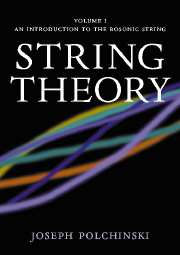
From, the standard textbook on the subject, String Theory by Joseph Polchinski:
Masses that are not zero in string theory are of the order [the Planck mass].  This is so large compared to experimentally accessible scales that these particles appear only in the virtual states.  Thus, we will be especially concerned with the massless string spectrum, since this must include all the particles of the Standard Model.  Of course, most known particles are massive, but these masses are so small compared to [the Planck mass] that they are zero to first approximation and become non-zero due to small symmetry-breaking effects.
So, it appears that the whole standard model is embedded in the massless states of string theory and that their masses on come because of small symmetry breaking.

For those who don't know, particles getting a mass because a symmetry has been broken does happen.  The very real Z abd W bosons get a mass because symmetries are broken.

It's just fun for me to think: assuming string theory is correct: all things we observe in nature are just the massless states of string theory with a some small masses from symmetry breaking.

Tuesday, February 2, 2010

Physics Quote Of The Day.

From the opening sentence of D3-brane Potentials from Fluxes in AdS/CFT:
Since the dawn of time, humankind has wondered, “what is the potential on the Coulomb branch of the conifold gauge theory, and what are the consequences for models of D-brane inflation?” In this paper, we continue this quest.
That is one of the best opening sentences to an journal article I have ever read!  I almost died when I read that.

Monday, October 12, 2009

Anything Allowed To Happen Happens? (Interesting Case for String Theory.)


I attended a colloquium here at UC Irvine where the speaker made an interesting case for string theory.  Warning: this is not a mainstream view, but a fun idea to peruse none-the-less.

His point was this: in the quantum field theories we know, to get correct answers you have to assume all physical processes consistent with fundamental principles do happen.   He therefore said (paraphrasing) "since string theory is consistent with the fundamental laws we know, so we should expect it to happen."

Let me elaborate further what he was driving at by discussing three things:

1.  The Path Integral:  When a particle travels from A to B it exhibits weird "quantum" behavior.  Richard Feynmann showed that this can be explained if we assume the particle takes all possible paths from A to B as seen in the above image.  In other words, you get the right answer if you assume every possible path a particle can travel it does travel.


2.  Feynmann Diagrams:  If you want to know how particles interact, again, to get the correct answer you need to assume they interact in every possible way consistent with physics.  A convenient way for tracking all possible ways two particles can interact is by drawing Feynmann Diagrams like those on the right.

3.  When as physicist wants to derive a relativistic field theory, he/she constructs a Legrangian containing every possible term possible consistent with underlying physics.  If he/she does not, then they would not get the right equations of motion.

Okay, back to the speakers point.  Because it does not violate any known laws of physics for particles, strings, branes, etc... to exists and be interacting together in some way or another, maybe we should assume they are.  We make similar assumptions in 1-3 above, and maybe the remaining issues with physics lie in the fact we aren't including them.  In other words, maybe string theoriests are on the right track by including them all; hence we see issues like quantum gravity going away.

Just to be clear, I've never heard this argument before and as far as I can tell it is not the mainstream view.  However, it is still an interesting case for string theory.

Wednesday, September 16, 2009

Physics Quote Of The Day.

Sorry to quote David Tong two days in a row, but this guy has some good quotes.

From David Tong's Lectures on String Theory:
Our current understanding of physics... is 15 orders of magnitude away from the Planck scale. Why do we think the time is now ripe to tackle quantum gravity? Surely we are like the ancient Greeks arguing about atomism. Why on earth do we believe that we’ve developed the right tools to even address the question?

The honest answer, I think, is hubris.
Wow, it just doesn't get any more candid than that.

Thursday, August 27, 2009

More Real Physicists On An Eternal Multiverse


This post is not an attempt to prove anything. You don't prove science by a popular vote.

It is another on inflation predicting an eternal multiverse.

Look, there are many papers/videos by real big-name physicists arguing for what I have maintained in previous posts like this one:
  1. Inflation is starting to be considered well established, experimentally proven physics that people need to take seriously.
  2. It seems inflation, no matter how hard you try to get rid of it, predicts an eternal nature to the universe.
  3. Furthermore it seems to always predict many pocket universes that we may or may not be able to detect experimentally. (This is still debatable.)
  4. There might be statistical ways of ruling out some of these ideas so, in addition to #3, there might be several ways of making these ideas falsifiable.
  5. People need to get over the idea that there was an initial signularity at the beginning of the universe/multiverse.  There are good reasons to believe there really was no beginning.
Don't get me wrong, all these ideas are very speculative.  But the big-name physicists who study theoretical cosmology are starting to really take this stuff seriously, and my claim is so should you. :)

Unfortunately, since physicists left to their own devices are often boring, you might not make it through all 66 minutes of this talk.  But if you could fight to watch just the first 10-15 minutes, you will see that see the issues we have discussed.

Wednesday, August 12, 2009

The String Landscape And Multiverse Thought Experiments

I enjoyed reading a thought experiment proposed by SteveP: Would it matter if you switched to an identical universe? He wonders if it would matter if you were transported to an identical universe where the only difference is the size of some fish. You should all read his post for more details as it is an interesting question.

This reminds me of the highly speculative, but nevertheless mainstream, theoretical physics known as the string landscape. See here for peer reviewed articles. (Again this stuff is very speculative.)

For those who don't know, string theory started out in the late seventies as an attempt to explain the strong interactions. It soon became apparent string theory may finally be the theory that explains the quantum nature of gravity. A major early problem was there were several consistent string theories. Which one describes our universe?

Then came M-Theory that unified all the string theories into a single theory that that predicts, by one popular interpretation, there are 10^500 types of universes all connected together in a giant multiverse. (For those who don't know, 10^500 is a really, really big number.) Each of these "types" of universes can happen any given number of times.

Anyways, as I read SteveP's post I couldn't help but think of the 10^500 different universes an alien might take me too if the string landscape is a correct idea. Some would support life and some wouldn't. Some would have Obama's socialist death squads for senior citizens and others would live in the paradise of Glenn Beck's imagination. (Okay, I made that one up. :) ) But some would be just like us, and if Nobel Prize winner Gell-Mann is correct, just the right accident may happen so that the only difference between us and them is the size of a fish.

I'll tell you how it goes when I get there SteveP. But in the meantime it was a great thought experiment.

PS: Just an FYI, string theory is not the only theory that predicts a multiverse. Almost all quantum cosmology theories predict a multiverse of some sort. The string landscape just predicts a really big multiverse.

Thursday, July 30, 2009

Falsifying String Theory With Statistics


As many of you know the string landscape gives on the order of 10^500 solutions for possible universes predicted by string theory. One way to look at this is string theory seems to predict just about any universe and so has no predictive power. Furthermore, with this line of thinking you usually conclude that string theory is not falsifiable.

Another way to look at is is perhaps string theory predicts a multiverse with 10^500 different classes of universes. Some people, who take this view, go on to use the term "anthropic landscape" since immediately this way of thinking opens up the possibility that there are 10^500 universes but only a small subset support life and so our existence is natural since the theory alone with no fine tuning predicts intelligent life should naturally arise in some universes. (You say the odds of having such perfect constants that support life is highly improbable by chance alone, but when you have 10^500 such universes become highly probable.)

So, with this as a backdrop, enter Bousso and Leichenauer. They decided that you can now falsify string theory by showing that string theory favors universes that support life with different physical constants than ours. If string theory says: "Yes, some universes support life, but those that do should typically have physical constants different than those you see" than this in some sense would falsify string theory.

They found of all their universes with observers, the constants of our universe differ from the most probably constants by 2-3 sigma depending on the constant. They view this as a good sign for string theory.

I'm not at all saying "go endorse the string landscape." It's just an interesting way to try to falsify string theory.

Tuesday, July 14, 2009

Another hint of strings?

Earlier this month, scienceblog.com, published an article entitled, "Physical reality of string theory demonstrated". For those of you who haven't yet seen it, it is worth a little read. No doubt you will now sings shouts of "proof" and "down with the unbelievers" due to this HUGE amount of evidence that string theory is THE theory. (Note the extra smattering of sarcasm)

At least nature seems to be dangling the little carrot of experimental testability in front of us once again. Things like this will hopefully keep the strings community going until we can prove (or in the very unlike event: disprove) that 'strings are the thing'!

Wednesday, February 25, 2009

How String Theory May Predict A 3+1 Dimensional World

This is a continuation of my "String Cosmology" post series. Remember, from the last post, that any compact universe should have strings that wind around, just like when you wind a string around a torus.

Well these winding strings, like a rubber band, want to compress any manifold down to the plank length. (At which point the dual momentum strings we discussed dually "push back" to prevent further collapse.) However, winding strings are oriented. Wrapping 3 times clockwise is different then 3 times counter-clockwise.

If we could have winding strings come in contact with anti-winding strings we would have the winding modes unwrap, and the universe expands. However, this process must be in equilibrium to keep the universe big for any length of time.

Well, a string sweeps out a 2 dimensional surface as it moves, so has a 2d interaction area. Same with a anti-winding string. So, the largest dimension where you could maintain long term expansion is a 2+2=3+1 dimensional space which would expand leaving the rest of the dimensions compactified.

This does something more, since it may take a long time before this equilibrium comes about, this could explain the high entropy in the universe.

Saturday, February 21, 2009

How String Theory Gets Rid Of Singularities

Okay, I admit up front I am probably glossing over a lot of details, (real string theorists please don't complain too loudly) but on a basic level I found a very profound explanation why string theory removes singularities from theories like GR form Cumrun Vafa, a very prominent string theorist at Harvard.

String theory has a duality where, if the planck length = 1, then the physics at a scale R is equivalent to physics at a scale 1/R. One way to see this is to remember that our universe, and most string models, is compact meaning the spaces have boundaries, even if at infinity. In string theory strings either exist wrap around the boundary, or they don't. (Think of all the ways to draw a string on a Torus. The strings either wind around the boundary or they don't.).

One can show in Fourier space, normal strings have energy ~n/R. Strings that wind around the boundary have energy ~m*R. Hence, every state at energy scale R represented by a normal string is equivalently described by a winding string at at 1/R. Therefore the particle/energy spectrum at energy scale R is equivalent to 1/R where winding strings now produce the normal string modes, and visa versa.

Now for defining distance. Recall with GR you get coordinate singularities. Singularities which exist only because at that point you are using bad coordinates. If you do a coordinate transformation, the singularity at that point goes away.

So if we use coordinates based off of light rays, as we usually do, we get good results until we run into singularities often at R=0. However, if for distances shorter than the planck length, we define a new coordinate distance based of the winding dual to light rays, then the singularity disappears because the physics at 1/R is equivalent to R. Hurray, no more singularity!

At this point Vafa points out it is therefore impossible to know if we really exist on scales greater then the plank length and are choosing to base distances off of light rays, or if we are actually living at distances much smaller than the planck length and are basing our distance measurements off of the winding mode counter part to light rays. :)

Tuesday, February 17, 2009

Has String Theory Predicted Its First Experimental Result?

Symmetry Magazine is a joint publication of SLAC and Fermilab and has just released as article entitled: A first: String theory predicts an experimental result. Since 2005 there has been a known phenomea where quark-gluon plasma starts acting like a superfluid at extremely high energies. This has baffeled physicits.

It turns out string theory predicts this should happen. Hurray for string theory. (This doesn't prove the theory, but is interesting enough to blog about.)