Pages

Showing posts with label inflation. Show all posts

Monday, August 16, 2010

A New Generation Of Copenhagen Interpretations.

In 1927, Neils Bohr and others formulated what became known as the Copenhagen interpretation of quantum mechanics, in Copenhagen Denmark.  This week I am attending a workshop in Copenhagen at the Neils Bohr Institute on that same ground that attracted so many famous physicists so long ago.

It's also interesting to reflect how far quantum mechanics has come.  In 1927 physicists were still trying to formulate what kind of theory quantum mechanics even is.  Today, the workshop began with with a talk entitled "The Quantum Origin of the Universe."  We've gone from formulating a new physical theory to explaining the whole structure of the universe with it in less then a century!!!  

There were 3 main talks today and I summarize briefly:

Viatcheslav Mukhanov:  Gave the talk about the quantum origins of the universe.  He emphasized the importance of inflation and claimed all objections to inflation are now really starting to look silly.  People either attack a mechanism of inflation ("Dude, I don't like inflation cuz it is some ad hoc scalar field...") showing their ignorance not understanding that the effects of the theory are mechanism independent. (Example: you get primordial density perturbations no matter what the mechanism.)  Or, they come up with some metaphysical argument why they don't like inflation.  (How dumb would I look if I gave a philosophical argument why I don't think it makes sense that the Earth orbits the sun even though we see it in experiment?)

At this point he quoted a the physicist Nobel Laureate Steven Weinberg who said (discussing cosmology):
Our mistake is not that we take our theories too seriously, but that we do not take them seriously enough. It is always hard to realise that these numbers and equations that we play with at our desks have something to do with the real world.
Always remember that quote!

Anupam Mazumdar:  Talked about two things, first emphasized how much progress had been made showing inflation really does recover low energy physics and the second half talked about how gravitational waves, if detected, could revolutionize the field.  The stuff on gravity was was very interesting.

Alan Heavens: Discussed what we will learn about the universe from gravitational lensing over the next decade or so. It was very interesting.  Right now you are used to seeing pictures of stars and galaxies.  Fine, but with gravitational lensing, in the future, we will be able to map out the 3D structure of the Dark matter Halos stars and galaxies sit in.    Furthermore, the 3D lensing reconstruction will test aspects of cosmology in all new ways and will be become a very stringent test on General Relativity. (For instance, it may be cosmologists using lensing who discover the hierarchy structure of the neutrino masses!)

Tuesday, May 4, 2010

The Big Bang Theory Song Gets It Right.


Every once in a while I watch a show on the Discovery Channel (or channel like it such as The Science Channel, etc...) about the beginning of the universe where they inevitably suggest the universe may have begun as a singularity.

Look, there was no singularity at the beginning of our universe!!!

The singularity is an artifact caused by applying classical physics to energy regiems where classical physics breaks down.  Therefore, people (and especially scientists) need to stop claiming the universe sprang from a singularity.

In fact, I was recently at a cosmology conference where a panel of prominent cosmologists told us one of the most important public relations things was can do is dispel the idea that the universe began as a singularity. (This was the same conference where we where entertained by the music from the drummer of the Grateful Dead.)

What Actually Happened?


The best description about what happend is found in the open lines of the theme song for the Big Bang Theory:
Our whole universe was in a hot dense state,
Then nearly fourteen billion years ago expansion started.
(Perhaps the Discovery Channel should hire Barenaked Ladies to start their material for them?)

We know ~13.7 Billion years ago the universe was in a hot dense state and began expanding in accordance with the Friedman equations.  That's what we know.

What Happened Before Then?

We don't know for 100% sure, but the data heavily favors the idea the universe went through an inflationary phase.

And What Happened Before Then?

This is where our understanding breaks down.  Many things are possible and I personally think the best motivated ideas are related to those where the universe inflates from a small patch of some pre-existing universe. (Many cosmologists share this belief)  Nevertheless, I admit this may be wrong.

However, one thing is for sure: the universe did not begin as a singularity!

Friday, April 16, 2010

Making The Multiverse Case As Simple As Possible.

I've tried to make the case for the multiverse in the past, but let's see if I can do a better job.  First a crude definition:

When I mean multiverse, I mean: in addition to our own observable universe, there are several other casually disconnected regions that are each "separate" universes.  (Separate from ours today in a casual sense.)

Here are my arguments:

1.  Inflation:  Inflation is a period of time when the comoving Hubble radius shrank.  This happens when the universe undergoes an accelerated expansion.  That's it.  I have made no reference to scalar fields, branes or anything else people try to pretend the definition of inflation is.

Now, assume this happened. (As the data seems to show really well.)  Look at the top figure.  We've discussed this before.  The universe starts as some patch, then expands such that the Hubble radius shrinks as shown.

This also means that regions that used to be casually connected to us no longer are as they have been "pushed out".  Furthermore, we have no reason to believe, after inflation, that our new casually connected region is the only one that continues to expand with galaxy formation etc... after inflation ends.

This begs the questions:
  1. How many casually disconnected regions were created by inflation? (Given a 60+ e-fold expansion, way too many to count.)
  2. Are we sure that the only thing that existed before inflation was this one casually connected patch that inflated?  How in the world can you justify that it is all that existed without giving some ad hoc argument?  If our patch existed, by a Copernican Principle type argument, we should expect our initial patch is not some special "only one".
  3. If inflation started from some quantum process on our initial patch, as many expect, what would prevent inflation from happening over and over again now that there are many more patches that could potentially inflate? (Quantum processes like radioactive decay happen again and again with a certain probability)
Anyways, given all this, we should expect inflation generically produces a very, very large multiverse which means a structure with many, many casually disconnected separate universes.  Each of these should be like our own with galaxy formation, stars, planets, (life?), etc...  

If you want to know what kind of structure we live in, you need to take what we see today and multiply it again and again.

2.  The CMB itself:

This isn't a separate argument as much as some data related to the above claims.

Well, it turns out that every ~1 square degree piece of our sky of the CMB represents a casually disconnected region.  Look at the middle images.  The orange circles represents casually disconnected regions. (Not drawn to scale)  This means we are receiving CMB photons from ~10^5 casually disconnected regions.
So today, somewhere on the order of 10^5 casually disconnected regions are coming into casual contact for the first time.  Inflation aside, what would lead one to believe these are the only casually disconnected regions?   A billion years ago these regions were not in casual contact.  How many other regions are still expanding and evolving independently without being in casual contact?  How many will never be in casual contact even as time goes to infinity?

Summary:

Just remember, a 60+ e-fold expansion (inflation) generically creates many many casually disconnected regions.  The overwhelmingly vast majority of which have been evolving as "separate universes".  This alone creates a multiverse like structure.  Furthermore, within the CMB itself we are observing regions that, until today, have existed without being in casual contact. (After inflation)  How many "separate universe" type regions exist today?

This means: think of everything you know and love about our observable universe.  Now you need to copy that an enumerable number of times if you want to actually imagine what kind of structure we live in.

Furthermore, when you realize that if inflation happens once, you probably should consider that nothing should stop it from happening again. (Or that it isn't still going on in some regions as is predicted.) This would eventually create even more innumerable separate regions of a "multiverse".  Such a scenario can best be pictured with the bottom figure.

Wednesday, February 10, 2010

Constraining Inflationary Models III: Primordial Non-Gaussianity.

It used to be the case that the spectral index ns and the tensor-to-scalar ratio r were two of the only constraints we could use in distinguishing between inflationary models.  Unfortunately, this really isn't enough.  Too many models predict values for the quantities that are well within the error bars and probably will remain so forever.

However, new hope has emerged from primordial non-Gaussianity.  Gaussianity is the idea that all the n-point correlation functions are described in totality by the two point correlation function plotted above. Non-Guassianity describes departures from this.

Now, what is a correlation function?  A 2 point correlation function tells you how 2 points are related to each other.  A three point correlation functions tells you how three points are related to each other, etc...  For example, a non-zero 3 point function tells you that the three different points in spacetime had some way of influencing each other: interactions.

Therefore it turns out, physically how you get a departure from Gaussianity is by having interactions between the quantum fields/branes/etc... driving inflation.  A measurement of non-Gaussianity gives is a measurement directly on how these fields were interacting and therefore contain a wealth of information about the character of these fields/branes/etc...!

In cosmology we can plot these correlation functions versus the multiple moments l as shown in the plot.  The lower the multiple show how points far away from each other were interacting.  The higher multiple moments show how points close together were interacting.

The three point function, or bispectrum, gives rise to three independent quantities that parametrize non-Gaussianity.  The four point function, or trispectrum gives rise to two more parameters.  

The interesting thing is each inflation model makes different predictions for the values of each of these parameters.  Combined with ns and r we will have 7 parameters to highly constrain inflationary models and weed out the rest.

This may help us finally understand what drove inflation.

Tuesday, February 9, 2010

Another Subtle Triumph Of Relativistic Cosmology.

I've been maintaining that inflation blows things up really big, pushing stuff outside our horizon. (Or said another way, the stuff is pushed so far away that it can no longer effect us as it has been pushed outside our light cone.)

So:

  1. If inflation happened, things should have been pushed outside our horizon.  (Think light-cone.)  
  2. As said before, the quantum fields during inflation would create perturbations on all scales, including the scales being pushed out of our horizon.
  3. After inflation stops, our horizon has a chance to "expand again" allowing those perturbations that got pushed outside our horizon to fall back in.
  4. These perturbations allow for gravitational collapse to form things like galaxies out of the matter contained inside the perturbation.
  5. Perturbations on the order of 1 Mpc (3 million light years) contain, given the density of matter in the universe, ~10^12 solar masses of matter and fell inside our horizon long enough ago to allow this matter to collapse into galaxies.
  6. We see galaxies with 10^12 stars in them. Check!
  7. Here's the kicker: Perturbations on the order of 10 Mpc fell into our horizon recent enough that there has not been enough time to have galaxies form from all the matter contained withen them.
  8. We see no galaxies with 10^15 stars in them. Double check!
  9. They have, however, re-entered long enough ago that we can measure stochastic properties of such perturbations confirming their existence.  Triple check.
This doesn't prove anythings as much as to say: what you should expect coming from inflationary cosmology is exactly what you see.  

(Repeating myself) Perturbations should have been created and, since inflation happened, pushed out of our light cone.  Those who fell in long enough ago should have formed things like galaxies with as much matter as is contained in such perturbations.  Those that are so large that they only fell into our horizon recently should not yet have formed galaxies containing all the matter they posses, meaning we should not see galaxies with their order of mass.  We don't.  We should however be able to discern they exist by their statistical properties.  They do and it is yet another subtle triumph for cosmology.

Think about it:
If the universe has really been around forever without anything like some inflationary phase: Why hasn't gravity pulled all the galaxies we see into bigger mega-galaxies by now?  Like always, inflationary cosmology provides the answer.

Monday, February 8, 2010

A Helpful Way To Understand Inflation Induced Perturbations

I heard an intuitive explanation about what is going on with inflation induced perturbations that I enjoy:

During inflation, the spacetime is expanding at an exponential rate (faster then the speed of light) driven by quantum fields.   These quantum fields are in some sense conveying information to the spacetime which reacts by expanding exponentially.

However, when the inflation field(s) turn off, that new information is communicated to the expanding spacetime with an amount of uncertainty that matches Heisenberg's uncertainty principle.  Given this "Heisenberg's uncertainty principle's" amount of uncertainty in knowing when to stop, some points in space stop inflating slightly differently than others.

If you do the math, this uncertainty should lead to fluctuations in the spacetime on the order of one part in 10^5, which is exactly what we see. (Go inflation getting another prediction right again!)

(If the above words made no sense), look at the picture.  (The picture is technically of something else, but it should get the job done.)  Each slice can be thought of as a patch inflating bigger and bigger.  Soon the quantum fields tell the spacetime to stop inflating.  Given there is some quantum uncertainty in this command, different regions stop inflating at slightly different times leading to the noticeable fluctuations in spacetime seen at the top.

Friday, February 5, 2010

Constraining Inflationary Models II: The Tensor-To-Scaler Ratio.

Spacetime is described by the metric tensor which has several "degrees of freedom".  Conveniently, these degrees of freedom can be separated into what are labeled scalar, vector and tensor modes.  These modes act independent of each other.  It is therefore helpful to break up the degrees of freedom of the tensor in this way.

Because this can be done, perturbations to spacetime due to inflation can be measured separately from each other as scalar, vector and tensor perturbations.  The scalar perturbations are the easiest to measure and have been measured with success since COBE.  The vector perturbations are unstable so we have no hope of detecting those today.  However, what remains to be detected are the tensor modes.

The tensor perturbations of the metric are those that can be described by a symmetric traceless tensor.  It turns out these were caused by a physical process that also can be described by a symmetric traceless tensor: gravity waves.

Whoever first detects these tensor modes may win a Nobel Prize.  In many ways this is the only remaining prediction of inflation not yet verified. (The COBE team, who first measured the scalar perturbations, got their Nobel Prize.)  Furthermore, a detection of the tensor modes would be an indirect detection of gravitational waves.

With all this said, the ratio between the tenor and scalar modes, r,  is predicted to be different by different inflationary theories.  The above chart shows constraints on r by the WMAP 7 year data.  (Same picture as before, I know.)  This parameter therefore is another that can be used to distinguish between inflationary models.

Wednesday, February 3, 2010

Constraining Inflationary Models I: The Spectral Index.

Inflation is characterized by an exponential expansion.  (Literally.)  One interesting property of an exponential expansion is that it is, what is known as, scale invariant.  This means if a 1 meter chunk of space doubled in size, then so did a 10 meter, and a 17 meter, and a 1898876 meter, etc...

If inflation was a purely classical process, then the spectrum of perturbations (fluctuations of spacetime) produced by inflation should be completely scale invariant.  (Since the expansion was an exponential.)  Without going into the technical details, cosmologists quantify just how scale invariant these perturbations are with a parameter call the spectral index ns.  If ns = 1, the perturbations are completely scale invariant.

However, if inflation is quantum in nature, the exponential expansion should end with measurable quantum fluctuations in it.  If this is the case, the spectral index should not quite be one.  Various inflationary models predict different values for ns with a single scalar field inflation predicting ns  = 0.96.

The latest WMAP 7 papers show that the best value, to one sigma, is ns = 0.963±0.012.  See the plot above to see the best fit values for the spectral index ns and the tensor to scalar ratio r. (Which will be talked about in the next post.)  Also in this plot are various predictions for many popular models of inflation.  As you can see, many are still withing the 95% confidence window. (Not all models are shown.)

This shows a couple things: One inflation really is a quantum process.  The value you get from a purely classical exponential expansion is ruled out by 3 sigma.  Second, as stated before, the simplest model of a single scalar field driving inflation is the one that works best.

Unfortunately,  enough other inflationary models are within a sigma or two of this value that we need more parameters to distinguish between the models.

Tuesday, February 2, 2010

Physics Quote Of The Day.

From the opening sentence of D3-brane Potentials from Fluxes in AdS/CFT:
Since the dawn of time, humankind has wondered, “what is the potential on the Coulomb branch of the conifold gauge theory, and what are the consequences for models of D-brane inflation?” In this paper, we continue this quest.
That is one of the best opening sentences to an journal article I have ever read!  I almost died when I read that.

Monday, February 1, 2010

Constraining Inflationary Models

I am going to write a series of posts that will both clarify why I am currently researching non-Gaussianity and explain how we can distinguish between inflationary models.  (The posts are already written so this this promise will be fulfilled. :) )

Without rehashing details, we know that inflation happened.  It makes several specific predictions with nearly all of them being verified better than people had a right to suspect. (The other predictions should be verified soon.)

Inflation is defined as a period where the universe experienced a superluminal expansion, or more technically, a phase in which the comoving Hubble radius shrank.  (See picture).   You can think of the Hubble radius as your light cone.  If space expands faster than the speed of light, the radius of influence of the light coming from you shrinks.

For example, if after a split second light has influenced everything within 100 meters of you, then the space expands superluminally, soon the light is only influencing objects that were once only 5 meters from you.  It's as if it's effective radius of influence shrinks.  (Again, look at the plot and try to make sense of it.)

What we don't know is the exact mechanism that drove inflation.  The problem is there are many models that do the trick: single scalar fields, multiple scalar fields, fields that are not scalars, branes from string theory, etc...  Interestingly, the model that best fits the data is the simplest one: a single scalar field and so this is the one most people study.

So in the next few posts I am going to explain ways we can distinguish between these models.  There are a few parameters that each model of inflation seems to predict different values for that can be used to rule out inflationary mechanisms.  Traditionally these the two parameters were the spectral index ns and the ratio of tensor to scalar modes r.  Recently, it has been discovered that there are 5 more parameters coming from what is known as non-Gaussianity.  Non-Gaussianity therefore has the potential to constrain and rule out models of inflation better than anyone could have expected a decade ago.

Thursday, October 8, 2009

Andrei Linde On Inflation

I have already quoted Alan Guth, often considered as the founding father of inflationary physics, as claiming inflation implies an eternal multiverse.  However, every cosmologist who cites Guth as proposing inflation will then immediately cite Andrei Linde.  This is because Linde's contribution to the initial inflationary models were just as important as Guth's.

This is what Linde says about the eternal nature of inflation, after doing a bunch of calculations, in his 2007 paper which has already been cited over 100 times:
The universe enters eternal process of self-reproduction. The existence of this process implies that the universe will never disappear as a whole. Some of its parts may collapse, the life in our part of the universe may perish, but there always will be some other parts of the universe where life will appear again and again, in all of its possible forms.
As I mentioned before in the above Guth post, inflation implying an eternal multiverse is just as real of a prediction that the universe is flat, produces distinct peaks observed in the power spectrum, produced scale-invariant curvature perturbations, made those perturbations Gaussian, produced a spectral index slightly less then one, and every other prediction we have verified.

I don't think it is fair to a physical theory, after seeing every other prediction is verified with flying colors, to reject the rest of the predictions as philosophy just because they may be out of our realm of detection.

This eternal multiverse coming from inflation is probably just as real as all the rest and I think people need to take that seriously.

Now, in fairness, Linde next says this:
One should be careful, however, with the interpretation of these results. There is still an ongoing debate of whether eternal inflation is eternal only in the future or also in the past.
I agree, we must be careful. I think it is very possible to read too much into all this. However, I still maintain this is more than just philosophy given that it is rooted in an underlying physical theory that on so many levels has been experimentally verified. (Admittedly, there are a few more predictions to go.)

Thursday, August 20, 2009

What Do You Do With Theories That Make Both Testable and Untestable Predictions?

I would like people's opinions on this:

I keep alluding to how modern cosmologists think the universe is actually an eternal structure, perhaps even a multiverse with many different types of universes.

Look, I'm not just making this stuff up because it is fun. It is a real prediction of inflation. I will quote Alan Guth himself: (This guy is a father of inflation, and if anyone is going to win the Nobel Prize for it its him.)
In this paper I have summarized the arguments that strongly suggest that our universe is the product of inflation. 
He names several predictions of inflation that have all been confirmed. It is a remarkable theory. In addition, inflation makes other where predictions people are divided about their testability:
Next I turned to the question of eternal inflation, claiming that essentially all inflationary models are eternal. In my opinion this makes inflation very robust: if it starts anywhere, at any time in all of eternity, it produces an infinite number of pocket universes... For that reason it is important for us to learn more about the evolution of the multiverse during eternal inflation.
He then says(which is my whole point):
It is the success of [the testable] predictions that justifies spending time on the more speculative [predictions] of inflationary cosmology.
So my question: what are we to do with such a theory? It makes several predictions, most of which can be tested and so far have past every test with flying colors. However, there are these other predictions that may not be testable. What is the more rational thing to do?
  1. Dismiss the "untestable" predictions as philosophy?
  2. Say, "since all predictions we can test pass with flying colors, the theory is probably true so we should take seriously all predictions, even those (perhaps) not testable"?
  3. Something else.
As you may have guessed, I fall into the second camp. Inflation is real. It has been verified on nearly every level it can possibly be verified. (Still a couple left I admit). It actually predicts the universe is eternal and that there are probably an infinite number of "pocket universes" out there in addition to ours. This is a real prediction and it is my opinion we should take it just as seriously as we take the others.

So what are you thoughts? What should we do with such a theory? What do we do with these possibly untestable predictions of inflation?

Friday, March 6, 2009

The Higgs and Inflaton: Two Peas in a Pod

The Higgs Boson is an scalar particle that single handedly makes the whole standard model of particle physics make sense. One problem: nobody has detected that it actually exists.

The Inflaton is an scalar particle that single handedly makes the whole standard model of Cosmology/Big Bang make sense. One problem: nobody has detected that it actually exists.

Isn't it amazing that a fundamental ingredient of two of the most experimentally successfully theories is a scalar particle which has never been detected? It is as if scalar particles have a Dr. Jekyll Mr. Hyde personality: The want to solve all our problems while at the same time cause everyone endless grief/time/money by escaping our detection!!!

They truly are two peas in a pod. :)

Wednesday, September 12, 2007

Can string theory accommodate inflation?


This from New Scientist:

String theory is having trouble producing inflation – the rapid expansion of space thought to have occurred in the early universe – at least in some of the theory's simplest incarnations, according to a new study.

The work suggests squaring string theory with the well-accepted notion of inflation will be challenging at best – and some even say that one or both theories may have to be abandoned.

String theory is a leading contender for the "theory of everything", which would unify all the forces of physics in one framework. Though there are many different versions of string theory, all posit that elementary particles are actually tiny vibrating strings, and that the universe contains extra spatial dimensions beyond the three that we can see.

Now, a new study suggests it may be difficult to reconcile string theory with the widely accepted theory of inflation, which explains several key cosmological observations – such as why the universe appears to have the same properties in whichever direction astronomers look.

The study was carried out by a team of researchers led by Mark Hertzberg of MIT in Cambridge, US. The team tried to produce inflation in three versions of string theory in which the extra dimensions are shaped like a doughnut – the simplest possibility. But they found that the conditions needed for inflation appear to be impossible to achieve in these simple versions.

Room for doubt

Many inflation scenarios have been proposed within more complex versions of string theory. But Hertzberg says all of them leave some room for doubt, because not all of the details that underpin them have been verified with complete calculations, though progress has been made in this direction.

He stresses that it could still be possible to robustly produce inflation within string theory. "I don't want to run around saying, 'Oh no, there's no inflation in string theory,'" he told New Scientist. "But since we haven't performed a complete search involving more complicated extra dimensions, we don't know."

Paul Steinhardt of Princeton University in New Jersey, US, who helped to pioneer the theory of inflation, says the findings are in agreement with work that he and others have done using other versions of string theory.

"I think the fact that it is difficult to combine inflation and string theory is very interesting," he told New Scientist. "It could mean they are completely incompatible, which would force us to abandon at least one of them."

Dark energy

He nevertheless cautions that there is still a chance that someone may find a robust way to achieve inflation in string theory in the future.

Another inflation pioneer, Andrei Linde of Stanford University in California, US, is more critical of the work, however.

He says the results only apply to a class of string theory versions called type 2a, which are irrelevant to the real universe because they have been shown to be incompatible with dark energy, the mysterious force causing the universe's expansion to accelerate.

"Why would you even try to describe inflation in a theory that cannot describe our universe?" Linde says.

Max Tegmark of MIT, a member of Hertzberg's team, counters that versions of type 2a string theory should not be written off just yet.

Narrow down

That is because neither it nor another type of string theory that does account for dark energy gives a perfect description of the real universe, he argues, since they predict that the universe should be filled with exotic "supersymmetric" versions of familiar particles like electrons – which are not actually observed.

More sophisticated models of type 2a theories may yet be able to support dark energy, he says.

String theorist Gary Shiu of the University of Wisconsin in Madison, US, says the fact that not every version of string theory is compatible with inflation is good news, because it will help narrow down which versions of the theory should be further investigated from the vast number of possibilities.

"Constructing a universe consistent with observations is not an easy act," he told New Scientist.

Friday, March 9, 2007

Musser's 10 Predictions by 2017

George Musser works for the Scientific American. He recently made a prediction of what he expects to see discovered in physics over the ten years.

Though they are just predictions, the fact of the matter is these predictions are all theoretically possible to have via the LHC at CERN, the Plank Satellite, Ligo, Lisa and other experiments going up over the next decade. If all goes well most and maybe all ten of these may in reality happen! We really are living in an interesting time in physics. Here is his list:
  1. HIGGS
  2. SUPERSYMMETRY
  3. WHAT DARK MATTER IS
  4. DARK ENERGY
  5. HOW INFLATION HAPPENED (ie... was it an eternal inflation model or other)
  6. GRAVITATIONAL WAVES
  7. PROTON DECAY
  8. LITTLE BLACK HOLES (Formed in particle accelerators)
  9. ANTHROPIC PRINCIPLE (How the Universe began, like #5. String Landscape?)
  10. OTHER EARTHS (Other earths with life. This one is the most far fetched but who knows)
Only time will tell. I hope to be working on a few of those at graduate school.

Saturday, February 24, 2007

Eternal Inflation and its Implications

As most of you know the Eternal Inflation Model is my favorite. (Hence the name of this blog). I am intrigued by it and hope to study it more closely in graduate school.

I found another great introductory paper on this topic by Alan Guth, father of inflation himself, called: "Eternal Inflation and its Implications."

Topics include:
  • What inflation does for cosmology.
  • Some experimental evidence of inflation.
  • Differences with his model verses Linde's model.
  • How inflation works.
  • Implications of String Theory Landscape and Multiverse. (Very interesting).
  • Difficulties in calculating probabilities.
  • The youngness paradox: Why so few other advanced civilizations.
  • Possible beginning of inflationary model altogether.
Anyways, it is a great article. Between Eternal inflation and the role of supersymmetry in Cosmology I really am starting to get some greet ideas for graduate school.

Friday, November 24, 2006

Introduction


My name is Joseph Smidt and this is my first blogging experience. I have named the blog "The Eternal Universe" since I am on the road to becoming a cosmologist and my favorite model for the universe is the Eternal Inflation Model. Decades of ever increasing experimental evidence concur that the observable universe as we know it sprang from an incredibly small, hot and dense region of space. In fact, there is substantial experimental evidence that, about 13.7 billion years ago, the entire observable universe was smaller than a baseball and inflated into what we see today. According to classical general relativity, the results we see lead inevitably to the conclusion that the universe sprang from an initial singularity. We call this the "Big Bang."

If however classical general relativity is extended to a quantum theory of gravity, then it is possible that the universe inflated from a very small quantum patch, not a singularity. Where did this quantum patch come from? The Eternal Inflation Model predicts it resided in another universe from which this universe emerged. It turns out, if you do the quantum math, that if you allow the universe enough time to exist, a small patch of the quantum fields that exist throughout the universe will eventually inflate and create a new universe. After the quantum fields inflate to sufficient sizes, they actually have the ability to gravitationally collapse and form galaxies, stars and planets which allow life to form and exist. It truly is a wondrous thing and the cycle continues in one big eternal round.

I really think I will find blogging a pleasurable experience. I will admit however that I know it can be a little dangerous. It seems when people share their opinions publicly, they are setting themselves up to offend someone or something. Hopefully I will be able to avoid such calamities.

Again, I wanted to start a blog because I think it will be fun. I will enjoy posting things and hope to build some good friendships with people around the web. May we all remember that we live in this great eternal universe together, so lets make the most out of it. May everyone have a great Thanksgiving weekend.

-- Joseph Smidt


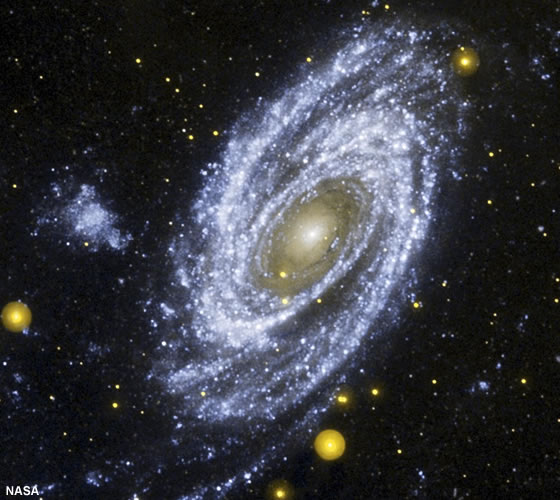
Picture on Top: Our Universe. Yes all the dots are galaxies, our universe is that big, and even bigger. :)

Picture on Bottom: image of atoms taken by IBM.

The inflated quantum fields not only gave rise to the the vast cosmos that we see in telescopes, they also form the atoms are bodies are composed of!