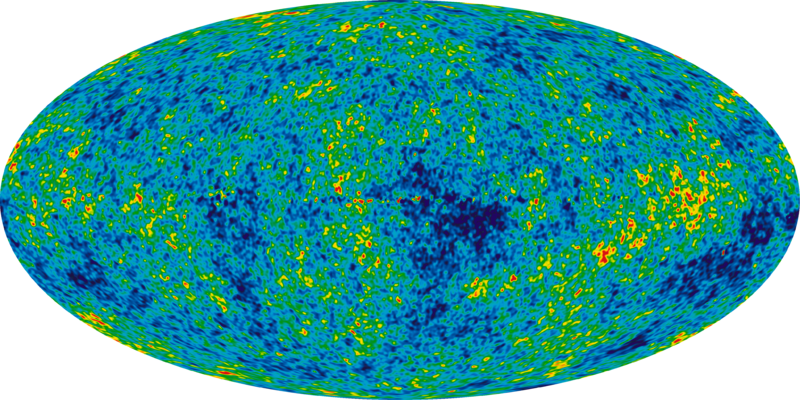
Pages

Showing posts with label big bang. Show all posts

Tuesday, May 17, 2011

Complex Ideas in 3Tweets. (The CMB)

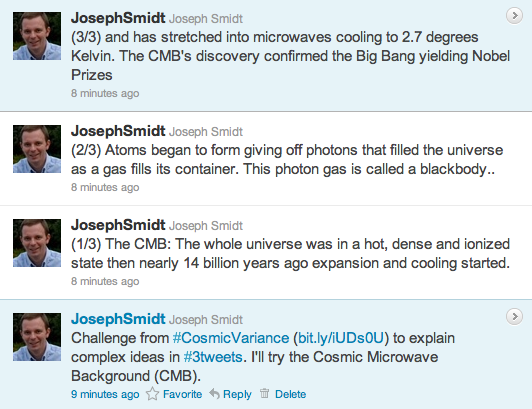
Sean Carroll has challenged people to describe complex ideas in 3 Twitter Tweets.  With that being said, I decided to tackle the Cosmic Microwave Background (CMB):

I encourage everyone to try do this with some complex idea as it is both fun and a useful skill to be able to boil down complex ideas to short simple explanations.   And even if you don't have a Twitter account you should try it. If nothing else, you can post three 140 character descriptions of any complex topic here in the comments.

Good luck!

Friday, September 10, 2010

Did Life Develop Shortly After Big Bang and Get Spread Throughout The Universe?

ResearchBlogging.orgI woke up to a very interesting paper by Gibson, Wickramasinghe, and Schild that appeared on the ArXiv last night and suggests that life most likely developed shortly after the big bang and was then spread throughout the universe.   They call this the biological big bang. (And at this point I should say that universe here means the "local universe" that was in casual contact between 2-8 million years after the big bang.)

I will show some plots and quotes below, but before I do I want to give the main arguments of the paper:

1.  Complex life originating on this earth is very improbable and scientists who believe such a thing are dismissing how unlikely it is.

2.  However after the big bang there was a brief period, between 2 and 8 million years after the big bang, where the formation of life becomes highly probable for these reasons:
  • The entire universe (not just one planet) was the in the critical temperature range (273-647K) for the formation of water and complex organic molecules like RNA.
  • The first supernovas had already by this point ejected the necessary elements and chemical compounds needed for the formation of complex organic molecules.
  • The elevated pressure and density of the universe at this stage contributed to very high reaction rates such that extremely unlikely molecules form quickly.
  • The elevated pressure and density of the universe at this stage further kept the majority of the universes in constant communication such that a survival of the fittest scenario could play out.
3. Life is spread throughout the universe by comets and meteors providing the seeds of life to otherwise sterile planets.

4. Life did not originate on earth but came to this sterile earth from another sector of the universe through these comets and meteors.

5.  The fundamental building blocks of life might actually be the same throughout the whole universe. (With the reminder that here I mean the local section in causal contact between 2-8 millions years after the big bang.)

6.  There is evidence for extra-tereestrial life.

Now, I'm not a bio-physicist so experts can correct me if any of the above is inaccurate, but I'm pretty sure those are the main ideas and conclusions discussed in the paper.

Quotes and plots for more details:

Gibson et al. starts out with the following questions:
Why should Earth be the only planet with life? Astrophysical spectra show dust clouds dominated by polycyclic- aromatic-hydrocarbons (PAH), strongly indicating that biological processes are commonplace in the Galaxy. The theory of cometary panspermia provides the logical mechanism for distribution of the seeds of life, but how are sufficient numbers of comets and meteors formed? How, when, and where did life begin in the first place, how widely is it distributed, and are life forms likely to be similar everywhere?
To which they respond:
In the present paper we explore aspects of this HGD (hydro-gravitational-dynamics) model in greater detail, suggesting that the conditions within ultra-high pressure interiors of primordial planets at 647K provide optimal conditions for life’s first origin. Given the large cosmological volumes available and the numerous panspermial mechanisms for communication of life templates provided by HGD cosmology, first life most plausibly appeared and was scattered among 10^80 available planetary interiors produced by the big bang in the time period t = 2-8 Myr. We term this period the biological big bang.
And here are some plots:
In this plot above, the authors contend that the supernovas, in the case type II but elsewhere they discuss type Ia, ejected the material needed for life in time for their "biological big bang" to begin.


In this above plot they show their timeline of the early universe.  Life begins at the "Goldilocks" temperatures and conditions and the necessary DNA/RNA molecules are carried away by comets.


This image is given as evidence for extra terrestrial life like ours.  It is an image of "Cyanobacteria fossils observed by Richard Hoover in Orgueil and Murchison meteorites."  In their paper they give evidence that the Red Rain organism is extra-terrestrial.

One more choice quote:
First life is assumed to have occurred on Earth since we see life everywhere and are taught to believe no convincing evidence exists for extraterrestrial life. Copernicus convinced the scientific community, and finally even the Vatican, that the Earth is not the center of the universe, and has recently been buried in hallowed ground. However, with respect to living organisms the scientific community remains in a pre-Copernican position, fiercely resisting concepts that DNA and many diseases and possibly antigens on Earth are continuously supplied by extraterrestrial sources. Because life exists profusely on Earth it is assumed that the formation of life must be a rather trivial matter, and that possibly life began spontaneously on this planet in several ways since life has existed from its beginning 4.6 Gyr ago. However, all laboratory attempts to create life have consis- tently failed and all serious attempts to model probabilities suggest they will always fail. Life chemistry is too complex to replicate with present technologies on human-life-time scales.
The standard Earth-based models for the origin of life, inspired by early suggestions of Haldane (1929) and Oparin (1957), are all based upon an unprovable article of faith. Faith comes in by pos- iting the existence of complex chemical pathways that are yet to be discovered, reaction networks that are somehow capable of bridging the difficult gap between chemistry and biology... Fred Hoyle in his classic book and lectures “Frontiers of Astronomy”, Maddox (2003), proposed the entire solar system as a better venue than Earth for the origin of life.
So again, if the paper is correct, it appears that life may have originated shortly after the big bang in a "biological big bang" and was then distributed throughout an otherwise sterile universe on planets like our own earth.

Carl H. Gibson, N. Chandra Wickramasinghe, & Rudolph E. Schild (2010). First life in primordial-planet oceans: the biological big bang Submitted to International Journal of Astrobiology. arXiv: 1009.1760v1

Wednesday, May 5, 2010

The CMB Is A Perfect Black Body Spectrum.

What is black body radiation?  I think the most helpful definition is: "the black-body... may be thought of as... a gas of photons."

Water vapor is a gas of water molecules.  The helium gas that you blow up balloons with is a gas of helium particles.  So what do you call a "gas" (in equilibrium) consisting of light particles or photons?  You call it black body radiation. (See more here.)

It shouldn't be hard to imagine that the Cosmic Microwave Background Radiation (CMB) should be a black body: The universe can be thought of a giant container.  In the early stages of the universe, photons were emitted at every point and were free to flow throughout the universe like helium gas is allowed to freely move throughout its container.  Hence, if early universe physics was true, we should expect the CMB to be a perfect black body.

Those are not the 1-sigma error bars, those are the 400-sigma error bars!


Look at the plot above. The black line is the theoretical curve for a black body spectrum. The error bars from actually measuring the CMB have been multiplied by 400. That's right, the errors on the CMB being a perfect black body spectrum are so small that you have to multiply them by ~400 just to see them!

That's one perfect back body spectrum, and yet again shows the data backs the theoretical predictions of early universe physics.

Tuesday, May 4, 2010

The Big Bang Theory Song Gets It Right.


Every once in a while I watch a show on the Discovery Channel (or channel like it such as The Science Channel, etc...) about the beginning of the universe where they inevitably suggest the universe may have begun as a singularity.

Look, there was no singularity at the beginning of our universe!!!

The singularity is an artifact caused by applying classical physics to energy regiems where classical physics breaks down.  Therefore, people (and especially scientists) need to stop claiming the universe sprang from a singularity.

In fact, I was recently at a cosmology conference where a panel of prominent cosmologists told us one of the most important public relations things was can do is dispel the idea that the universe began as a singularity. (This was the same conference where we where entertained by the music from the drummer of the Grateful Dead.)

What Actually Happened?


The best description about what happend is found in the open lines of the theme song for the Big Bang Theory:
Our whole universe was in a hot dense state,
Then nearly fourteen billion years ago expansion started.
(Perhaps the Discovery Channel should hire Barenaked Ladies to start their material for them?)

We know ~13.7 Billion years ago the universe was in a hot dense state and began expanding in accordance with the Friedman equations.  That's what we know.

What Happened Before Then?

We don't know for 100% sure, but the data heavily favors the idea the universe went through an inflationary phase.

And What Happened Before Then?

This is where our understanding breaks down.  Many things are possible and I personally think the best motivated ideas are related to those where the universe inflates from a small patch of some pre-existing universe. (Many cosmologists share this belief)  Nevertheless, I admit this may be wrong.

However, one thing is for sure: the universe did not begin as a singularity!

Thursday, February 18, 2010

Play WMAP's "Build A Universe" Game.

*UPDATE*: The game doesn't seem to be on this site working correctly.  Go to the WMAP link to play it. It will make more sense.  Sorry about that. (It really is pretty cool!)

How do scientists use Cosmic Microwave Background (CMB) data to figure out how much dark energy, dark matter and regular matter there is? How do they calculate other fundamental quantities such as Hubble's constant?

One way is to examine a real gem that can be extracted from the CMB: The power spectrum. (See above image.) The power spectrum is a 2-point correlation function which means it determines how well different points in the sky relate to each other. (See link for explanation of what this is.)

It turns out, the shape of the power spectrum is highly sensitive to the values of many physical parameters such as percentage of dark matter, dark energy, the value of the spectral index, etc... To demonstrate how much this is the case, I have attached WMAP's "WMAP's CMB Analyzer".  It is a fun little game that at the same time is very educational.


Hint, best fit values from CMB are approximately:
Atoms: 4%
Cold Dark Matter: 22%
Dark Energy: 74%
Hubble's Constant: 73
Reionization Redshift: 11 z
Spectral Index: 0.96

Tuesday, February 16, 2010

What Are These Correlation Functions Anyways?

I have, and will continue to discuss correlation functions so I might as well write a post describing what they are in more detail.

Two Point Correlation Function:
A two point correlation function describes how two different points in space are related.  For example: Think of the earth and what temperature it is right where you are standing.  What can you say about the temperature 10 feet away?  The odds are that it is close to being the same temperature.
Thus we say at small scales, or between two points close together, temperature is highly correlated.
Now, pretend you are in Irvine California.  If I ask this question: "Knowing it is 70 degrees outside in Irvine, what temperature would we expect it to be in Beijing Chaina?"  You would say "I have no way of knowing, the temperatures are not related." or in other words:
We say on large scales, or between two points far apart, temperature is hardly correlated.
Three (and higher) Point Correlation Function:

Now let's say you are in a small room where one wall is held at 100 degrees and the other held a 0 degrees.  Can you tell me anything about the temperature of a point in the middle of the room. Yes, it is probably some temperature between 0 and 100 degrees.  Knowing the temperature values of two points in a room can often tell you about temperature of a random third point.
Thus we say, in such a scenario, we have a non-zero three point function since each three points are somewhat correlated.
It should be obvious now that you can have higher n-point correlation functions.

Interactions Between Points:

In some sense, n-point correlation functions directly tell you something about interactions going on between n-points.

Two points close together that have different temperatures interact in a way that effects the temperature of the other point.  Two points very far away at different temperatures have a hard time interacting with each other in a way that effects the temperature of the other.
Thus, interactions are what gives rise to a non-zero two point function which therefore becomes a statistic quantifying the interactions.
I'm sure if you thought about it long enough you would realize in my three-point example above, correlations are again related to interactions between points.

The CMB.

Note in the figure how the CMB shows correlation between all scales. (Low l values represent correlation at large scales, high l values represent correlation at small scales.)   This could only happen if points at both small and large scales had ways of interacting with each other.  Given points at large scales in the sky are not in casual contact with other points, only one known thing can explain this:

A superluminal expansion or, in other words: Inflation!

Friday, February 12, 2010

The Big Bang, Culture And Our Unique Place In Time.

Lawrence Krauss submitted a paper that is short and should be assessable to all our readers named The Big Bang, Modern Cosmology and the Fate of the Universe: Impacts upon Culture.

The paper raises some interesting ideas.  I will go through some:

1. The question "where did we come from" has been as fundamental in shaping our culture as anything else.  How will our expanding knowledge of the physics behind our origins effect this?
Ever since humans have had the capacity to wonder, they have been inspired by the night sky to wonder about questions such as: Where did we come from?, or, Are we Alone?, or How will the Universe end? These questions and others form the very basis of much of human culture, beginning with myths and religion, and moving, over the past 400 years into the domain of modern science...
Eighty five years ago our universe consisted of a single galaxy, our Milky Way. Now we know there are over 400 billion galaxies in the observable universe! More remarkable still, almost all people now take for granted the fact that our universe had a beginning which occurred a finite time ago... The Big Bang changed everything.
 2. Modern cosmology sometimes hints that the anthropic principle may be right after all.  There may not be a fundamental principle forcing our universe to be as it is.  It could be universes are quantum mechanically generated over and over until finally one with life emerges.

In some sense this spells the end for science as we know it:
As appealing as this [anthropic principle] may seem on the surface, it is rife with problems... If anthropic arguments are correct (while we may never be able to falsify them), it suggests that science as we have known it for the past 400 years is, at a fundamental level, over. The march of physics has constantly been aimed at showing that the universe must be the way it is, based on fundamental principles. If anthropic arguments are correct, physics becomes, at a fundamental level merely an environmental science.
3.  One thing really bizarre is that we are living in one of the only periods in the universe's history where we could ever "see" the Big Bang happened.  Why do we live in such a special time, perhaps the only time in history when we could even know about the Big Bang?
In particular we find that in a time comparable to the age of the longest lived stars all evidence that the Big Bang will disappear–observers will not be able to perform any observation or experiment that infers either the existence of an expanding universe dominated by a cosmological constant, or that there was a hot Big Bang.
Krauss then ends like this:
We appear to live in a very special time: the only time when we can observationally verify that we live at a very special time! Of course, however, it is likely that all observers at all times may feel this is the case... Perhaps observations made in the far future will reveal aspects of the universe we cannot yet measure that will change the current, strange model we have uncovered for the cosmos, or that will reveal aspects of dark energy that we cannot now even imagine.
The last century has clearly changed our understanding of the place of humanity, and the earth, within the cosmos. The revolutions of the past several decades have changed everything about our understanding of the future. Will these revolutions change our cultural perspective in a way that changes behavior?
Any thoughts?

Friday, September 25, 2009

An Inflationary Iniverse Is The "Ultimate Free Lunch"

Great quote from the Wikipedia:
Alan Guth has described the inflationary universe as the "ultimate free lunch": new universes, similar to our own, are continually produced in a vast inflating background.
This is based of of Guth's actual quote coupled with the grand view of what may be going on:
It is said that there’s no such thing as a free lunch. But the universe is the ultimate free lunch.”

Monday, September 7, 2009

Big Bang Prediction #2: How Do We Determine The Elemental Abundances?

Dear science community,

The Big Bang predicts that the percentages of the various elements in the universe have to be very strict ratios. (Ie. how much hydrogen versus helium versus Lithium, versus etc... has to be exact.)

This calculation is straight forward.  This is how you do it:

1. Realize You Start With A Plasma.  Using basic thermodynamics you show that the universe cools as it expands.  Therefore our past was much hotter.  If you go back far enough in time, you come to situation where the universe is so hot that the energy literally rips the atoms apart into their fundamental components.  This is called a plasma.

2. Run The Tape Forward.  This nearly homogeneous and isotropic plasma cools as the universe expands.  The fundamental quarks that form protons and neutrons begin doing so.  However, they must  conform to the laws of physics.  If you use some highfalutin math, like relativistic Boltzmann equations, you find that a quark soup cooling in an expanding universe would produce ~12% neutrons and ~88% protons.

3. Elemental Production Gone Wild.  At this stage, armed with protons, neutrons and a cooling universe, elemental production goes crazy.  It turns out elements want to be at the top of this chart to the left (click to see) for physical reasons I don't want to get into now.  Hydrogen quickly forms and two neutrons grab two protons and form Helium, and then they try to start Lithium and then....

4. Universe's Expansion Immediately Ruins The Party.  As soon as these elements begin forming, the quick expansion of the universe pulls these atoms too far apart to form the heavy elements at the top.  Sure the helium and hydrogen atoms want to further combine to form such atoms but the universe's expansion pulls them too far apart to do so.

5. What We Are Left With?  I mentioned ~12% of the mass was neutrons and that the first thing they do is pull in two other protons to form Helium before the party is crashed.  Since protons are about the same mass as neutrons, this means ~24% of the mass of the universe should be Helium.  The rest should essentially all hydrogen since the next elements on the list didn't have time to really form before expansion took over. 

 So this is the prediction: ~24% Helium, ~76% Hydrogen and trace amounts of other things such as Lithium.

The chart to the right highlights all this even better.  The red strip is the prediction by the Big Bang Threory.  The boxes show the measured values with experimental error factored in.

As you can see, this prediction of the Big Bang is confirmed every well by experiment.

Moreover, a hot cooling plasma in an expanding universe is the only known mechanism to produce such abundances!  First, If we didn't start with a hot cooling plasma we wouldn't get 12% neutron production by mass.  Second, if these reactions were not going on in an expanding universe then all the elements at the top of the first chart would have been eventually produced.

To explain what is observed you need both a hot dense plasma and an expanding container/universe: the Big Bang.

Nick can post later how this works in stars and you will find that, since there isn't an expansion inside stars ruining the party, the heavy elements above are able to form. (See picture at top.)

Thursday, August 27, 2009

More Real Physicists On An Eternal Multiverse


This post is not an attempt to prove anything. You don't prove science by a popular vote.

It is another on inflation predicting an eternal multiverse.

Look, there are many papers/videos by real big-name physicists arguing for what I have maintained in previous posts like this one:
  1. Inflation is starting to be considered well established, experimentally proven physics that people need to take seriously.
  2. It seems inflation, no matter how hard you try to get rid of it, predicts an eternal nature to the universe.
  3. Furthermore it seems to always predict many pocket universes that we may or may not be able to detect experimentally. (This is still debatable.)
  4. There might be statistical ways of ruling out some of these ideas so, in addition to #3, there might be several ways of making these ideas falsifiable.
  5. People need to get over the idea that there was an initial signularity at the beginning of the universe/multiverse.  There are good reasons to believe there really was no beginning.
Don't get me wrong, all these ideas are very speculative.  But the big-name physicists who study theoretical cosmology are starting to really take this stuff seriously, and my claim is so should you. :)

Unfortunately, since physicists left to their own devices are often boring, you might not make it through all 66 minutes of this talk.  But if you could fight to watch just the first 10-15 minutes, you will see that see the issues we have discussed.

Saturday, August 22, 2009

How Should We View The Universe's Expansion?

Dear Science community,

The universe appears to only have 3 dimensions, yet relativity says it is 4 dimensional. (With time on the same footing as space.)  Moreover it is expanding and we are told it has no center.  How are we to visualize all of this?

It turns out if you find a good graduate level cosmology textbook, like Weinberg 2007, you will find that you derive the geometry of the universe starting with a normal sphere.  (Think surface of a balloon to make sure we are on the same page.)  You then generalize this sphere to having four dimensions, consistent with Einstein's equations, and find that this new "generalized" sphere models our universe exceptionally well.  In fact, this geometry is the only one consistent with  isotropy and homogeneity, things I will blog about later.


Therefore, in a very real sense you should visualize our universe as the surface of a "generalized", higher dimensional, balloon or sphere.

Pretend we were 2 dimensional creatures living on the surface of a normal balloon.  Even though the balloon fills a 3 dimensional space, we on the surface would only view it as 2 dimensional. If the balloon expands, what would we see?  We would see exactly what the picture describes below:

 As time marches on, all the other 2-D galaxies would be moving away from us.  Where would the center of our universe be?  There is no center of the surface of a balloon.

The same goes for us.  Though spacetime is a 4 dimensional object, we being trapped on the surface of this "generalized" balloon means that we only see three dimensions. Moreover there is no center of the universe any more than there is a center to the surface of a balloon.  (The Big Bang could be viewed as the center.  I'll let you think about that.)  And lastly, galaxies moving away from us is mostly due to the space between us expanding, not their actual velocities.  (Dots on a balloon move away from each other as the balloon expands even though they themselves aren't moving.)

Now, notice I keep saying "generalized".  That is very important.  A normal balloon surface, or 2-sphere to be technical, only has one type of curvature.  In higher dimensions a "3-sphere", like what we have, can be generalized to have 3 types of curvatures consistent with Einstein's equations that give rise to an open, closed and flat universe. (More on this later.)

Okay, hopefully that solves a lot of visualization problems.  Please ask questions!

Tuesday, August 18, 2009

Big Bang Prediction #1: Is The Universe Expanding?

Dear science community,

Albert Einstein proposed the general theory of relativity in 1915. When the Catholic Priest Georges Lemaître discovered the Big Bang was the solution you get when you apply general relativity to cosmology he quickly informed Einstein. He also pointed out this solution predicts the universe is expanding in a fashion now known as Hubble's Law.

When Einstein learned of this he said "Your math is correct, but your physics is abominable." Einstein did not like the idea that the universe was expanding since everybody knew that the universe was static, infinite and eternal. In fact, Einstein then added a constant to his equations to try to force general relativity to predict a static universe. After evidence the universe was expanding emerged, Einstein said the addition of this extra constant was the greatest blunder of his life and removed it. (Actually, removing it may have been the greatest blunder of his life because we know it it is real and drives the acceleration of the universe.)

Two years later, in 1929, Edwin Hubble (on left) published a paper that showed the universe was expanding. He discovered this by red shifts which works just like the doppler shift you can use to tell if a car is coming closer or going farther away. Think of when a car passes you going very fast. It makes a zaaaooommm sound right? Higher pitched when it is approaching and lower pitched when it is going away. The "lower pitch" happens with light too and scientists say the light is red-shifted. (Lower wavelengths are red.)

Hubble used the redshift in the light from the galaxies to determine how fast they are moving away from us. He then used that to discover Hubble's Law: the further away a galaxy is from you, the faster it is moving away from you. The Plot above was Hubble's original plot. 1 Mpc, or Megaparsec is ~3.26 million light years away.

This was a legitimate prediction of the Big Bang confirmed! Nobody had ever guessed the universe is expanding. Lemaître not only predicted the universe was expanding, but that it was expanded in a way that yields the exact law Hubble later discovered. It is a prediction that continues to be confirmed today. The plot to the right is a more modern plot showing just how exactly Hubble's Law, a real prediction of the Big Bang, is followed.

Click on the plots if they are hard to see. Again questions and interesting observations or additions to the story welcome!

Sunday, August 16, 2009

What Major Problems In Physics Were Resolved By The Big Bang?

(Someone following the blog felt that more than LDS people are interested in these questions and that the title "Letters To The LDS Community" seemed as if I was only concerned about answering LDS' peoples questions. Because of this, and not wanting to give a feeling of exclusion to non-LDS people, I am changing the title of these things to "Answers To Science Questions". LDS people can still take comfort in the fact that this title echos a series by a man named Joseph Fielding Smith. :) Almost the perfect name to have.)
Dear science community
,

If there were infinitely many stars in the universe that has existed forever, as physicists used to believe, major problems occur. There are three issues I want to discuss that were very troubling before the Big Bang was proposed:

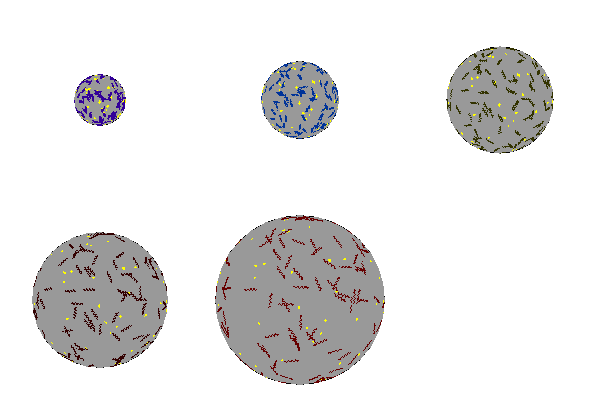
1. Olbers' paradox. The night sky should not be dark but very bright! Every single direction you look you should see a star since a.) given an infinite number of stars there should be one there and b.) even if light has a finite speed, given "forever" the starlight should have arrived here by now. The top picture describes what you should see. As time progresses, more and more starlight from an infinite number of stars should shine on the earth producing a blazing night sky to gaze at, not a dark one.

Another way to think about this is mathematical: Set up an infinite sky with infinitely many stars shining brightly forever and ask how many photons should be at any given point. The answer is every point in the universe should eventually be flooded with photons from every direction so that there isn't a dark spot anywhere.

The Big Bang made us give up the idea that the number of stars is infinite and that the universe, in the form it is today, has been around forever solving Olbers' paradox.

2.) Universe Is Not In Thermodynamic Equilibrium: Take a pan of cold water and throw a hot object inside and what will happen? Given enough time, the pan of water and the object will become the same temperature. This is called thermodynamic equilibrium.

If the universe has existed forever it should be in thermodynamic equilibrium by now. Infinitely many stars producing heat for an infinite amount of time would heat up the whole universe to be the same temperature as themselves. However, the majority of the universe is cold, not hot like the stars.

Take away the infinite time, as the Big Bang does, and the thermodynamic equilibrium problem goes away.

3. Stars are no more than 12-13 billion years old. We have ways of measuring how old stars are. (Will blog on this later.) Surprisingly, we can't find any stars older that 12-13 billion years old. Maybe you say stars like creatures die and give rise to new stars. Okay, where are the infinity many dead stars, and why are all the "dead stars" we know about still no older than 12-13 billion years old?

It turns out the Big Bang should have happened ~13.7 billion years ago and it would take ~1 billion years for most types of stars to form after such an event. Thus the Big Bang resolves this problem with physics too.

Now, I don't believe I touched on every problem solved by the Big Bang. (Minus the predictions.) I'm sure others will know more problems so please share them in the comments.

If there are any questions about this please ask.

Tuesday, August 11, 2009

What Is The Big Bang?

Dear science community,

Now that I have had a very kind introduction, I think it's time to answer the first question: What is the Big Bang? Given that early universe physics and the accompanying high energy physics is my level of expertise, I will be answering many questions relating to the Big Bang. (This will take several weeks and you will all be experts.) If anyone has any questions at all just ask, and I will write a specific blog post for your question. (Unless it is inappropriate.) We will then move on to other science.

The Big Bang was proposed by Catholic Priest named Georges Lemaître who discovered it as a solution to Einstein's Equations of General Relativity. (I will blog about many details of this later so stay tuned.) He discovered, with some very reasonable assumptions, that General Relativity predicted the universe had a finite age and began in a very hot and dense state before expanding into the majestic structure we see today.

Like all good scientific theories, the early Big Bang model cleared up many known inconsistencies in physics and at the same time made some distinct predictions that scientists had never before considered. (Again, I will blog more about each inconsistency and prediction later.) The three main "new" predictions the original big bang models made were:
  1. The universe was expanding.
  2. The percentages of the various elements in the universe had to be very strict ratios. (Ie. how much hydrogen versus helium versus Lithium, versus etc... had to be exact.)
  3. That there should be some relic photons or light left over from the early universe with microwave size wavelengths and an average temperature of ~3 degrees Kelvin. This is called the Cosmic Microwave Background Radiation or CMB.
Needless to say, all three of these predictions were discovered within the first few decades of Big Bang research. In modern times we get all sorts of other phenomena that is surprisingly explained by the Big Bang and it's more modern additions like inflation.

Now, do not let anybody confuse you. The physical effects predicted by the Big Bang are real and the Big Bang is the only known physical theory that predicts these phenomena. Moreover, the Big Bang is consistent with every experiment we throw at it, something very few theories live to boast about. The Big Bang is on very solid ground scientifically.

It should also be said that the Big Bang was met with much skepticism by early scientists. In fact, the name "Big Bang" was coined by Fred Hoyle, who opposed the theory, to scare and or shock people. Nevertheless, because of the above reasons, the Big Bang seems here to stay as a pillar of modern physics.

Joseph Smidt

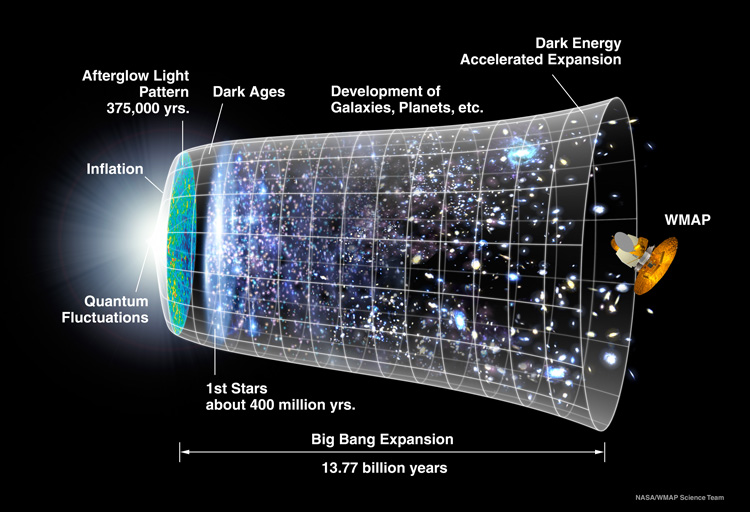
PS: Click on picture to see a timeline.

Friday, March 6, 2009

The Higgs and Inflaton: Two Peas in a Pod

The Higgs Boson is an scalar particle that single handedly makes the whole standard model of particle physics make sense. One problem: nobody has detected that it actually exists.

The Inflaton is an scalar particle that single handedly makes the whole standard model of Cosmology/Big Bang make sense. One problem: nobody has detected that it actually exists.

Isn't it amazing that a fundamental ingredient of two of the most experimentally successfully theories is a scalar particle which has never been detected? It is as if scalar particles have a Dr. Jekyll Mr. Hyde personality: The want to solve all our problems while at the same time cause everyone endless grief/time/money by escaping our detection!!!

They truly are two peas in a pod. :)

Saturday, February 28, 2009

CP Violation May Explain Why No Antimatter

CP symmetry says that every interaction in particle physics must obey charge conjugation and parity. (If you don’t understand the above statement don’t worry, you just need to know such a symmetry exists.)

Though CP symmetry was thought to be an exact symmetry, it turns out it is violated by weak interactions. If CP was an exact symmetry, there should be just as much antimatter produced by the big bang as matter. However, as we look around us we should be easily convinced this isn’t the case. :)

However, since CP is violated, there should have been slightly more matter produced than antimatter. Soon after the big bang every antimatter particle then annihilated itself with a matter particle leaving only the excess of matter which is seen today. This is probably why there is no antimatter.

Sunday, March 30, 2008

Report: Brian Greene @ BYU


Brian Greene coming to BYU for the forum address was exciting for me in a few ways. First off Brian Greene came to BYU and secondly, I got to give the forum invocation and spend some extra time with Dr. Greene. It was a lot of fun to sit on the stand and feel 'all official' and then the fancy catered lunch afterwards was for 14 or so people in the Hinckley building. Anyway, I am sure that you're all not as interested in that stuff as I am, so I will move onto the meat of Dr. Greene's visit: string theory.
The address itself was very exciting; from Dr. Greene's initial wandering around the podium and his intensity to his great explanations of how the concepts of space and time have changed throughout the years. There were also two Q&A sessions: one right after the forum and then another for physics students later. I attended both and I will list, in bullet form, some points that he made.
  • There is no stringy big bang model yet
  • He does not 'believe in string theory' and will not until experimentally verified. It was nice to hear him say that
  • Earth stays in orbit due warping in 'time.' I am not sure what he meant by that exactly
  • Dark matter might be 'regular' matter hidden in extra dimensions
  • Quantum foam is 'smoothed' out due to the minimum length scale introduced by strings. It does so because it prevents you from probing scales smaller than the string length. Also, this minimum length scale is what allows string theory to couple GR with quantum and it does not break Lorentz invariance
  • As of now, there are no definite energies we need to probe at the LHC, but it could be soon when we get those numbers
  • There are no practical application for string theory yet, but that's what they first thought when QM was first discovered
  • String theory might come close to an eternal truth
  • String theory unifies forces since all the force mediating particles come from the same strings
  • Each of the 5 string theories is a different perturbative expansion
So that's a little of what Dr. Greene discussed. It really was a wonderful forum; he's a great speaker and is very enthusiastic about strings. You might be curious what he said when asked about rumors that string theorists are leaving string theory by the droves or what he thought about the last few books that claim string theory is wrong. He did address those issues and said that people are not abandoning string theory and that those books basically say the same that all string theorists say: that string theory has not yet been experimentally verified. Here is a link to the BYU NewsNet (not quite accurate) article reporting on the forum address.

Monday, July 2, 2007

The Loop Quantum Big Bounce

Theoretical physicist Martin Bojowald of Pennsylvania State University in University Park has a cosmology model, based on Loop Quantum Gravity, that claims to to be able to peer back before the big bang. What does his analysis find? It finds that our universe formed from another universe that collapsed down to a point then bounced back. This previous universe may have been physically different then ours in various ways, but after the bounce it became the universe we know and love. Also, he predicts the relics of the previous universe are probably too faint to be detected.

Not everyone is satisfied with the result. I for one a skeptical of loop quantum gravity since I don't understand it (yet) and the vast majority of theorists think other methods are better. Personally I really like the String Landscape model, which is being covered extensively at TASI 2007. (The theme is "The String Universe") Plus, the blog is named after the idea that the universe is formed from some sort of eternal inflation process so the bias has to come out.

Others like Caltech Cosmologist Sean Carroll have already blogged against it. A quote from him: "Someday we’ll understand how the Big Bang singularity is resolved in quantum gravity. But the real world is going to be more complicated (and more interesting) than these simple models."

Or as the Scientific American states:
Physicist Donald Marolf of the University of California, Santa Barbara, says the finding would be strengthened if it turned up in other models of quantum gravity, such as string theory. "No one has good control over this physics in any approach to quantum gravity," he says, "and it is important to explore a broad range of models and ideas."
Here is an article by New Scientist.

Hopefully in the future we will be able to test such theories.

Monday, May 28, 2007

No Evidence Of Big Band In 100 Billion Years?

This from the Scientific American:

Cosmologists have put themselves in the shoes of their future counterparts by pondering the consequences of dark energy, an enigmatic force discovered in 1998 that seems to be pulling galaxies apart at a steadily increasing clip. Eventually, this accelerating expansion of space will yank galaxies away from each other faster than light can travel between them, leaving our galaxy and its immediate neighbors isolated in a vast darkness.

In the process, all current evidence for the big bang would either vanish or become so diluted as to be imperceptible, says cosmologist Lawrence Krauss of Case Western Reserve University, who has studied the idea with Vanderbilt University physicist Robert Scherrer. "It will lead them to the wrong conclusion about what the universe is doing. The universe will look static, and that's vastly wrong, because the universe is expanding so fast they can't see it."

Take the expansion itself, first identified by Edwin Hubble in 1929 from the red tinge of distant supernovae. As space puffs up like a balloon, it stretches the wavelength of light from the bluer side of the spectrum toward the red. Krauss says that in 100 billion years or so the light from receding galaxies will have been stretched like taffy to a wavelength longer than our galaxy (100,000 light-years) and, therefore, be impossible for telescopes to detect.

The cosmic microwave background radiation, a residue of matter's first flash of light following the big bang, will suffer a similar fate. As its wavelength expands, Krauss says, the radiation will start to be soaked up by interstellar dust, potentially becoming indistinguishable from other light sources...

Friday, November 24, 2006

Introduction


My name is Joseph Smidt and this is my first blogging experience. I have named the blog "The Eternal Universe" since I am on the road to becoming a cosmologist and my favorite model for the universe is the Eternal Inflation Model. Decades of ever increasing experimental evidence concur that the observable universe as we know it sprang from an incredibly small, hot and dense region of space. In fact, there is substantial experimental evidence that, about 13.7 billion years ago, the entire observable universe was smaller than a baseball and inflated into what we see today. According to classical general relativity, the results we see lead inevitably to the conclusion that the universe sprang from an initial singularity. We call this the "Big Bang."

If however classical general relativity is extended to a quantum theory of gravity, then it is possible that the universe inflated from a very small quantum patch, not a singularity. Where did this quantum patch come from? The Eternal Inflation Model predicts it resided in another universe from which this universe emerged. It turns out, if you do the quantum math, that if you allow the universe enough time to exist, a small patch of the quantum fields that exist throughout the universe will eventually inflate and create a new universe. After the quantum fields inflate to sufficient sizes, they actually have the ability to gravitationally collapse and form galaxies, stars and planets which allow life to form and exist. It truly is a wondrous thing and the cycle continues in one big eternal round.

I really think I will find blogging a pleasurable experience. I will admit however that I know it can be a little dangerous. It seems when people share their opinions publicly, they are setting themselves up to offend someone or something. Hopefully I will be able to avoid such calamities.

Again, I wanted to start a blog because I think it will be fun. I will enjoy posting things and hope to build some good friendships with people around the web. May we all remember that we live in this great eternal universe together, so lets make the most out of it. May everyone have a great Thanksgiving weekend.

-- Joseph Smidt


Picture on Top: Our Universe. Yes all the dots are galaxies, our universe is that big, and even bigger. :)

Picture on Bottom: image of atoms taken by IBM.

The inflated quantum fields not only gave rise to the the vast cosmos that we see in telescopes, they also form the atoms are bodies are composed of!