Two things. First, back to problems with supersymmetry. Tommaso Dorigo has posted this very helpful plot that explains what is meant by "The LHC sees no signs of SUSY". If you squint closely, on top of all the colors you will see a small red line. That red line represents the prediction for what the LHC should see in the data if only the standard model particles existed at the energies being probed. The dotted black line is the prediction if supersymmetry is real at the energies being probed. The black dots with error bars are what was measured.
As you can see, there is thus far no reason to believe anything but the standard model is happening at these energies from this search optimized for the detection of supersymmetry. It's still pre-mature as only a small portion of the total data is in. Still, if I was hoping for SUSY I would be a little worried at this point that nothing is leaving a hint anywhere in any bin whatsoever!
Question I have For Particle Experimentalists: (And here is the reason I said that last sentence.) My experience with cosmology data is, as more data comes in, the confidence regions change a little but not by several sigma in every bin! Take WMAP for example. Has the confidence intervals for the 7 year data changed in every bin by several sigma from the first year data? No way! Changes are made, but the entire power spectrum has not shifted in every bin by several sigma.
Why would I expect particle data to be any different? Can anyone help me out here? I mean, if WMAP came back with every bin being inconsistent with a Lambda-CDM universe would 6 more years of data have changed that!
Now, what it may be is that you only need a detection in one bin, not all bins. Fine, but again, from my cosmology experience, the error bars will shrink and midpoint change a little over time, but very seldomly have I ever seen the midpoint to change so much that what is initially excluded by a sigma or two is now verified at a 5 sigma level!
So any help here by those who know more is appreciated.
Now to MOND. By now many of you have read Sean Carroll's post debunking MOND. (A theory that attempts to replace dark matter). Let's just say MOND doesn't work. So in commemoration I wanted to post the image above reminding ourselves why some gave MOND a chance at all while at the same time reminding ourselves why nobody pays attention to it any more.
For mor information read Sean's post.
Pages
Showing posts with label dark matter. Show all posts
Thursday, March 3, 2011
More Problems With SUSY... and MOND Humor.
| Tweet |
|
|
Labels:
cosmology,
dark matter,
particle physics,
supersymmetry
Friday, January 28, 2011
Dark Matter Reconstruction From Radio Experiments.
As photons move through the universe they get gravitationally lensed as the pass by large clumps of matter. (As shown in the image above.) Dark matter, being the dominant form of matter, lenses these photons more than anything. Therefore, by studying the lensing properties of incoming photons, in principle we can reconstruct what the profiles of the dark matter doing that lensing.
Now, put (hopefully) more simply: we can't directly see dark matter. But taking the statistical lensing properties of the incoming photons we can hopefully reconstruct what the dark matter looks like. In this way we can "see" the clumps of dark matter in the universe directly.
Recently, Brown and Battye have proposed a new method for reconstructing the projected dark matter distribution using radio surveys like SKA and e-MERLIN. They then test their method on simulated data as discussed below.
The plot above shows a mock initial dark matter distribution from which they make simulations of the kind of data e-MERLIN would see coming from such a distribution of dark matter. If their method works, this is the distribution they will reconstruct.
This next plot above shows how well they are able to reconstruct the input dark matter distribution. As can be seen, the main features, especially the two dominant clusters, can be resolved fairly well. (Especially given the input data is smoothed by the beam of the instrument and so this at some level is approaching as good as things get for a single experiment.)
Punchline: So, using this lensing reconstruction technique for be can begin to "see" what the underlying dark matter clumps look like.
I for one am excited about where lensing is headed. Utilizing a variety of lensing techniques, including the method for radio sources done here, we may one day reconstruct the dark matter throughout the universe with great precision, especially when we combine the data from many experiments at many wavelengths. Again, in this way we can visually "see" the dark matter that comprises our universe.
Michael L. Brown, & Richard A. Battye (2011). Mapping the dark matter with polarized radio surveys E-Print arXiv: 1101.5157v1
Friday, June 25, 2010
A Great History Of The Evidence For Dark Matter.
In the paper Dark Matter: A Primer Garrett and Dudagives give a nice historical background to the accumulating evidence for dark matter. Lets go through the history they lay out.
1. J. H. Oort: Astronomers have come to tust what is known as the mass to light ratio, M/L, that does a good job telling you what the mass of luminous matter should be based off of the luminosity of that matter. This relation is normalized such that for the sun, M/L = 1. In the 1930, Oort found that the stars moving on the galactic plane were moving faster than the galaxy's escape velocity! He knew what the mass of the visible matter should be from M/L and discovered stars in the galatic plane are moving too fast to be bound by that much mass. He postulated more mass must be present in the galaxy than can be attributed to the visible matter.
2. F. Zwicky: Zwicky studied the Coma Cluster and found that the stars had much more kinetic energy than they should from the viral theorem, KE= - 1/2 PE, assuming that the cluster had te amount of mass predicted by M/L. He then worked out how much mass this cluster must be to have that high of a kinetic energy and found the mass should be about 10 times more mass than the visible matter. (Again, from M/L measurements.)
3. Vera Rubin: Vera Rubin studied the rotation curves for 60 galaxies. These curves should obey the well known relation v(r) = sqrt(G m(r)/r) where v is the velocity, r is the radius, m is the mass and G is the gravitational constant. Instead, she found that the velocity was not consitant with the amount of mass seen in visable matter. Instead, new unseen matter is needed to explain the rotation curves. (See plot above.)
4. D. Walsh et al: in 1979, D. Walsh et al. were among the first to detect gravitational lensing. They watched how the light was bent by certain distant galaxies. The problem was that the galaxies had to have more mass to bend the light as profoundly as it did than come from the M/L relation. Dark matter could explain this discrepancy.
5. Microlensing: Several MACHOS studies went into effect and all came to the same conclusion: the missing matter could not be attributed to brown dwarfs, neutron stars, black holes, planets or other "dark" objects made of matter that we are familiar with. This extra mass had to be coming from some exotic type matter thus far unknown.
6. BBN: Big Bang Nucleosynthesis is one of the great achievements of modern cosmology. It turns out, the Deuterium to Hydrogen ratio (D/H) is heavily influenced by the overall density of baryons in the universe. Using D/H, one finds that the amount of baryons in the universe is much smaller than the total baryonic matter. The rest must be coming from some extra dark matter.
7. The CMB: The power spectrum taken from the Cosmic Microwave background is highly sensitive to the amount of baryonic matter in the universe. See the plot above. As the amount of baryons, \Omega_b, changes, so does the power spectrum... by a lot! The red error bars show the measured value. As can be seen, baryonic matter only makes up 4.6% of the universe. From the same power spectrum on finds that the total matter in the universe is more like 25% of the universe indicating that the vast majority of the matter is matter we don't understand.
8: N-Body Simulations and SDSS: Numerical simulations of large structure formation have been performed. Only those that include dark matter give results that match what we observe from large structure surveys such as the Sloan Digital Sky Survey.
9. The Bullet Cluster: "Smoking gun" evidence for dark matter, as some would say, came from a recent experiment involving the Bullet Cluster. The Bullet Cluster recently collided with a larger galaxy. In such a collision, dark matter should just pass through without interacting and the visible matter heated up giving a tremendous amount of X-Ray emissions. It was clear that the matter causing the majority of the lensing was not centered in the same spots as the luminous matter. This showed convincingly that the amount of baryonic matter in galaxies is not as large as the amount of dark matter. Furthermore, in 2007 another team confirmed a ring-like structure of dark matter was found after the collision of two massive galaxies.
10. Penny et al: In 2009, Penny et al. found that a significant amount of dark matter would be needed to hold certain galaxies together that were experiencing a significant amount of tidal forces. These galaxies were surprisingly stable given how little luminous mass they had.
As you can tell. This is a great article and I recommend everyone read it.
All images taken from the article cited.
Katherine Garrett, & Gintaras Duda (2010). Dark Matter: A Primer Eprint arXiv: 1006.2483v1
1. J. H. Oort: Astronomers have come to tust what is known as the mass to light ratio, M/L, that does a good job telling you what the mass of luminous matter should be based off of the luminosity of that matter. This relation is normalized such that for the sun, M/L = 1. In the 1930, Oort found that the stars moving on the galactic plane were moving faster than the galaxy's escape velocity! He knew what the mass of the visible matter should be from M/L and discovered stars in the galatic plane are moving too fast to be bound by that much mass. He postulated more mass must be present in the galaxy than can be attributed to the visible matter.
2. F. Zwicky: Zwicky studied the Coma Cluster and found that the stars had much more kinetic energy than they should from the viral theorem, KE
3. Vera Rubin: Vera Rubin studied the rotation curves for 60 galaxies. These curves should obey the well known relation v(r) = sqrt(G m(r)/r) where v is the velocity, r is the radius, m is the mass and G is the gravitational constant. Instead, she found that the velocity was not consitant with the amount of mass seen in visable matter. Instead, new unseen matter is needed to explain the rotation curves. (See plot above.)
4. D. Walsh et al: in 1979, D. Walsh et al. were among the first to detect gravitational lensing. They watched how the light was bent by certain distant galaxies. The problem was that the galaxies had to have more mass to bend the light as profoundly as it did than come from the M/L relation. Dark matter could explain this discrepancy.
5. Microlensing: Several MACHOS studies went into effect and all came to the same conclusion: the missing matter could not be attributed to brown dwarfs, neutron stars, black holes, planets or other "dark" objects made of matter that we are familiar with. This extra mass had to be coming from some exotic type matter thus far unknown.
6. BBN: Big Bang Nucleosynthesis is one of the great achievements of modern cosmology. It turns out, the Deuterium to Hydrogen ratio (D/H) is heavily influenced by the overall density of baryons in the universe. Using D/H, one finds that the amount of baryons in the universe is much smaller than the total baryonic matter. The rest must be coming from some extra dark matter.
7. The CMB: The power spectrum taken from the Cosmic Microwave background is highly sensitive to the amount of baryonic matter in the universe. See the plot above. As the amount of baryons, \Omega_b, changes, so does the power spectrum... by a lot! The red error bars show the measured value. As can be seen, baryonic matter only makes up 4.6% of the universe. From the same power spectrum on finds that the total matter in the universe is more like 25% of the universe indicating that the vast majority of the matter is matter we don't understand.
8: N-Body Simulations and SDSS: Numerical simulations of large structure formation have been performed. Only those that include dark matter give results that match what we observe from large structure surveys such as the Sloan Digital Sky Survey.
9. The Bullet Cluster: "Smoking gun" evidence for dark matter, as some would say, came from a recent experiment involving the Bullet Cluster. The Bullet Cluster recently collided with a larger galaxy. In such a collision, dark matter should just pass through without interacting and the visible matter heated up giving a tremendous amount of X-Ray emissions. It was clear that the matter causing the majority of the lensing was not centered in the same spots as the luminous matter. This showed convincingly that the amount of baryonic matter in galaxies is not as large as the amount of dark matter. Furthermore, in 2007 another team confirmed a ring-like structure of dark matter was found after the collision of two massive galaxies.
10. Penny et al: In 2009, Penny et al. found that a significant amount of dark matter would be needed to hold certain galaxies together that were experiencing a significant amount of tidal forces. These galaxies were surprisingly stable given how little luminous mass they had.
As you can tell. This is a great article and I recommend everyone read it.
All images taken from the article cited.
Katherine Garrett, & Gintaras Duda (2010). Dark Matter: A Primer Eprint arXiv: 1006.2483v1
| Tweet |
|
|
Labels:
cosmology,
dark matter,
particle physics,
physics,
theoretical physics
Saturday, December 19, 2009
Primer On WIMP Dark Matter.
First, let's state that dark matter could be all sorts of things, but there is a lot of motivation to believe they are weakly interacting massive particles. (WIMPS) It turns out our own Jonathan Feng at UC Irvine is considered one of the world's greatest experts on WIMPS and has some accessible review articles on dark matter collider physics here and here. (The first especially should be assessable all physicists. I took images from them.)
I Think Therefore I Am

The fact that a particle exists should tell you it must somehow interact with other particles. All particles are created and destroyed in interactions with other particles. It turns out, using arguments from cosmology taking the expansion on the universe into account, how abundant a particle is is directly related to it's typical cross section, or likelihood that it interacts with other particles. (See equation above.)
The graph on the right demonstrates this. The higher the cross-section, the lower its abundance in the universe. If it interacts too much, it won't be abundant enough. It it interacts too little, it will be too abundant enough.
However, if a non-relativistic particle interacts with typical weak scale cross sections, its relative abundance to rest of the matter is just right to be dark matter. This is called the "WIMP Miracle".
How Can We Detect it?
We know the the particle has to be non-relativistic because dark matter must be cold. The typical non-relativistic weak scale cross section is given in the equation above. Alpha is the hyperfine structure constant, m is the mass and k is a parameterizing allowed small deviations from from the weak scale to still work. The graph on the right shows masses that work.
In some sense that's it! If we can find any non-relativistic particle dominated by weak interactions with the right mass, 100 GeV - 1TeV, supersymmetric or not, we can feel fairly confident we have discovered dark matter.
At this point you may ask: "Wait, we know of particles whose dominate interaction is at the weak scale, like say neutrinos. Why aren't they the dark matter?". Well, the relativistic nature of these particles changes enough so that they don't work anymore. (For example they have a different cross section.)
But How Do We Know If It Is Supersymmetric?
(I think) Most non-collider surveys will have a hard time answering this question. They can answer the more important question: "Is this a non-relativistic particle dominated by weak interactions with a mass on the order of 100 GeV -1TeV?". If yes, we have our dark matter.
Every different dark matter candidate, such as the supersymmetric ones, have specific ways they interact with other particles. These ways are described by Feynman Diagrams. The plot to the right shows the interactions specifically for the neutralino. Colliders can test these diagrams better than anything else.
So here is the oversimplified formula:
I Think Therefore I Am

The fact that a particle exists should tell you it must somehow interact with other particles. All particles are created and destroyed in interactions with other particles. It turns out, using arguments from cosmology taking the expansion on the universe into account, how abundant a particle is is directly related to it's typical cross section, or likelihood that it interacts with other particles. (See equation above.)
The graph on the right demonstrates this. The higher the cross-section, the lower its abundance in the universe. If it interacts too much, it won't be abundant enough. It it interacts too little, it will be too abundant enough.
However, if a non-relativistic particle interacts with typical weak scale cross sections, its relative abundance to rest of the matter is just right to be dark matter. This is called the "WIMP Miracle".
How Can We Detect it?
We know the the particle has to be non-relativistic because dark matter must be cold. The typical non-relativistic weak scale cross section is given in the equation above. Alpha is the hyperfine structure constant, m is the mass and k is a parameterizing allowed small deviations from from the weak scale to still work. The graph on the right shows masses that work.
In some sense that's it! If we can find any non-relativistic particle dominated by weak interactions with the right mass, 100 GeV - 1TeV, supersymmetric or not, we can feel fairly confident we have discovered dark matter.
At this point you may ask: "Wait, we know of particles whose dominate interaction is at the weak scale, like say neutrinos. Why aren't they the dark matter?". Well, the relativistic nature of these particles changes enough so that they don't work anymore. (For example they have a different cross section.)
But How Do We Know If It Is Supersymmetric?
(I think) Most non-collider surveys will have a hard time answering this question. They can answer the more important question: "Is this a non-relativistic particle dominated by weak interactions with a mass on the order of 100 GeV -1TeV?". If yes, we have our dark matter.
Every different dark matter candidate, such as the supersymmetric ones, have specific ways they interact with other particles. These ways are described by Feynman Diagrams. The plot to the right shows the interactions specifically for the neutralino. Colliders can test these diagrams better than anything else.
So here is the oversimplified formula:
- Find a particle dominated by weak interactions. (Like a neutrino except non-relativistic.)
- Ensure the mass is on the order 100 GeV -1TeV. (You've discovered dark matter!!!)
- Run an experiment at the LHC for a particle of just that mass interacting mostly through weak interactions.
- Compare the findings with the proposed models of such particles.
- If one lines up perfectly you know what particle you are dealing with. (Ie... some like a supersymmetric neutralino)
Smarter people than me may be able to pinpoint the exact particle without a collider, but as far as I know it may take the LHC to do this. It's initial discovery however should be able to be accomplished without the LHC however.
| Tweet |
|
|
Labels:
Answers,
CERN,
cosmology,
dark matter,
Particle Accelerator
Friday, December 18, 2009
Latest Dark-Matter Parameters from CDMS
I posted previously on the possible detection of dark matter in the Soudan mine in northern Minnesota. Here's a slightly more technical version of their results. Before I get too far into this, let me say that I am not a particle physicist, so I know just enough about these things to be dangerous. Perhaps Joe can correct anything I get wrong.
There are two big issues with dark matter - what is it and why is it dark. If dark matter is made of WIMPs (and there is very good evidence that it is), the question becomes what are these particles. We know they don't have electric charge like protons or electrons. We know they don't bind together like the nuclei of atoms. The one thing that we know for sure is that they have mass, but how much mass per particle is unknown. If we know how much mass an individual WIMP has, we can use theoretical tools to tell us what it is.
The other big issue with dark matter is why is it dark, or in other words why doesn't it interact with normal matter the way we're used to. As I mentioned, we know that dark matter doesn't interact via electromagnetism or the strong nuclear force and that it does interact through gravity. The only fundamental force we're not sure about is the weak nuclear force. So the question then becomes if dark matter does interact with normal matter via the weak nuclear force, how much does it interact? That is quantified as the interaction cross-section.
That leads us to the big result from the CDMS preprint:

This plot shows two things. The filled areas are theoretical predictions based on a popular dark matter candidate, supersymmetric particles. If that theory is right, the dark matter particles should be found in those shaded areas. The lines show the area above which various experiments would have found the WIMPs if they were there. That means that the only places the WIMPs can be hiding is below those lines. Essentially, all this hubbub is about those little bumps in the CDMS upper limits on the interaction cross sections at about 40 and 70 GeV/c^2. Hopefully as detectors improve and they have more time to take data, those bumps will turn into filled regions where dark matter has actually been detected.
There are two big issues with dark matter - what is it and why is it dark. If dark matter is made of WIMPs (and there is very good evidence that it is), the question becomes what are these particles. We know they don't have electric charge like protons or electrons. We know they don't bind together like the nuclei of atoms. The one thing that we know for sure is that they have mass, but how much mass per particle is unknown. If we know how much mass an individual WIMP has, we can use theoretical tools to tell us what it is.
The other big issue with dark matter is why is it dark, or in other words why doesn't it interact with normal matter the way we're used to. As I mentioned, we know that dark matter doesn't interact via electromagnetism or the strong nuclear force and that it does interact through gravity. The only fundamental force we're not sure about is the weak nuclear force. So the question then becomes if dark matter does interact with normal matter via the weak nuclear force, how much does it interact? That is quantified as the interaction cross-section.
That leads us to the big result from the CDMS preprint:

This plot shows two things. The filled areas are theoretical predictions based on a popular dark matter candidate, supersymmetric particles. If that theory is right, the dark matter particles should be found in those shaded areas. The lines show the area above which various experiments would have found the WIMPs if they were there. That means that the only places the WIMPs can be hiding is below those lines. Essentially, all this hubbub is about those little bumps in the CDMS upper limits on the interaction cross sections at about 40 and 70 GeV/c^2. Hopefully as detectors improve and they have more time to take data, those bumps will turn into filled regions where dark matter has actually been detected.
75% Chance of Laboratory Detection of Dark Matter Reported
From a press release by the Cyrogenic Dark Matter Search (CDMS) collaboration:
Now clearly a 75% chance of having detected weakly-interacting massive particles (WIMPs) is different from a detection, which would have taken 5 particles according to the CDMS press release, but it's still pretty darn good. Perhaps the most useful result is that the claim to have placed much stronger upper limits on the interaction rates of possible WIMP candidates. The press release is not a journal paper or even a pre-print so it's pretty short on hard data, but overall this seems to be an important day for 23% of the mass of the universe.
[Update]: There is a pre-print on arXiv.org with some of the technical details. Check back here later for a slightly more technical summary.
"In [the 2007-2008] data set there are indeed 2 events seen with characteristics consistent with those expected from WIMPs... We estimate that there is about a one in four chance to have seen two backgrounds events..."Here's a link to a news story on this release from the Daily Mail (UK).
Now clearly a 75% chance of having detected weakly-interacting massive particles (WIMPs) is different from a detection, which would have taken 5 particles according to the CDMS press release, but it's still pretty darn good. Perhaps the most useful result is that the claim to have placed much stronger upper limits on the interaction rates of possible WIMP candidates. The press release is not a journal paper or even a pre-print so it's pretty short on hard data, but overall this seems to be an important day for 23% of the mass of the universe.
[Update]: There is a pre-print on arXiv.org with some of the technical details. Check back here later for a slightly more technical summary.
Tuesday, October 6, 2009
Be Prepared For Posts On Dark Matter.
I am not finished with all evidence for the Big Bang but I decided to start another series on dark matter. I will still finish the Big Bang stuff but, to be honest, as a blogger you have to write about the things most on your mind at the moment otherwise your posts begin to reek. (Sorry if they already do.)
First I want to talk about what the evidence is for dark matter. Specifically I want to discuss:
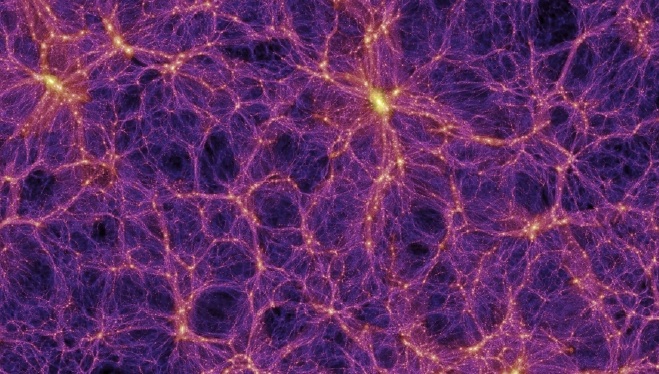
Though we don't know exactly what dark matter is, we know it is some type of matter that is effectively collisionless and doesn't have a lot of kinetic energy (It moves slowly). Through numerical simulations we know if we could see it, on really large scales, we would see this:
What is amazing about this picture is this is exactly the cob-web pattern we see galaxies forming into in the real universe. This is evidence that the dark matter, more than anything else, governs how large scale structure such as clusters and galaxies form.
Anyways, I have skipped over all the details but just know future posts will make up for it. Dark matter is cool, and if nothing else you will see interesting pictures/plots and have any questions you are will to ask answered. (So please ask.)
Therefore, please start leaving questions so I know what needs to be covered specifically.
First I want to talk about what the evidence is for dark matter. Specifically I want to discuss:
- Galactic rotation curves.
- Clusters and lensing.
- The power spectrum of the Cosmic Microwave Background.
- The formation of large scale structure.
- The famous Bullet Cluster collision.
- Neutrinos
- The lightest supersymmetric particles (LSP).
- Axions
- Machos
- Wimps in general
Though we don't know exactly what dark matter is, we know it is some type of matter that is effectively collisionless and doesn't have a lot of kinetic energy (It moves slowly). Through numerical simulations we know if we could see it, on really large scales, we would see this:
What is amazing about this picture is this is exactly the cob-web pattern we see galaxies forming into in the real universe. This is evidence that the dark matter, more than anything else, governs how large scale structure such as clusters and galaxies form.
Anyways, I have skipped over all the details but just know future posts will make up for it. Dark matter is cool, and if nothing else you will see interesting pictures/plots and have any questions you are will to ask answered. (So please ask.)
Therefore, please start leaving questions so I know what needs to be covered specifically.
Sunday, June 8, 2008
A Rather Boring Title (with VERY Interesting Implications)
I saw this a couple of weeks ago, actually the day after it hit the major news services, but I haven't gotten around to commenting on it.
There has been a paper published recently in Astrophysical Journal Letters under the unassuming title of THE ENERGY OUTPUT OF THE UNIVERSE FROM 0.1 μM TO 1000 μM (preprint here). This may seem like an unamazing title to a paper but it has the potential to make a rather large splash in the astrophysics community. Here's why: it gives a correction to the mass to light ratio (MLR) of galaxies (in the paper they call it the galaxy luminosity function). The MLR is a measure of how much mass you expect there to be in a galaxy based on how bright it is.
So the interesting part is that this changes all of the standard (textbook and literature) estimates of the mass of galaxies. What this does is it affects the estimates of dark matter inside (and around) of a galaxy. But the ramifications do not stop there. By changing the accepted MLR of galaxies this also affects the estimates of how much mass is in a galaxy cluster. This goes all the way back to Fritz Zwicky and his "discovery" of dark matter in the coma cluster of galaxies. So this effectively changes all our estimates of how much "normal" matter there is in the universe.
So here is the basic argument (here are also some simple news articles about it that give a general overview: space.com, NYTimes): Galaxies emit light, all types. We see it. Interstellar dust emits infrared radiation. The power output of the interstellar dust is more than the power absorbed by the light coming from the nearby galaxy. So the galaxy must be emitting more light than we think it is. If we correct for dust and increase our estimate of the MLR then there are more stars producing more light. The galaxy is brighter than we think and suddenly the amount power absorbed from the light of the galaxy equals the unaccounted for infrared radiation!
The articles that I gave links to above give a good overview of what lead them to this conclusion, and it is quite interesting. They did a statistical analysis of the galaxies in the sky and saw that there were more face on galaxies than edge on galaxies. This raised some questions because if you have a random distribution of galaxies then you shouldn't see this.
I will not go into depth about their argument, but I will emphasize that this changes all of our estimates of mass in galaxies and the amount of dark matter in the universe, and by extension the amount of dark energy. There will be a lot of things that will have to be recalculated. I can't wait to see how this will affect things, and I want to be part of it. Their work seems very good and will not be easy to refute. I just wanted you guys to be aware of this because you will most likely hear something about this in the future.
There has been a paper published recently in Astrophysical Journal Letters under the unassuming title of THE ENERGY OUTPUT OF THE UNIVERSE FROM 0.1 μM TO 1000 μM (preprint here). This may seem like an unamazing title to a paper but it has the potential to make a rather large splash in the astrophysics community. Here's why: it gives a correction to the mass to light ratio (MLR) of galaxies (in the paper they call it the galaxy luminosity function). The MLR is a measure of how much mass you expect there to be in a galaxy based on how bright it is.
So the interesting part is that this changes all of the standard (textbook and literature) estimates of the mass of galaxies. What this does is it affects the estimates of dark matter inside (and around) of a galaxy. But the ramifications do not stop there. By changing the accepted MLR of galaxies this also affects the estimates of how much mass is in a galaxy cluster. This goes all the way back to Fritz Zwicky and his "discovery" of dark matter in the coma cluster of galaxies. So this effectively changes all our estimates of how much "normal" matter there is in the universe.
So here is the basic argument (here are also some simple news articles about it that give a general overview: space.com, NYTimes): Galaxies emit light, all types. We see it. Interstellar dust emits infrared radiation. The power output of the interstellar dust is more than the power absorbed by the light coming from the nearby galaxy. So the galaxy must be emitting more light than we think it is. If we correct for dust and increase our estimate of the MLR then there are more stars producing more light. The galaxy is brighter than we think and suddenly the amount power absorbed from the light of the galaxy equals the unaccounted for infrared radiation!
The articles that I gave links to above give a good overview of what lead them to this conclusion, and it is quite interesting. They did a statistical analysis of the galaxies in the sky and saw that there were more face on galaxies than edge on galaxies. This raised some questions because if you have a random distribution of galaxies then you shouldn't see this.
I will not go into depth about their argument, but I will emphasize that this changes all of our estimates of mass in galaxies and the amount of dark matter in the universe, and by extension the amount of dark energy. There will be a lot of things that will have to be recalculated. I can't wait to see how this will affect things, and I want to be part of it. Their work seems very good and will not be easy to refute. I just wanted you guys to be aware of this because you will most likely hear something about this in the future.
Thursday, March 6, 2008
Why Study Supersymmetry? Part 2: Dark Matter
The existence of dark matter is now well established. Though there are different ideas about what dark matter is, the only idea that fits the data are WIMPS: weakly interacting massive particles.
The standard model cannot account for dark matter. The closest particle to dark matter is the neutrino. Unfortunately, neutrinos are too "hot" to be dark matter. (They have to much kinetic energy.) For galaxies to form properly dark matter must be "cold." Second, neutrinos wouldn't be produced in a large enough abundances to to account for dark matter. In fact, was further confirmed in the latest WMAP results.
Supersymmetry provides an ideal dark matter candidate. It is called the LSP, the Lightest Supersymmetric Particle. The LSP can be a few different particles, based on currently unknown parameters. Two of the most probable are the neutralino and gravitino.
The reason why the LSP provides such a good candidate is: The LSP is cold, weakly interacting, stable and should be produced in the correct abundances.
One reason the LSP is produced in the correct abundances is because all superpartners created in the hot big bang decay into it. The LSP is also stable. The reason is based on something called R-Parity. It is a result of a symmetry of the superspace generators for those who must ask. Interestingly enough this symmetry also keeps the proton from decaying to quickly and from baryon and lepton numbers form being violated.
So, in a SUSY universe, particles and their superpartners are created during the hot big bang. As the universe cools below the the SUSY breaking scales, many particles decay into the lightest supersymmetric particle. This stable particle is cold, very weakly interacting, and account for the majority of the matter in the universe.
The standard model cannot account for dark matter. The closest particle to dark matter is the neutrino. Unfortunately, neutrinos are too "hot" to be dark matter. (They have to much kinetic energy.) For galaxies to form properly dark matter must be "cold." Second, neutrinos wouldn't be produced in a large enough abundances to to account for dark matter. In fact, was further confirmed in the latest WMAP results.
Supersymmetry provides an ideal dark matter candidate. It is called the LSP, the Lightest Supersymmetric Particle. The LSP can be a few different particles, based on currently unknown parameters. Two of the most probable are the neutralino and gravitino.
The reason why the LSP provides such a good candidate is: The LSP is cold, weakly interacting, stable and should be produced in the correct abundances.
One reason the LSP is produced in the correct abundances is because all superpartners created in the hot big bang decay into it. The LSP is also stable. The reason is based on something called R-Parity. It is a result of a symmetry of the superspace generators for those who must ask. Interestingly enough this symmetry also keeps the proton from decaying to quickly and from baryon and lepton numbers form being violated.
So, in a SUSY universe, particles and their superpartners are created during the hot big bang. As the universe cools below the the SUSY breaking scales, many particles decay into the lightest supersymmetric particle. This stable particle is cold, very weakly interacting, and account for the majority of the matter in the universe.
Tuesday, May 15, 2007
Unique Dark Matter Structure Spotted
I would link to the article but this is from an email Los Alamos sent me:Astronomers using NASA's Hubble Space Telescope have discovered a ghostly ring of dark matter that formed long ago during a titanic collision between two galaxy clusters. Dark matter makes up most of the universe's material. Ordinary matter, which makes up stars and planets, comprises only a small percent of the universe's matter. The ring's discovery is among the strongest evidence yet that dark matter exists.
Astronomers have long suspected the existence of the invisible substance and theorized that it is the source of additional gravity that holds galaxy clusters together. Such clusters would fly apart if they relied only on the gravity from their visible stars. Although astronomers do not know what composes dark matter, they hypothesize that it is a type of elementary particle that pervades the universe.
"This is the first time we have detected dark matter as having a unique structure that is different from both the gas and the galaxies in the cluster," said astronomer M. James Jee of Johns Hopkins University in Baltimore. Jee is a member of the team that spotted the dark matter ring.
The ring, which measures 2.6 million light-years across, was found in the cluster CL0024+17, located 5 billion light-years from Earth. The team unexpectedly found the ring while it was mapping the distribution of dark matter within the cluster. Although astronomers cannot see dark matter, they can infer its existence in galaxy clusters by observing how its gravity bends the light of more distant background galaxies. During the team's analysis, they noticed a ripple in the mysterious substance, somewhat like the ripples created in a pond from a stone plopping into the water.
Jee said, "Although the invisible matter has been found before in other galaxy clusters, it has never been detected to be so largely separated from the hot gas and the galaxies that make up galaxy clusters. By seeing a dark matter structure that is not traced by galaxies and hot gas, we can study how it behaves differently from normal matter."
...(Stuff I am Leaving Out)...
The team's paper has been accepted for publication in the June 1 issue of Astrophysical Journal.
To learn more about the Hubble Space Telescope, including images and more information about dark matter ring in cluster CL0024+17, visit:
http://www.nasa.gov/hubble
Friday, March 9, 2007
Musser's 10 Predictions by 2017
George Musser works for the Scientific American. He recently made a prediction of what he expects to see discovered in physics over the ten years.Though they are just predictions, the fact of the matter is these predictions are all theoretically possible to have via the LHC at CERN, the Plank Satellite, Ligo, Lisa and other experiments going up over the next decade. If all goes well most and maybe all ten of these may in reality happen! We really are living in an interesting time in physics. Here is his list:
- HIGGS
- SUPERSYMMETRY
- WHAT DARK MATTER IS
- DARK ENERGY
- HOW INFLATION HAPPENED (ie... was it an eternal inflation model or other)
- GRAVITATIONAL WAVES
- PROTON DECAY
- LITTLE BLACK HOLES (Formed in particle accelerators)

- ANTHROPIC PRINCIPLE (How the Universe began, like #5. String Landscape?)
- OTHER EARTHS (Other earths with life. This one is the most far fetched but who knows)
| Tweet |
|
|
Labels:
dark energy,
dark matter,
higgs,
inflation,
Particle Accelerator,
supersymmetry
Thursday, March 8, 2007
Minimal Supersymmetric Standard Model (MSSM)
(Click on image to read)Today in our theory meeting we again brought up the Minimal Supersymmetric Standard Model (MSSM). Being as it is one of the three main areas I want to vigorously study in graduate school I thought I would write a post in tribute to it.
The MSSM is the minimal extension of the standard model which allows for supersymmetry. If it turns out to be correct it may solve three major problems:
- The Hierarchy Problem: The Higgs Boson is so much lighter than the Plank mass. For details for this problem see the Wikipedia.
- Helps work out the Grand Unification Details.
- It may solve the Dark Matter Problem: the lightest supersymmetric particles should be stable and have the properties of dark matter! :)
should be apparent at energy levels achieved at CERN. (I am going to love graduate school). This is both very theoretical and very testable. If the don't find it at CERN it will be back to the drawing board. (For all our string theorists out there, it could be bad news for string theory if supersymmetry is not found.)In graduate school I want to apply MSSM physics to accelerator physics, dark matter and early universe physics.
Speaking about string theory, if the MSSM model holds then there would be more motivation for studying string theory. I would like to investigate any string phenomenology at the MSSM or MSSM+1 energy ranges if such phenomenology exists.
| Tweet |
|
|
Labels:
dark matter,
higgs,
quantum field theory,
string theory,
supersymmetry,
Theory of Everything
Tuesday, February 13, 2007
Physics Reports
(Click on Picture to View)I found another great place to keep up on good physics reviews: Physics Reports. They seem to do a great job of posting good review articles on a wide range of topics.
Recently I viewed one of the best review articles on Dark Matter I have ever read: "Particle dark matter:evidence, candidates and constraints" by Gianfranco Bertone, Dan Hooper and Joseph Silk.
As the title suggests they start off describing the evidence of dark matter. I was shocked how much there was. Too bad they published before this last cluster merger experiment, they would for sure have included that too.
They then show what properties dark matter should have and what some good candidates are. This is where things got really good. They described supersymmetry and showed that the lightest supersymmetric particles make perfect dark matter candidates. What's also great is that the lightest supersymmetric particles are stable so they should be floating around if supersymmetry is correct. I was really impressed with there account of supersymmetric candidates and why they are likely.
Lastly, the article talk about observations which tell us some constraints and ways we could detect them. Again, I hand it to those experimenters for being so ingenious.
It was a great article. I encourage everyone to read it and much more from Physics Reports.
Monday, November 27, 2006
What Would I Like to See in Graduate School?
As many of you may know I hope to be off to graduate school next year. If I am like the average graduate student I will be there 5-6 years meaning I may be there until 2012-2013.(Yikes!) I happen to be going at perhaps the best time in history. In the next 5-6 years we may come up with some of our most profound discoveries ever. Here is what I hope to see.

1. The Higgs field and Supersymmetry: We all have been thankful for the success of the Standard Model, but I believe we are ready to move on. One major particle that I am desperately hoping CERN finds is the Higgs Boson. Come 2007, the LHC, at CERN will be operating at energies higher then currently being achieved anywhere else; on the order of of 14 TeV. In addition to finding the Higgs, I am really crossing my fingers that we will find strong evindence for supersymmetry. Not only will supersymmetry give us a huge slew of new particles to explore, it will hopefully resolve some of our issues such as the vacuum energy problem and candidates for dark matter.
2. Gravitational Waves: Being able to detect light we cannot see visually, like infrared and microwaves, has greatly furthered our understanding of nature. I hope we will soon add to that gravitational waves. Gravitat
ional waves will greatly enhance our ability to study the universe. We will better understand centers of Galaxies, neutron stars and black holes. In addition, many are very excited on what light gravitational waves will shed on the initial stages of the universe. That will help us further understand not only large stellar objects, but also the small particles which formed in the early stages of the universe. Hopefully LIGO and LISA will be successful which I am at graduate school.
3. Neutrino Background: Many are familiar with the CMB or cosmic microwave background radiation but not as many people are familiar with the theoretical neutrino backgrou
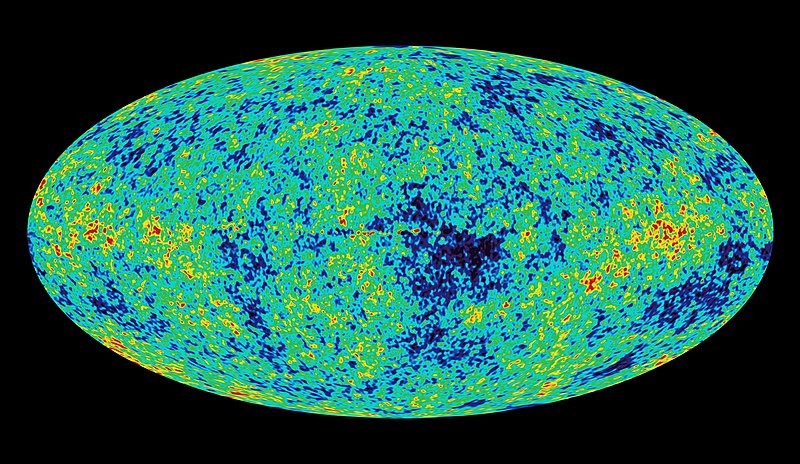
nd. It turns out, there should be a huge collection of neutrinos left over from the big bang era which haven't interacted with anything. We should be able to study this collection much as we can study the CMB to determine truths about the universe. Surely there will be much learned from the neutrino background, and this is yet another discovery I hope we make soon.
4. Pop III Objects: Stars and planets today have lots of elements heavier then hydrogen and helium. During the initial stages of the universe, it was practically all hydrogen and helium. Because of this the physics of the cosmos was very different then it is today. These differences make all the difference in the world if you are trying to understand the unive
rses history. Understanding the universe's history is very important in uncovering how and why the universe is the way it is. Hopefully the Hubble, or more realistically the new James Webb Telescope which will launch in 2013, will detect these objects.
5. Dark Matter and Dark Energy: This may be asking a little much, but with some luck the above things will set straight what is dark matter and dark energy. Maybe supersymmetry is responsible, or maybe something else.
6. The Stage Set for the Theory of Everything: Okay, I have to realistically believe quantum gravity, etc... will not be solved in the next 5-6 years. However, if we can understand the basics of supersymmetry, information coming from gravitational waves, the neutrino background, early population III objects and the higgs field, we might be able to have enough cosmological data to really get somewhere. I've said it before, and I will keep saying it, string theorists are demanding particle accelerators the size of the solar system to

test things that will result in understanding quantum gravity. We may never have such accelerators, but we do have an event about 13.7 Billion years ago with energies high enough that if we could examine it close enough we may be knocking on the door to understanding quantum gravity and more. These are the events I hope to see which I believe will lead up to that.

1. The Higgs field and Supersymmetry: We all have been thankful for the success of the Standard Model, but I believe we are ready to move on. One major particle that I am desperately hoping CERN finds is the Higgs Boson. Come 2007, the LHC, at CERN will be operating at energies higher then currently being achieved anywhere else; on the order of of 14 TeV. In addition to finding the Higgs, I am really crossing my fingers that we will find strong evindence for supersymmetry. Not only will supersymmetry give us a huge slew of new particles to explore, it will hopefully resolve some of our issues such as the vacuum energy problem and candidates for dark matter.
2. Gravitational Waves: Being able to detect light we cannot see visually, like infrared and microwaves, has greatly furthered our understanding of nature. I hope we will soon add to that gravitational waves. Gravitat
3. Neutrino Background: Many are familiar with the CMB or cosmic microwave background radiation but not as many people are familiar with the theoretical neutrino backgrou
4. Pop III Objects: Stars and planets today have lots of elements heavier then hydrogen and helium. During the initial stages of the universe, it was practically all hydrogen and helium. Because of this the physics of the cosmos was very different then it is today. These differences make all the difference in the world if you are trying to understand the unive
rses history. Understanding the universe's history is very important in uncovering how and why the universe is the way it is. Hopefully the Hubble, or more realistically the new James Webb Telescope which will launch in 2013, will detect these objects.5. Dark Matter and Dark Energy: This may be asking a little much, but with some luck the above things will set straight what is dark matter and dark energy. Maybe supersymmetry is responsible, or maybe something else.
6. The Stage Set for the Theory of Everything: Okay, I have to realistically believe quantum gravity, etc... will not be solved in the next 5-6 years. However, if we can understand the basics of supersymmetry, information coming from gravitational waves, the neutrino background, early population III objects and the higgs field, we might be able to have enough cosmological data to really get somewhere. I've said it before, and I will keep saying it, string theorists are demanding particle accelerators the size of the solar system to
test things that will result in understanding quantum gravity. We may never have such accelerators, but we do have an event about 13.7 Billion years ago with energies high enough that if we could examine it close enough we may be knocking on the door to understanding quantum gravity and more. These are the events I hope to see which I believe will lead up to that.
| Tweet |
|
|
Labels:
CERN,
dark energy,
dark matter,
graduate school,
Gravitational Waves,
higgs,
neutrino,
Pop III,
string theory,
supersymmetry
Subscribe to:
Posts (Atom)