Pages

Showing posts with label NASA. Show all posts

Monday, August 6, 2012

"Dare Mighty Things"

     Far better it is to dare mighty things, to win glorious triumphs even though checkered by failure, than to rank with those poor spirits who neither enjoy nor suffer much because they live in the gray twilight that knows neither victory nor defeat. -- Teddy Roosevelt
Last night after a journey of several hundred million miles a small hunk of metal successfully touched down rather softly on the surface of Mars. 150 million miles away (and 14 minutes later) a large group of people started jumping up and down. This is the spirit of human exploration and a desire to dare mighty things.


The scientists at the JPL and NASA may just be smiling for days if not weeks.
A happy John Grunsfeld speaking with reporters after the landing.

Friday, March 16, 2012

Great Videos of Solar Storms

As you may have read the Sun had a bit of a temper tantrum earlier this month.  Here's a great video of the flares (there are actually two of them in rapid succession) from NASA's Solar Dynamics Observatory.


And here is a time-lapse movie of the strong northern lights the storm generated when it hit Earth's magnetosphere.


With the solar cycle just heating up, it may be a stormy couple years.

Monday, December 5, 2011

Kepler Finds A Possibly Live One

The Kepler mission has been looking for planets that might have liquid water (and therefore life as we know it) and it looks like they have their first confirmed candidate - the oh-so-memorably-named Kepler 22b.  Kepler 22b, or just 22b for short, has a radius 2.4 times as big as the Earth's and orbits a star that has roughly 2% less mass than the Sun every 289 days. That places it right at the inner edge of that star's habitable zone (the range of distances from their star where planets might have liquid water), as illustrated by this lovely NASA graphic.

If you assume an Earth-like greenhouse effect for 22b (which is a big assumption considering Venus and Mars have drastically different atmospheres than Earth), the mean surface temperature (assuming it has a surface) would be a balmy but not unreasonable 22 degrees Celsius compared to Earth's mean surface temperature of about 14 degrees Celsius.

NASA likes to call this type of planet a "Super-Earth", however that's something of a misnomer as planets with more than twice the radius of Earth probably aren't primarily rocky planets like Earth, Venus, and Mars but rather more like smaller, defrosted versions of our solar system's ice giants, Neptune and Uranus.  Using planetary structure models, one can map out the range of possible compositions for a planet of a given radius (remember with Kepler's transit data they know the planet's size but not it's mass).


As you can see, 22b likely has a composition with significant amounts of hydrogen and helium, which means it may have a very thick, deep atmosphere. Alternatively it could have very large amounts of water, but at this point there's just no way to tell what it's made of as the planet is too far from it's star to be detected using the radial velocity technique, which can determine a planet's mass.  It's possible that space telescopes like Hubble and Spitzer might be able to get some information on the composition of the planet's atmosphere, but most likely this one is going to have to wait for new telescopes and instruments to be characterized more fully.

The best part is that 22b is not alone.  The Kepler team only officially announces a planet as discovered when they can confirm it using another telescope (here they used Spitzer to verify a transit), but the list of "planet candidates" in habitable zones is growing.  As of the now, there are about a half-dozen planet candidates in habitable zones that are smaller than 22b. 


As Kepler approaches it's third anniversary, expect those numbers to increase dramatically.  You can already see the trend by comparing the numbers of planets from the June 2010 (in blue), February 2011 (in red), and December 2011 (in yellow) data releases.

You can find the official NASA press release here and the slides from that press release (which are the source of these lovely images) here.

Tuesday, August 2, 2011

The Art of NASA

The latest issue of Physics Today has an excellent article about art inspired (and funded) by NASA.  Thanks to the singular James Webb, NASA decided that photography and video alone were not enough to express what NASA does, so he contacted the National Gallery of Art and the rest is, well, beautiful.  Here are a few of my favorites - check the Physics Today article for more or just stop by the exhibit in Smithsonian Air and Space Museum.

Friday, July 8, 2011

JWST on the Chopping Block: AAS Weighs In

As I previously posted, it looks like the James Webb Space Telescope faces an uphill battle just to avoid the scrap heap.  Today the American Astronomical Society released a statement on the proposed cancellation of JWST.  To no one's surprise, the statement is strongly in favor of continuing JWST, making the argument that "Too many taxpayer dollars have already been spent to cancel the mission now; its benefits far outweigh the remaining costs", in addition to the more standard arguments about preserving jobs, maintaining America's leadership in space technologies, and the benefits to scientific research.

Essentially, I think the single most compelling argument for JWST is the "only way out is through" line of thinking.  We've already spent over $3 billion on this thing, so we're pretty heavily invested.  Additionally, the Hubble Space Telescope was 7 years late, cost three times as much as projected, and has been worth every penny, so there is precedent for this sort of situation working out well in the end.

Wednesday, July 6, 2011

James Webb Space Telescope on the Chopping Block?

The House Appropriations committee released it's preliminary 2012 budget for "Commerce, Justice, and Science" and the news for science at NASA is not pretty.  From the committee's press release:
"The budget includes... $4.5 billion for NASA science programs, which is $431 million below last year's levels.  The bill also terminates funding for the James Webb Space Telescope, which is billions of dollars over budget and plagued by poor management."
NASA originally proposed a lunch date of 2011 and a total cost of $1.6 billion.  Current estimates place the expected launch date in 2018 at the earliest with a price tag of over $6.8 billion.  With government finances getting tight and everybody in Washington in a budget-cutting mood.  It looks like the next of NASA's flagship science missions might never make it off the ground.

Wednesday, April 13, 2011

Important Anniversaries (Slightly Late)

While I am currently staring at a room full of undergrads worrying over an Astro test, I though it appropriate to mention that yesterday we had two very important anniversaries. Yesterday was the 50th anniversary of Yuri Gagarin's flight. He was the first person to travel to outer space and to orbit the earth. Perhaps many people just don't realize how amazing that is that someone was able to leave the atmosphere of our planet, travel all the way around it, and come back. That single act has radically changed the way we see the universe and our part in it.

On a slightly related note, yesterday was also the 30th anniversary of the first space shuttle launch. That has also been very important for how we view our place in the universe. We are only beginning to explore and to know our universe. Here's to more years of exploration and life changing events.

(On an almost completely unrelated note, yesterday was the 150th anniversary of the start of the American Civil War. But that is an important anniversary for more terrestrial concerns.)

Wednesday, October 6, 2010

Was the Space Shuttle Worth It?

After 134 missions, 5 shuttles, 14 lives lost, and $174 billion dollars, the space shuttle program is scheduled to end on February 27, 2010.  The next generation of launch vehicles is still up in the air but no one is talking about a reusable vehicle like the shuttle.  Meanwhile the Russians are essentially still using the same one-time-use Soyuz system they've been launching since the 70's at much lower costs.  So now that we're approaching the end of an era in space exploration, let's ask the question:  was the shuttle program worth it?

If you ask the American public it was.  A Rassmusen Reports survey showed that 52% of those polled though the shuttles were worth the cost in dollars and lives, while only 28% disagreed.  Encouragingly, even in tough economic times like the present, 78% of Americans think it's important or very important to have an unmanned space exploration program and 72% say the same about a manned space exploration program.

I'm grateful that the US keeps investing in space exploration, however I personally think that the shuttle program was a poor way to do it.  With a fleet of vehicles that can only go into low-earth orbit there was no real destination for the shuttle program until the building of the International Space Station (and even then one has to ask why are we going there?).  Without a destination, the shuttle program fell into a "cause-of-the-year" syndrome where the shuttle became a zero-G research lab, a construction vehicle, a delivery truck, and a service van, to name a few.  Without a focused mission, NASA lost much of the public attention it had with the Apollo program.  Now if you ask people why NASA sends men and women into space you're likely to get responses like "good question".

I'm not trying to pin all of the inefficiencies and short-comings of the American space program on the shuttles, but I have to wonder if we could have done more over the past 30 years without it.

Sunday, September 19, 2010

A view of deforestation

I was looking for some satellite images recently and I came across a site maintained by NASA called Visible Earth. It contains thousands of images taken of the earth from various satellites. There were a few images that I found particularly striking, so I thought I would share them with you. I was looking for images of deforestation because I have been reading the book Collapse: How Societies Choose to Fail or Succeed by Jared Diamond, and it deals heavily with the effects of deforestation on societies (you can read my review of the book on my personal blog, if you are interested).

One of the hard things about deforestation, and climate change in general, is that many parts of the earth have already been impacted so we don't have a good idea of what the earth looked like before human impact so we can't get a clear picture of the extent to which we have changed the environment. Satellite imagery is only helpful up to a point because we only have a few years worth of data and that can't tell us much about the past, so it is hard to predict how much our actions will affect the climate in the future, and how much needs to be done to preserve our environment. But in some cases areas of the world have been preserved because of the actions of certain governments and thus provide us with a "control group" to show us how much we have already imacted the environment.

Here is one image of northern Argentina and southern Brazil with Paraguay on the top left and Uruguay on the bottom right. [You can find higher resolution images here.]
The country borders are shown as very thin black lines, but if you notice the dark green "boot" shaped thing in the middle, that is the provice of Misiones in Argentina. A significant protion of that provice is designated as "preserve" and even the parts that aren't are still preserved for specialty logging. The dark green tail coming off the end of the boot is a national park in Bazil.

Another view taken at a different time gives an even starker view of the extent of the deforestation. [Hi-res here]
So at one point that entire area, from the northern edge of the picture, south to almost the boarder with Uruguay, and from the ocean to the Río Paraguay was as green as Misiones now is. That should give you an idea of the extent of deforestation that we are dealing with. So when some people get concerned about the impact that we are having on the environment, this is what they are fretting about.

Now a view from the ground. In case you were wondering, this is what Misiones looks like from the ground (ok maybe these are the more touristy parts).

Wednesday, August 11, 2010

Global Warming Could Be Bad... Or It Could Be Worse

The data on global climate chance from 1950 to the present leads to some pretty solid conclusions - the Earth's climate is warming and human greenhouse gas emission is at least one of the leading causes.  What everyone really wants to know, however, is not what has happened but what will happen to our climate if we keep doing what we're doing.  That's a much tougher question because it relies almost totally on computer models that use hundreds of parameterizations, simplifications, and approximations, some of which are poorly understood.  However the models aren't stupid - when one feeds in historical data one generally reproduces historical results - and climate scientists generally know what the uncertainty on each of these estimates are.

Based on these models the IPCC estimates that there will be a 1.8 to 4 degree Celsius rise in average global temperature by the year 2100, however with all the uncertainties some people might be inclined to say that there's a good chance it really won't be that bad.  They're right - turns out it might be worse.

From NASA's ever-useful Earth Observatory comes the results of running a suite of climate models thousands of times tweaking various parameters randomly (but in proportion to their uncertainty) on each run.  By doing this scientists get a feel for just how much what they don't know about their models can impact the results.  We call the result a probability distribution function, which shows the relative likelihood of the global average temperature increase by 2100.  Here's the result:

Clearly the highest probability is for an increase of between 1.8 and 4 degrees, as the IPCC claimed, but according to the models there is almost no chance of less than 1.8 degrees of warming while there is a decent chance of between 4 and 6 degrees of warming, and a slim chance of as much as 10 to 12 degrees of warming.

Wednesday, July 28, 2010

Astronomer Leaks Kepler Data in TED Talk

UPDATE (7/29):  It turns out that Sasselov wasn't jumping the gun as much as it seems.  The Kepler team had already released data on  " 706 stars... [which] have exoplanet candidates" in a paper published to arXiv.org on July 14th.  It appears that NASA didn't want to make too big of a deal out of this since they are formally only exoplanet candidates, rather than detections, however Sasselov seems to have done that anyway via this TED talk.  The bottom line is that Sasselov didn't spill the beans, rather it seems that everybody seriously botched the PR on this very exciting peice of science.
[Thanks to Darin for the heads-up]

*********************************

To borrow a line from the movie Zoolander, extrasolar planets are sooooo hot right now. And right now the hot topic in the field of extrasolar planets is the results from the Kepler Space Telescope, which since March of 2009 has been staring at the same patch of sky continuously, looking for the tell-tale dimming of stars as extrasolar planets pass in front of them. Obviously ground-based telescopes can't do this and Kepler will be the first space-based telescope to do it for large numbers of stars, so it is likely that Kepler will find the first Earth-like extrasolar planets in human history.

The problem is that for an extrasolar observer with an alien version of the Kepler spacecraft to find the Earth, he/she/it would need at least 2 years of data before he/she/it could definitively say that he/she/it had detected our planet because what you really need to see are three dimming events with the time between the 1st and 2nd equal to the time between the 2nd and 3rd. That in and of itself is no big deal - good things come to those who wait. However people are impatient and scientists love it when the public actually cares enough to be impatient. So a week ago one of the very select few astronomers with actual data, Dimitar Sasselov, leaked the initial results in a TED talk. You can see the whole talk below (the kicker comes at roughly the 8:15 mark), but here's what he wasn't supposed to show us:The official count as of today is actually 471, most of which are the size of Saturn or bigger, so Sasselov just indirectly announced that (a) Kepler has found more planets in 18 months that the rest of the astronomical community had in 10 years and (b) most of Kepler's planets are Earth-sized.

Anyone who knows anything about NASA's views on preempting their press conferences knows that Sasselov is going to get a very stern talking to.

Here's the TED talk:

Saturday, June 19, 2010

More On Why The Private Sector May Be Better Than NASA.

I've already blogged about how I have no issue with the private sector taking over many of NASA's responsibilities, and that I'm not exactly crying the Constellation program was canceled.  From MBO:
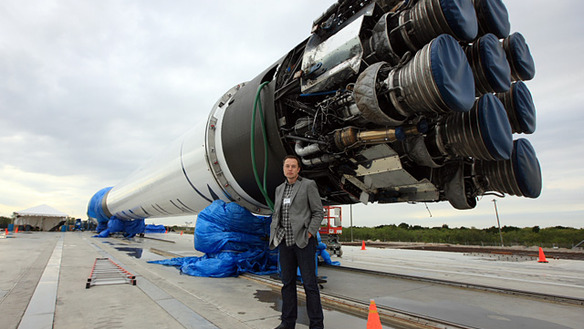
For less than the cost of the Ares I mobile service tower, SpaceX has developed all the flight hardware for the Falcon 9 orbital rocket, Dragon spacecraft, as well as three launch sites. SpaceX has been profitable for three consecutive years (2007 through 2009) and expects to remain modestly profitable for the foreseeable future. The company has over 1000 employees in California, Texas and Florida, and has been approximately doubling in size every two years. A majority of the future growth is expected to occur in Texas and Florida.
Let's look at some realities:
  1. The entire SpaceX program appears to be cheapter than NASA's service tower!
  2. SpaceX is already profitable and is doubling in growth every year.
Why would I care if human spaceflight and hauling cargo is passed over to SpaceX? It appears to me that the private sector may do some things even better than NASA.  

And I've said it before:  The reality is the US is sooo advanced technologically that our private sector can do what most countries could only dream of!

So no gripping that cutting some of NASA's programs somehow puts the US behind technologically speaking. It appears this private route will be cheaper and profitable as well.  Go SpaceX!

Tuesday, June 15, 2010

The Awakening Sun Might Keep 2012 Theorists Happy.


I find it interesting that NASA is warning there may be "unprecedented levels of magnetic energy from solar flares after the Sun wakes “from a deep slumber” sometime around 2013" and that furthermore
Scientists believe it could damage everything from emergency services’ systems, hospital equipment, banking systems and air traffic control devices, through to “everyday” items such as home computers, iPods and Sat Navs.
Due to humans’ heavy reliance on electronic devices, which are sensitive to magnetic energy, the storm could leave a multi-billion pound damage bill and “potentially devastating” problems for governments.
 This should keep people concerned about December 23, 2012 (eerily close to 2013) happy.

So Nick, should we be scared?  Is the sun going to awaken and destroy human civilization?  Do we quickly need to make another Inconvenient Truth movie now about how if we all own too many electronic devices the sun might destroy society?

Saturday, June 5, 2010

Move Over NASA, Here Comes The Private Sector.


I've heard a lot of whining and complaining over Obama's decision to cut back on manned space exploration programs like Constellation.  A lot of it is centered around the idea that we may fall behind other countries in the "space race" sense.

However, the reality is the US is sooo advanced technologically that our private sector can do what most countries could only dream of!  So why shouldn't we let them?  Why use taxpayer's money to do what old fashioned competition and the free market may be able to do just as well?

The recent successful launch of the the SpaceX's Falcon 9 rocket underscores that the private sector is moving into a position to do what only the government has been able to do so far.  I say let them do it.  From the Huffington Post:
A multimillionaire's test rocket... successfully reached orbit in a dry run for NASA's push to go commercial.  SpaceX's Falcon 9 rocket achieved Earth orbit... drawing praise from NASA, the White House and others...

Friday's launch helps vindicate President Barack Obama's plan to give private companies the job of ferrying cargo and ultimately people to the space station, freeing up NASA to aim for true outer space. 
"This bodes very well for the Obama plan," said Musk, the co-founder of PayPal. "It shows that even a sort of small new company like SpaceX can make a real difference."
Don't get me wrong, the government will always need to fund basic science.  However, when it comes to hauling cargo to and from space or sending people to do photo ops on the moon and space stations, why not just let the free market foot the bill?  Seriously!

Sunday, May 16, 2010

NASA: Hottest Jan.-Apr. On Record. (Useful Plots)

Thought people could use some useful plots from NASA.   One thing this data is supposed to show is that Jan-Apr is the hottest on record.

 You can debate what they mean for yourselves.  Enjoy. :)


Wednesday, May 5, 2010

Resurrecting Old Species, Life on Mars and The Suns.

Three news stories struck me as interesting:

Scientists Rebuild Wooly Mammoth Blood

Scientists have already "resurrected" an extinct goat through cloning.  Now, it looks like scientists have used ancient DNA of a Woolly Mammoth to rebuild the extinct creature's blood.

Look, I know I should be more skeptical, but I just may live to see the day when Jurassic Park is more of a reality.

NASA cites new evidence for life on Mars.

This is another one of those "I hope to see before I die" things.  I'm sure there is life outside of planet Earth.

It really doesn't make sense that there wouldn't be, unless you are a skeptical extremist.  I say extremist because on one hand the evidence supporting the idea is mounting (the above link is one example) and then there's that whole Copernican Revolution from which good scientists learn that they shouldn't consider this Earth as "the one special place in all the cosmos". (And the cosmos is pretty big might I add.)


Suns to wear 'Los Suns' jerseys for Game 2

This is not a political statement.  No matter where you stand on this law, you have to admit the Suns wearing "Los Suns" for Cinco De Mayo in light of Arizona's new immigration law is pretty funny.

Tuesday, May 4, 2010

Physics Works: Global Warming Edition

When people talk about human influences on the global climate, they tend to think that there is much less certainty in the conclusions than actually exists. In fact while the models have a lot of approximations and simplifications, they really do an excellent job simulating the global climate history. You want proof? Behold NASA's really pretty graph (click for a larger version or click here to read the full article):
The dashed line is recorded average global temperature anomaly, which are uncertain to maybe 0.3 degrees C but become particularly reliable after about 1970 when space-based measurements became available. The red line is the average of several global climate models including human influences and the blue line is the average of those same models without human influences. You'll note that almost all of the observed warming does not occur in the models without human influence. All I have to say is WA-BAM! Physics Works!

One other interesting thing to note: the two largest natural influences on climate are volcanoes (labeled and with vertical grey lines) and the El Nino cycle. So it's not that the climate isn't strongly influenced by natural events, it's just that these events don't tend to produce a consistent heating or cooling effect. Humanity, on the other hand, is consistently heating the planet and shows no signs of stopping.

Monday, April 26, 2010

Say Hello to SDO

The Solar Dynamics Observatory was launched on February 11th of this year and is now officially online, taking pretty pictures, and releasing data. It will provide images of the entire sun at 500 mile resolution every 10 seconds and stream all of that data (close to 2 TB per day) down to earth. How to deal with 2 TB of data per day is another issue entirely.

I'm going to be posting more about NASA's latest solar observatory, but for now, say hello to SDO and great images of the sun (click for full resolution).

Friday, April 16, 2010

Obama's New Space Policy. (Very Nice!)

As many of you have heard, President Obama has laid out his new space policy.  Bad Astronomy has a good write up about it:
1) As before, NASA’s budget will be increased in the new plan. Let me repeat that: NASA’s overall budget will go up. And not just a little; we’re talking $6 billion over the next five years. A lot of that goes into scientific research. So far from it being doom and gloom, that’s good news.

2) A new heavy-lift rocket will be developed. Let me repeat that as well: funding is provided for NASA to create a new heavy-lift vehicle. So yes, Constellation will be canceled, but a new system will be developed that (hopefully) will be within budget and time constraints.
3) The Orion capsule, based on Apollo capsule legacy, will still be built. Initially it will be for space station operations as an escape module, but can be adapted later for crewed space missions.

4) He wants NASA to plan manned missions to near-Earth asteroids in the 2020s, and to Mars in 2030s, but no return to the Moon.
As Phil gives his thoughts over at BA, here I will give my thoughts:

People need to understand NASA's budget is going up.  I see this as a good thing.  More money and less expensive moon missions == more science.

Second, going to the moon accomplishes three main goals:
  1. Good for PR and America's image.
  2. Good for inspiring the next generation of scientsis and engineers.
  3. Good for developing new technologies that otherwise would not have needed to be developed.  (That later can be used for other useful things)
But we've already been to the moon several times!  If we instead now shift to near-Earth asteroids and Mars four things should happen:
  1. I think successfully going to near-Earth asteroids and Mars will be even better for America's image than returning to the moon.  There is not as much "coolness" in been-there-done-that type accomplishments.  Near-Earth asteroids and Mars missions would demonstrate we are once again forging new frontiers that nobody has ever traveled.
  2. There is much better science to be discovered in going to near-Earth asteroids and Mars.
  3. Between #1 and #2 above, I think near-Earth asteroids and Mars missions would be better for inspiring the next generation of scientists and engineers than accomplishing that which was done in the 1960s.  This will be new and exciting with lots of new science to boast about. 
  4.  We already have the technology to go to the moon.  Again, think 1960s.  The new technology will really come by going to new places with new hurdles to jump over.
  5. Near-asteroid missions are cheaper than the moon so we get more bang for the buck.
Anyone else have any thoughts?  Is Obama's plan perfect?  No, but it is better than funding us to just return to the moon and show everyone that in 2020 we can still do what we did in 1969

It's time for a little innovation, and yes, it's time for change. :)

Friday, February 5, 2010

The Breakdown Of Obama's Budget For Science.

I got an email today from the AAS that said this.  Thought some people would be interested:

SUMMARY: The President's budget request for FY 2011 has been released.
Overall, science funding will rise despite the proposed spending
freeze with most big investments in climate change research, renewable
energy, and STEM education. The doubling path for the three key
science agencies included in the American Competitiveness Initiative
(NSF, DOE, and NIST) is maintained by providing them a combined
$13.3B, an increase of $824M (6.6%) over the FY 2010 enacted total.

DETAILS:

The President has released his Administration's budget request for FY
2011. Science has fared well despite the spending freeze proposed by
the President on all non-discretionary spending. This budget request
asks for a 5.9% increase in non-defense R&D spending (an increase of
$3.7B for a total of $66B). The country's total R&D budget request for
FY 2011 is $147.7B once the defense R&D funding is included. This is
an increase of $343M or 0.2% over the enacted FY 2010 level. There is
also significant investment in programs to foster the next generation
of S&T workers, both at the NSF, DOE and the Department of Education.

The breakdown for the agencies relevant to our community is as follows:

NSF: The NSF request is for $7.4B, an increase of 8% over 2010 levels.
The Mathematical and Physical Sciences Directorate (MPS), which houses
the Astronomical Sciences (AST) within NSF, receives a 4.3% increase
and AST receives a 2.5% increase to $251.77M.

Of the facilities supported by MPS, the AST facilities have done very
well getting a majority of the funding increases. The requests and the
percent increase over FY2010 estimates are: ATST - $2M, ALMA - $23.5M
(33.8%), Gemini - 1$19.58M (2.5%), IceCube - $2.5M (16.3%) and LIGO -
$30.30 (6.3%).

The Graduate Research Fellowship (GRF) program sees a 16.4% increase
to $158.24M while the Faculty Early Career Development Program
(CAREER) sees a 6.5% increase to $209.16M. There is also an additional
investment of $103M to realign and consolidate existing programs to
broaden participation by under-represented groups in the S&T
workforce.

NASA: The biggest change at NASA is of course a new vision for the
manned space flight program. NASA's total budget request is for $19B
with $5B for the Science Mission Directorate. The biggest increase
within SMD goes to Earth Science in line with the Administration's
focus on renewed investment in global climate change research.

Planetary Science sees a small increase, targeted to identify and
catalog Near Earth Objects. Some really good news for planetary
science is that the Plutonium-238 production restart is called out
prominently. Members might recall that the Administration had
requested $30M in funds in the last budget for the Pu-238 production
restart required to power missions to explore other planets in the
solar system. Congress had zeroed out the request citing inadequate
detail. This request reopens the dialogue. Heliophysics sees a small
increase as well of roughly $13M. Astrophysics funding declines over
2010 levels by 2.5% (~$27M). The good news for the astronomy community
is that new money has been requested to fund the increased investment
in earth science and space science was not cut to fund that increase.

DOE: The Office of Science at DOE receives a 4.4% ($217.7M) increase
for a total of $5.1B. The High Energy Physics program, which supports
astronomical programs such as Fermi, receives a 2.3% increase for a
total of $829M. Fusion energy sciences are down 10.8% to $380M. Of
some interest to our community might be that the U.S. ITER project
sees a decrease of $55M compared to FY 2010 levels. This is a
reflection of the pace of construction and W.F. Brinkman, the Office
of Science Director, is quoted as saying that the DOE was not willing
to provide money for ITER until it had solved some underlying problems
and the funding reduction was intended to "send a message."

The President's budget request reflects the priorities of the
Administration. It is very supportive of science, including
curiosity-based science, but has focused its big investments in
climate change research, renewable energy sources, and STEM education.
There is also a substantial investment in technology development at
NASA. We must now engage Congress about the role astronomy plays in
the national agenda and what our community can contribute to the
nation. Everyone is awaiting the report from the Decadal Survey to set
funding priorities for astrophysics. But we need to start talking to
lawmakers now about the role of astronomy in the innovation agenda.