Pages

Showing posts with label Peer Reviewed Research. Show all posts

Wednesday, January 12, 2011

First Planck Results: The Sunyaev-Zeldovich Effect.


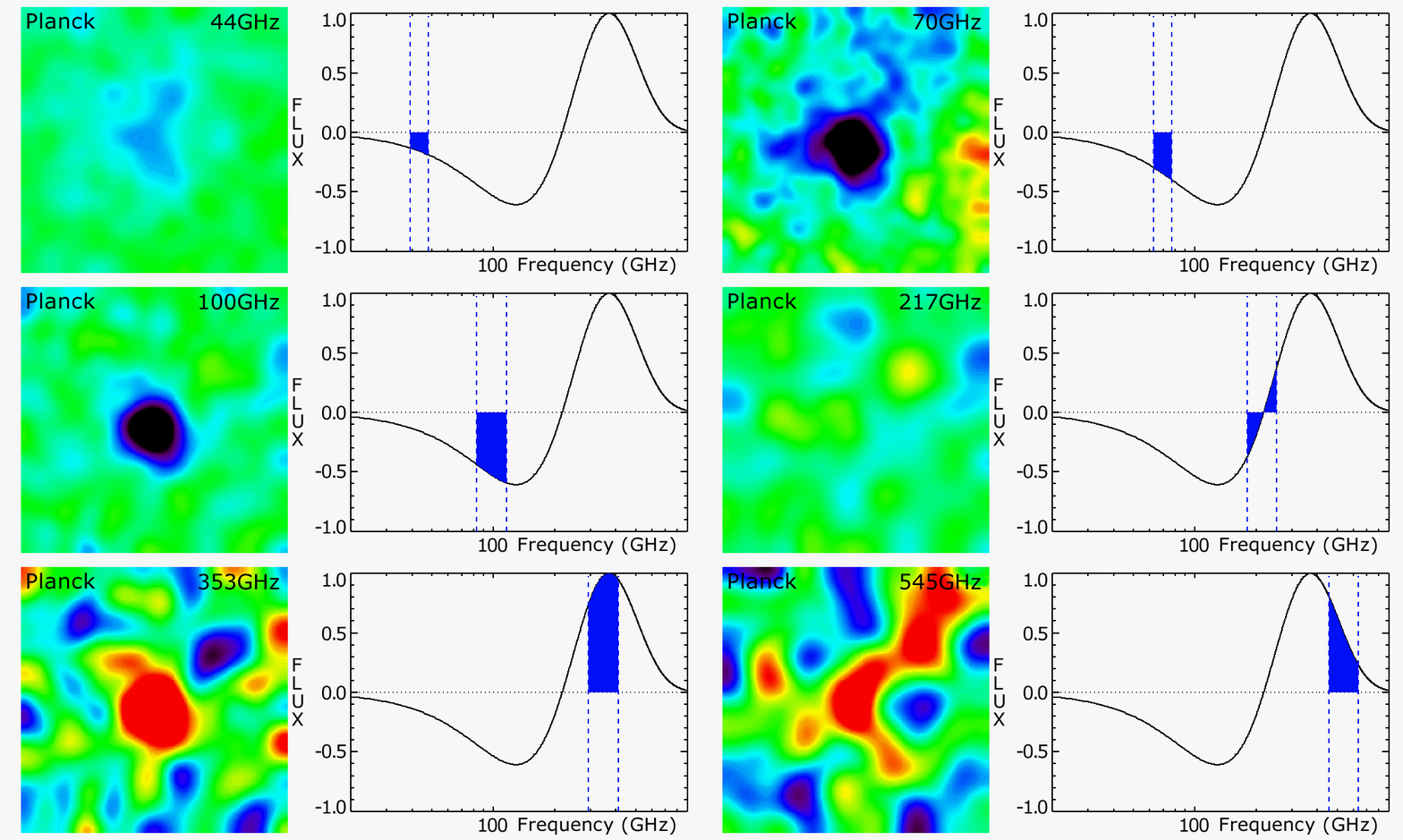
There's been many bloggers writing about the first Planck results presented here at AAS and in Europe but I would like to write a little more than has been written on the Sunyeav-Zeldovich results as I think they are impressive.  Impressive both in terms of the science we get as well as well as this particular example shows how precise CMB experiments have become.  I will focus on the results from this paper.

Okay, what is this effect anyways? The Sunyaev–Zel'dovich effect: "is the result of high energy electrons distorting the cosmic microwave background radiation (CMB) through inverse Compton scattering, in which the low energy CMB photons receive an energy boost during collision with the high energy cluster electrons."  And the thing is, clusters of galaxies are filled with high energy electrons in what is known as the intra-cluster medium (ICM).

This means that we can use specific distortions in the CMB to both locate clusters of galaxies and infer science from them from estimating the Hubble constant to extracting information on the physics driving galaxy and structure formation.

Look at the image above: it shows the precision at which Planck can observe this "SZ" effect.  (And it is just amazing!)  In this image you should note several things.  First, Planck intentionally is observing the sky at many frequency bands to see this stuff. (And watch the frequency change with tie in the image.)  At the lowest frequencies the boost on CMB photons yields a diminished flux, at higher frequencies it is an enhanced flux, and right at 217 GHz there is should be flux.

And if you look closely at the image up top you can see that Planck is seeing this!  The cluster in the center has diminished flux at low frequencies, denoted by the blue smudge,  no flux at 217 GHz and enhanced flux for high frequencies. (Now the smudge turns red.)  So Planck can see this effect really well and the science going into this effect can be studied in detail.

The next two plots to the right show how the mass and luminosity of these clusters relate to redshift. Redshift again being a measure of how far away these objects are from us.   These relations can now be compared to physical models and tell us a lot of science about the universe. Again, what is so great is Planck is seeing a lot of clusters and is able to see how the physical properties of these clusters relate with redshift. (Or as time progressed throughout the universe.)

Now, this stuff is all interesting but the really cool stuff, the main stuff Planck was built for, won't be released until next year. That should be a good day for cosmology and I for one am very excited! Cosmology has become a very precise science indeed!

Come in B-modes.... Come on! :)
ResearchBlogging.org
The Planck Collaboration. (2011). Planck Early Results: The all-sky Early Sunyaev-Zeldovich cluster sample Submitted to A&A. arXiv: 1101.2024v1

Thursday, December 30, 2010

The Effects Of Special Relativity On Planetary Orbits.

General relativity affects the orbits of planets in ways Newtonian gravity cannot account for. Interestingly, Lemmon and Mondragon explore if special relativity can account for the same behavior predicted by general relativity.   They find that qualitatively it can, but quantitatively it comes up a little short and so the full general relativistic treatment is still needed.

First a reminder: Precession:  Let's remind ourselves the effects coming from general relativity.  The first is the precession of the orbit demonstrated for Mercury in the image above.  The dotted curve shows what is expected from Newtonian gravity alone: an obit that stays fixed in an elliptical shape forever.  The solid line shows how this changes with general relativity: the orbit moves or precesses over time around the sun.

It may help to consider the gyroscope on the right: if you were to put a red dot on the edge of the spinning disk, and watched above, you would not see that it only traces out a circle as it spins, but a precession pattern like the one in the plot above.


Second reminder: A shrunken orbit:  The second effect general relativity makes is that of shrinking the orbit, illustrated in the plot above again for Mercury.  This is an image of Mercury's potential energy.  Planets want to minimize their potential energy and therefore, like a ball on a hill, "roll to the bottom" of their potential.  As can bee seen, the bottom of the potential for Newtonian gravity is at a larger radius than for general relativity.   Therefore, general relativity forces planets to have a smaller radius.

Note: Both of the effects above have been verified experimentally and are major reasons why general relativity was embraced in the first place.

But is full general relativity really needed? Turning back to the paper, the authors decide to work out these effects in special relativity alone.  First, we start with precession.  Using special relativity alone you get:

Where G is the gravitational constant, c is the speed of light, a is the semimajor axis and e is the eccentricity.  This rate of precession is equivalent to 7.16 arcseconds per century.  This should be compared to precession predicted by general relativity which is 43 arcseconds per century.  Therefore, special relativity undershoots by a factor of 6.

And what about the radius? For special relativity the change in radius is a similar story and becomes:
where 1/2ε is the correction. General relativity gives a correction of 3ε, and so therefore again special relativity comes up short by the same factor of 6.

Always the same factor of 6 huh? I guess so, and I don't off of the top of my head know why it should always been a factor of six.  Anyways, despite being off by this factor, it is very interesting that special relativity predicts the same qualitative behavior as general relativity which is absent in Newton.  Furthermore, since calculations in special relativity are significantly simpler than for general relativity, this special relativistic calculation is ideal if you are just trying to give a qualitative picture of what effects are relativistic.  Perhaps a good one for undergraduates?

Anyone want to take a stab at why it is always a factor of 6???
You can in the comments. :)

Tyler J. Lemmon, & Antonio R. Mondragon (2010). First-Order Special Relativistic Corrections to Kepler's Orbits Submitted to American Journal of Physics arXiv: 1012.5438v1