Pages

Showing posts with label supersymmetry. Show all posts

Thursday, March 3, 2011

More Problems With SUSY... and MOND Humor.

Two things.  First, back to problems with supersymmetry.   Tommaso Dorigo has posted this very helpful plot that explains what is meant by "The LHC sees no signs of SUSY".  If you squint closely, on top of all the colors you will see a small red line. That red line represents the prediction for what the LHC should see in the data if only the standard model particles existed at the energies being probed. The dotted black line is the prediction if supersymmetry is real at the energies being probed. The black dots with error bars are what was measured.

As you can see, there is thus far no reason to believe anything but the standard model is happening at these energies from this search optimized for the detection of supersymmetry.  It's still pre-mature as only a small portion of the total data is in. Still, if I was hoping for SUSY I would be a little worried at this point that nothing is leaving a hint anywhere in any bin whatsoever!

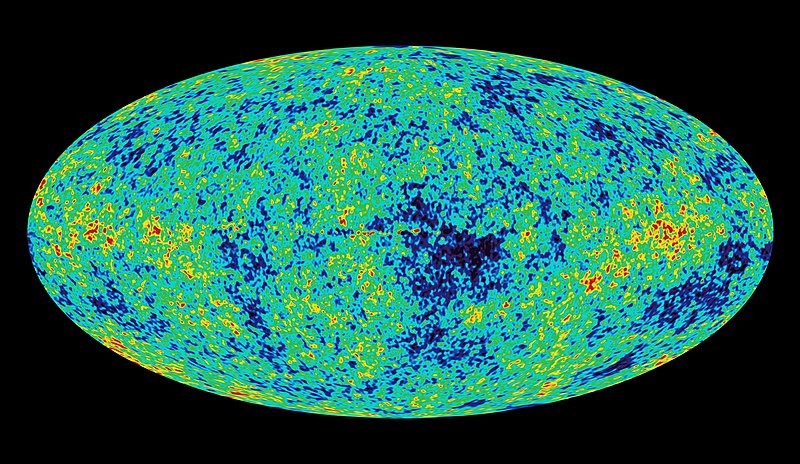
Question I have For Particle Experimentalists:  (And here is the reason I said that last sentence.)  My experience with cosmology data is, as more data comes in, the confidence regions change a little but not by several sigma in every bin! Take WMAP for example. Has the confidence intervals for the 7 year data changed in every bin by several sigma from the first year data? No way! Changes are made, but the entire power spectrum has not shifted in every bin by several sigma.

Why would I expect particle data to be any different?  Can anyone help me out here?  I mean, if WMAP came back with every bin being inconsistent with a Lambda-CDM universe would 6 more years of data have changed that!

Now, what it may be is that you only need a detection in one bin, not all bins.  Fine, but again, from my cosmology experience, the error bars will shrink and midpoint change a little over time, but very seldomly have I ever seen the midpoint to change so much that what is initially excluded by a sigma or two is now verified at a 5 sigma level!

So any help here by those who know more is appreciated.


Now to MOND.  By now many of you have read Sean Carroll's post debunking MOND. (A theory that attempts to replace dark matter).  Let's just say MOND doesn't work.  So in commemoration I wanted to post the image above reminding ourselves why some gave MOND a chance at all while at the same time reminding ourselves why nobody pays attention to it any more.

For mor information read Sean's post.

Tuesday, March 1, 2011

Supersymmetry A Sinking Ship?

I really like supersymmetry, the idea there is some fundamental symmetry between fermions and bosons.  Unfortunately nature doesn't care what I think.  And even more unfortunately, the LHC has been running at very high energies for a while now and nobody is seeing so much as a hint for it.

A few quotes from this Nature article sum up the situation:
The LHC is now rapidly accumulating data at higher energies, ruling out heavier territory for the super particles. This creates a serious problem for SUSY... As the super particles increase in mass, they no longer perfectly cancel out the troubling quantum fluctuations that they were meant to correct. Theorists can still make SUSY work, but only by assuming very specific masses for the super particles — the kind of fine-tuning exercise that the theory was invented to avoid. As the LHC collects more data, SUSY will require increasingly intrusive tweaks to the masses of the particles. 
So far the LHC has doubled the mass limit set by the Tevatron, showing no evidence of squarks at energies up to about 700 gigaelectronvolts. By the end of the year, it will reach 1,000 gigaelectronvolts — potentially ruling out some of the most favoured variations of supersymmetry theory.
So basically, supersymmetry's biggest appeal is that it provides a "natural" solution to many problems in theoretical physics.  (Like why the Higgs mass so small.)  However, enough parameter space is being ruled out by the LHC that is appears that fine-tuning may be required to get SUSY to work correctly.  But the whole point behind SUSY's appeal is that it appeared to be a theory where fine tuning was not needed.

So by saying: "well supersymmetry may still exist if we do a bunch of fine tuning" seems to destroy the whole point for why we thought SUSY was a good idea in the first place.

Next:
Privately, a lot of people think that the situation is not good for SUSY... This is a big political issue in our field... For some great physicists, it is the difference between getting a Nobel prize and admitting they spent their lives on the wrong track... [Some have] been working on it for almost 30 years now, and I can imagine that some people might get a little bit nervous.
Now, before I get too hard on the theory, we are only in the first few years of the LHC operating at high energies.  Still, after 30 years you would hope that if SUSY was as "natural" as people have assumed, you would hope by now you would have a hint.  I mean, it's one thing to say we don't have enough to claim discovery but we don't even have enough evidence to suggest a hint!

So, is SUSY a sinking ship?  I think abandoning SUSY is still pre-mature.  However, if the LHC cannot see so much as even a hint in the next few years, I will think things will start looking really bad indeed.

Thoughts?

Tuesday, June 22, 2010

Could Latest Particle Finding Hint At Supersymmetry?

You may have heard the media throwing out headlines like the "God Particle" May Be Five Distinct Particles", referring to the latest findings that five Higgs Bosons may fit the data better than one.
In an experiment called DZero... Scientists recently found that collisions of protons and antiprotons produced pairs of matter particles more often than pairs of antimatter particles.   The difference... can't be explained by a standard model that assumes the existence of a single Higgs boson...
The DZero results can, however, be explained if scientists assume the Higgs boson is actually five particles...
Now, when I first heard these results I thought "What's really interesting here isn't that there may be 5 Higgs Bosons, but that this sounds an awful lot like supersymmetry." Luboš Motl agrees.  (Read his post for more details.)

Here's why this is interesting from the supersymmetry perspective: In the traditional non-supersymmetric standard model the Higgs Boson is a "doublet", meaning in semi-layman's terms it consists of two complex fields. (A double of the Lie Group SU(2) to be more precise.)  But each complex field can be decomposed into two fields representing the real and imaginary parts. (Just like the complex number z can be decomposed into numbers a and b such that z = a + ib.)

After symmetries are broken, three of the four fields go into giving the W+, W- and Z Bosons mass.  The single degree of freedom left over becomes the long sought after Higgs.

In supersymmetry you need the Higgs to really be two Higgs doublets to avoid anomalies. (Or in lay terms, to get the math to work out right.)  Therefore, there are 4+4 = 8 particles that after symmetry breaking become 8 - 3 = 5 particles.  Again, the 3 like the above were "eaten" to give the W+, W- and Z bosons mass.

So, data where five Higgs particles is a better fit isn't interesting because there may be five God particles, but because this could be hinting at supersymmetry!  However, before I count my chickens before they hatch, let me repeat the famous mantra: Half of all three sigma detections are false.  In other words, this five particle best fit may or may not be real.

This is the article: Bogdan A. Dobrescu, Patrick J. Fox, Adam Martin: CP violation in B_s mixing from heavy Higgs exchange, arXiv:1005.4238.

Monday, March 15, 2010

The 120 Order Of Magnitude Problem.

(The forth post in the dark energy series.)

Now to address the concern the that value of the cosmological constant is off by 120 orders of magnitude from what we expect from theory.  To start off with, let's talk about the Higgs Boson.

The public, media, and many scientists, are greatly anticipating the detection if the Higgs.  Nobody seems to be claiming the Higgs is some mysterious thing scientists seem to know nothing about.  It makes predictions.  It fits the physics well.  It makes the standard model work.  But, like the cosmological constant, it seems experimentally confirmed theory (things like supersymmetry is not confirmed yet.) and experiment disagree by several orders of magnitude about what it's mass should be.

The Hierarchy Problem
This is the famous Hierarchy problem.   Scientists admit to it's existence, but none seem to treat the Higgs as being mysterious. Here's the problem:
  1. You calculate the Higgs mass using standard understood QFT.
  2. You find that the Higgs mass should be up at the Planck scale because of loop divergences at energy scales we don't understand.
  3. From experiment you find that the Higgs mass should be at the 100 GeV scale, (this is several orders of magnitude too small).
  4. You invent some unobserved machinery, like supersymmetry, that explains why the Higgs mass should be at the 100 GeV scale after all. (Seriously, string theory and the hierarchy problem are the real reasons why we have supersymmetry.)
  5. The media, even the Wikipedia, now nicknames the Higgs as the God Particle and people don't seem to take much issue with it.
Now let's look at the cosmological constant's size.  (Do these divergences make me look fat?)

Back to the paper:
The problem [of the cosmological constant's value] is similar (but worse) to the problem given by the Higgs mass, which scales quadratically in the standard model, and can be taken as an indication that “there is something we have not yet understood” in Higgs physics.
 How similar.  This is how we find the discrepancy:
  1. You calculate the value of lambda (the cosmological constant) using standard understood QFT.
  2. You find that the lambda should be a "Planck-scale vacuum energy" from loop divergences at energy scales we don't understand.
  3. From experiment you find it is very small, about 120 orders of magnitude smaller than this Planck-scale value.
  4. You successfully invent some unobserved machinery,  like string theory, that can explain the discrepancy.
  5. Everyone maintains the cosmological constant is dark and mysterious.
Maybe it's high energy particle physics that is the real problem.

The problem of the cosmological constant being off by 120 orders of magnitude is analogous to the Higgs' mass being off by several orders of magnitude.   The real problem may have nothing to do with the Higgs or the cosmological constant being weird or mysterious, but may be that we just don't understand physics at high energies.

Now, just to be honest, the machinery needed to fix the cosmological constant problem needs to be more sophisticated than what is needed for the Higgs.

Still, given its analogous nature, in this context, I wonder if the cosmological constant is being treated unfairly.

Thursday, September 3, 2009

Modern Economics Like Physics Without Symmetry Breaking.

There is an article by Paul Krugman that I mention for two reasons:
  1. It's Paul Krugman!  You probably cannot point to another living economist with as many honors as him.
  2. It is a perfect segway into a discussion on how symmetry breaking ruins the elegance of theoretical physics.
Theoretical physics is often described as elegant.  It is full of symmetries yielding aesthetically pleasing equations.   Learning all of this stuff can be quite fulfilling and gives you a real sense of wonder for how majestic nature is.

Then you look outside and realize all of this beauty is only approximately correct.  Many symmetries are broken to some degree.  Sure there are still some left, such as the symmetry keeping the photon massless, but most are not really exact.

From a calculation standpoint this is a real nightmare.  The symmetries make the math not only elegant but tractable.  Every symmetry that breaks creates a lot of mess that physicists have to learn to deal with.

For example, supersymmetry is so beautiful and elegant I have heard one physicist say if it isn't correct "God messed up".  However, if supersymmetry is correct, it is broken and causes so much mess and hardship that nobody knows how to properly deal with it.

Now onto economics.  One of Krugman's main points boils down to: the mathematical models in modern economics theory are very elegant, clever and inspiring.  However, they are about as accurate as theoretical physics without symmetry breaking.

To quote one example Krugman gives:
The theoretical model that finance economists developed by assuming that every investor rationally balances risk against reward — the so-called Capital Asset Pricing Model, or CAPM (pronounced cap-em) — is wonderfully elegant. And if you accept its premises it’s also extremely useful. CAPM not only tells you how to choose your portfolio — even more important from the financial industry’s point of view, it tells you how to put a price on financial derivatives, claims on claims. The elegance and apparent usefulness of the new theory led to a string of Nobel prizes for its creators, and many of the theory’s adepts also received more mundane rewards: Armed with their new models and formidable math skills — the more arcane uses of CAPM require physicist-level computations — mild-mannered business-school professors could and did become Wall Street rocket scientists, earning Wall Street paychecks.
But, as you know, this model failed to predict what recently happened.  Despite it's elegance and award winning nature, CAPM fails to take into account messes that exists in the real world.

It seems theoretical economics is about as useful as theoretical physics without symmetry breaking.  Sure there is an incredible amount of good stuff the theory gives you and its founders should be showered with praise.

However, until economists admit their models aren't perfect and that they need to work out the messy details of the real world, much like physicists have to with symmetry breaking, economic models are going to fail to predict economic predicaments such as the one we have before us.

Tuesday, July 1, 2008

Irvine Will Have Major Say In Particle Funding

The government has assigned a panel of 21 members to decide the future of funding for particle physics over the next decade called P5.

Two of the 21 members selected are faculty at UC Irvine:
  1. Andrew Lankford
  2. Henry Sobel
Irvine is the only university with more than one member and most universities don't have any.

This isn't to say nah, nah nah, nah nah, nahhh, as much as it is to say: it is cool to work around people who have so much sway in my future.

Here's what I need to convince them: Increase particle's current budget, build a bigger accelerator then the one planned for Texas here in the US, and finally, give NSF grants to everyone doing supersymmetry research. Then, in about 5 or so years, fund the addition of 100 new particle theory faculty positions across the US.

Any objections?

Wednesday, June 18, 2008

String Theorist Quote Of The Day

I don't know whether Lisa Randall or Raman Sundrum consider themselves string theorists, however I bet most physics would describe their +775 cited paper "Out Of This World Supersymmetry Breaking" as at least border line string theory.

In it they give several features of a good SUSY theory:
6. A desirable (though not essential) feature is testability.

Spoken like a good string theorist. :)

Thursday, March 6, 2008

Why Study Supersymmetry? Part 2: Dark Matter

The existence of dark matter is now well established. Though there are different ideas about what dark matter is, the only idea that fits the data are WIMPS: weakly interacting massive particles.

The standard model cannot account for dark matter. The closest particle to dark matter is the neutrino. Unfortunately, neutrinos are too "hot" to be dark matter. (They have to much kinetic energy.) For galaxies to form properly dark matter must be "cold." Second, neutrinos wouldn't be produced in a large enough abundances to to account for dark matter. In fact, was further confirmed in the latest WMAP results.

Supersymmetry provides an ideal dark matter candidate. It is called the LSP, the Lightest Supersymmetric Particle. The LSP can be a few different particles, based on currently unknown parameters. Two of the most probable are the neutralino and gravitino.

The reason why the LSP provides such a good candidate is: The LSP is cold, weakly interacting, stable and should be produced in the correct abundances.

One reason the LSP is produced in the correct abundances is because all superpartners created in the hot big bang decay into it. The LSP is also stable. The reason is based on something called R-Parity. It is a result of a symmetry of the superspace generators for those who must ask. Interestingly enough this symmetry also keeps the proton from decaying to quickly and from baryon and lepton numbers form being violated.

So, in a SUSY universe, particles and their superpartners are created during the hot big bang. As the universe cools below the the SUSY breaking scales, many particles decay into the lightest supersymmetric particle. This stable particle is cold, very weakly interacting, and account for the majority of the matter in the universe.

Monday, March 3, 2008

Why Study Supersymmetry? Part 1: The Hierarchy Problem

This is the first of several post where I will try to explain why supersymmetry is so appealing. I am starting with what is known as the hierarchy problem. This is not my favorite reason for studying supersymmetry, but it is historically the first one that really compelled physicists to study supersymmetry. Here is a good reference.

Feynman diagrams are literally terms of a perturbation theory expansion. Loops in Feynman diagrams represent higher order quantum corrections to underlying physics.

To determine the mass of a particle loops have to be taken into account. Loops drive the mass of a particle to infinity for they represent divergent integrals. Even if you make an energy cutoff to avoid infinity, loops drive the particle mass all the way to your energy cutoff.

Given the above statement, the reason why the masses of particles are so small is because symmetries "cancel" loop contributions and drive loop corrections to zero.

Mass of the Photon(See picture above):

When you calculate loops for to determine the photon mass you find the loop contribution is zero. This is because QED has a U(1) symmetry that cancels the loops and drives the mass to zero. Hence, because of symmetries the photon remains massless.

Mass of the Electron (See picture above):

Electron mass is small. This is because QED has an approximate axial U(1) symmetry in addition to the U(1) spoken above. This symmetry is broken giving the electron a slight mass. Because, the symmetry is "almost" there, enough of the loop contributions are canceled, and the electron's mass is still small. (Compared to infinity or the Plank scale where you make your cutoff.)

Mass of Higgs:

Now we turn to Higgs. There is no symmetry in the SM that should keep the Higgs mass small. Because of this, the mass of the Higgs should be driven toward infinity and should therefore be as big as the cutoff scale.(Usually taken to be plank scale.) But if the standard model Higgs is real, it should have a small mass, around 1 TeV.

This is called the hierarchy problem. There is no symmetry in the standard model to cancel these loop contributions to give the Higgs a small mass, yet the Higgs mass should be small if it exists.

So now here is the golden question: What symmetry, if it existed, would drive the quadratic loops of the Higgs mass to zero?

It turns out a symmetry that transforms fermions to bosons and vice versa is exactly the symmetry that does the trick. It does the job perfectly and the "quadratic divergences" of the loops are exactly canceled.

This symmetry is called supersymmetry. This was the first "convincing" evidence that something like supersymetry needs to exists. If it does, it makes sense that the Higgs mass is small.

Saturday, June 2, 2007

More Exciting Particle Rumors!

Tommaso Dorigo, a collider physicist and blogger, is letting out a rumor that there may have been a 4-5 sigma detection of a particle around 180 GeV of mass. If tis is the case, as he explains, it could very well be a supersymmetric particle. I am excited to see if this is more than a rumor since 4-5 sigma is serious business.

Friday, March 9, 2007

Musser's 10 Predictions by 2017

George Musser works for the Scientific American. He recently made a prediction of what he expects to see discovered in physics over the ten years.

Though they are just predictions, the fact of the matter is these predictions are all theoretically possible to have via the LHC at CERN, the Plank Satellite, Ligo, Lisa and other experiments going up over the next decade. If all goes well most and maybe all ten of these may in reality happen! We really are living in an interesting time in physics. Here is his list:
  1. HIGGS
  2. SUPERSYMMETRY
  3. WHAT DARK MATTER IS
  4. DARK ENERGY
  5. HOW INFLATION HAPPENED (ie... was it an eternal inflation model or other)
  6. GRAVITATIONAL WAVES
  7. PROTON DECAY
  8. LITTLE BLACK HOLES (Formed in particle accelerators)
  9. ANTHROPIC PRINCIPLE (How the Universe began, like #5. String Landscape?)
  10. OTHER EARTHS (Other earths with life. This one is the most far fetched but who knows)
Only time will tell. I hope to be working on a few of those at graduate school.

Thursday, March 8, 2007

Minimal Supersymmetric Standard Model (MSSM)

(Click on image to read)
Today in our theory meeting we again brought up the Minimal Supersymmetric Standard Model (MSSM). Being as it is one of the three main areas I want to vigorously study in graduate school I thought I would write a post in tribute to it.

The MSSM is the minimal extension of the standard model which allows for supersymmetry. If it turns out to be correct it may solve three major problems:
  • The Hierarchy Problem: The Higgs Boson is so much lighter than the Plank mass. For details for this problem see the Wikipedia.
  • Helps work out the Grand Unification Details.
  • It may solve the Dark Matter Problem: the lightest supersymmetric particles should be stable and have the properties of dark matter! :)
What's great about MSSM is not only will it probably solve a lot of problems, but it should be apparent at energy levels achieved at CERN. (I am going to love graduate school). This is both very theoretical and very testable. If the don't find it at CERN it will be back to the drawing board. (For all our string theorists out there, it could be bad news for string theory if supersymmetry is not found.)

In graduate school I want to apply MSSM physics to accelerator physics, dark matter and early universe physics.

Speaking about string theory, if the MSSM model holds then there would be more motivation for studying string theory. I would like to investigate any string phenomenology at the MSSM or MSSM+1 energy ranges if such phenomenology exists.

Thursday, March 1, 2007

100 TeV Accelerator in Our Backyard

As many of you know there is something special about the TeV range: at this energy we should start to see the Higgs, supersymmetric particles and other beyond the standard model physics. Because of this CERN will operate at 14 TeV and hopefully find all of the above.

However, according to researchers, the black hole in the center of our galaxy is accelerating particles at 100 TeV and smashing them into each other giving off a colossal display of gamma rays and other things. Perhaps one day we will have the technology to study these collisions in such a way that we will be able to harness a 100 TeV accelerator nature was nice enough to give to us. And if not it is still a cool thing.

Tuesday, February 13, 2007

Physics Reports

(Click on Picture to View)

I found another great place to keep up on good physics reviews: Physics Reports. They seem to do a great job of posting good review articles on a wide range of topics.

Recently I viewed one of the best review articles on Dark Matter I have ever read: "Particle dark matter:evidence, candidates and constraints" by Gianfranco Bertone, Dan Hooper and Joseph Silk.

As the title suggests they start off describing the evidence of dark matter. I was shocked how much there was. Too bad they published before this last cluster merger experiment, they would for sure have included that too.

They then show what properties dark matter should have and what some good candidates are. This is where things got really good. They described supersymmetry and showed that the lightest supersymmetric particles make perfect dark matter candidates. What's also great is that the lightest supersymmetric particles are stable so they should be floating around if supersymmetry is correct. I was really impressed with there account of supersymmetric candidates and why they are likely.

Lastly, the article talk about observations which tell us some constraints and ways we could detect them. Again, I hand it to those experimenters for being so ingenious.

It was a great article. I encourage everyone to read it and much more from Physics Reports.

Monday, November 27, 2006

What Would I Like to See in Graduate School?

As many of you may know I hope to be off to graduate school next year. If I am like the average graduate student I will be there 5-6 years meaning I may be there until 2012-2013.(Yikes!) I happen to be going at perhaps the best time in history. In the next 5-6 years we may come up with some of our most profound discoveries ever. Here is what I hope to see.

1. The Higgs field and Supersymmetry: We all have been thankful for the success of the Standard Model, but I believe we are ready to move on. One major particle that I am desperately hoping CERN finds is the Higgs Boson. Come 2007, the LHC, at CERN will be operating at energies higher then currently being achieved anywhere else; on the order of of 14 TeV. In addition to finding the Higgs, I am really crossing my fingers that we will find strong evindence for supersymmetry. Not only will supersymmetry give us a huge slew of new particles to explore, it will hopefully resolve some of our issues such as the vacuum energy problem and candidates for dark matter.

2. Gravitational Waves: Being able to detect light we cannot see visually, like infrared and microwaves, has greatly furthered our understanding of nature. I hope we will soon add to that gravitational waves. Gravitational waves will greatly enhance our ability to study the universe. We will better understand centers of Galaxies, neutron stars and black holes. In addition, many are very excited on what light gravitational waves will shed on the initial stages of the universe. That will help us further understand not only large stellar objects, but also the small particles which formed in the early stages of the universe. Hopefully LIGO and LISA will be successful which I am at graduate school.

3. Neutrino Background: Many are familiar with the CMB or cosmic microwave background radiation but not as many people are familiar with the theoretical neutrino background. It turns out, there should be a huge collection of neutrinos left over from the big bang era which haven't interacted with anything. We should be able to study this collection much as we can study the CMB to determine truths about the universe. Surely there will be much learned from the neutrino background, and this is yet another discovery I hope we make soon.

4. Pop III Objects: Stars and planets today have lots of elements heavier then hydrogen and helium. During the initial stages of the universe, it was practically all hydrogen and helium. Because of this the physics of the cosmos was very different then it is today. These differences make all the difference in the world if you are trying to understand the universes history. Understanding the universe's history is very important in uncovering how and why the universe is the way it is. Hopefully the Hubble, or more realistically the new James Webb Telescope which will launch in 2013, will detect these objects.

5. Dark Matter and Dark Energy: This may be asking a little much, but with some luck the above things will set straight what is dark matter and dark energy. Maybe supersymmetry is responsible, or maybe something else.

6. The Stage Set for the Theory of Everything: Okay, I have to realistically believe quantum gravity, etc... will not be solved in the next 5-6 years. However, if we can understand the basics of supersymmetry, information coming from gravitational waves, the neutrino background, early population III objects and the higgs field, we might be able to have enough cosmological data to really get somewhere. I've said it before, and I will keep saying it, string theorists are demanding particle accelerators the size of the solar system to test things that will result in understanding quantum gravity. We may never have such accelerators, but we do have an event about 13.7 Billion years ago with energies high enough that if we could examine it close enough we may be knocking on the door to understanding quantum gravity and more. These are the events I hope to see which I believe will lead up to that.