The big bang produced only Hydrogen and Helium with trace amounts of Lithium. (For the most part.) This is a problem for star formation because stars need to be "cool" to form and typically you need heavier elements to help the star cool off. This is why:
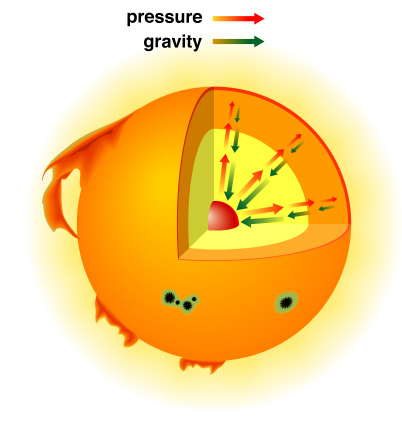
Gravity pulls mass together. However, as matter gets pulled together it heats up and this heat causes the matter to want to expend again. (See the image above.) In order to form something like a star you need a way to keep the matter cool so that gravity can pull the matter into a dense ball without pressure ripping it apart. In modern stars, heavy elements do this by releasing energy through photons.
To first order, photons can only be reabsorbed by elements/molecules "like" the element/molecule that released the photon. Since modern stars contain some but not many heavier elements, the photons that get released by heavier elements never get reabsorbed and exit the star cooling it off.
However, the first stars only had Hydrogen and Helium and lots of it. By the above argument, any photons being released by a Hydrogen or Helium atom would quickly get absorbed by another as they are so plentiful in stars. For this reason, the early stars must have been very large and massive as they had no way of cooling into the types of stars we had today.
The Results:
Kreckel et al. has published an article in Science discussing advances in this area. It turns out, that molecular hydrogen appears to have cooled off these early stars better than anything else. The problem is there is a lot of uncertainty over how much molecular hydrogen there was in early stars.
Kreckel et al. preform experiments in a lab and put tight constraints on the amount of molecular hydrogen, H2, that must have existed in the early stars. These constraints tighten the uncertainty in the mass of early stars from a factor of 20 times the jeans mas to a factor of two. Ie... there error bars on the mass of the first stars has dropped by a factor of ten with the new constraints on the molecular hydrogen abundance! It is amazing how much influence cooling channels have on a star's mass.
Now we can be excited for the James Webb Space Telescope that may allow us to study these first stars in detail.
Kreckel, H., Bruhns, H., Cizek, M., Glover, S., Miller, K., Urbain, X., & Savin, D. (2010). Experimental Results for H2 Formation from H- and H and Implications for First Star Formation Science, 329 (5987), 69-71 DOI: 10.1126/science.1187191
Pages
Showing posts with label Pop III. Show all posts
Wednesday, July 7, 2010
Massive Early Stars And Molecular Hydrogen Cooling
Monday, November 27, 2006
What Would I Like to See in Graduate School?
As many of you may know I hope to be off to graduate school next year. If I am like the average graduate student I will be there 5-6 years meaning I may be there until 2012-2013.(Yikes!) I happen to be going at perhaps the best time in history. In the next 5-6 years we may come up with some of our most profound discoveries ever. Here is what I hope to see.

1. The Higgs field and Supersymmetry: We all have been thankful for the success of the Standard Model, but I believe we are ready to move on. One major particle that I am desperately hoping CERN finds is the Higgs Boson. Come 2007, the LHC, at CERN will be operating at energies higher then currently being achieved anywhere else; on the order of of 14 TeV. In addition to finding the Higgs, I am really crossing my fingers that we will find strong evindence for supersymmetry. Not only will supersymmetry give us a huge slew of new particles to explore, it will hopefully resolve some of our issues such as the vacuum energy problem and candidates for dark matter.
2. Gravitational Waves: Being able to detect light we cannot see visually, like infrared and microwaves, has greatly furthered our understanding of nature. I hope we will soon add to that gravitational waves. Gravitat
ional waves will greatly enhance our ability to study the universe. We will better understand centers of Galaxies, neutron stars and black holes. In addition, many are very excited on what light gravitational waves will shed on the initial stages of the universe. That will help us further understand not only large stellar objects, but also the small particles which formed in the early stages of the universe. Hopefully LIGO and LISA will be successful which I am at graduate school.
3. Neutrino Background: Many are familiar with the CMB or cosmic microwave background radiation but not as many people are familiar with the theoretical neutrino backgrou
nd. It turns out, there should be a huge collection of neutrinos left over from the big bang era which haven't interacted with anything. We should be able to study this collection much as we can study the CMB to determine truths about the universe. Surely there will be much learned from the neutrino background, and this is yet another discovery I hope we make soon.
4. Pop III Objects: Stars and planets today have lots of elements heavier then hydrogen and helium. During the initial stages of the universe, it was practically all hydrogen and helium. Because of this the physics of the cosmos was very different then it is today. These differences make all the difference in the world if you are trying to understand the unive
rses history. Understanding the universe's history is very important in uncovering how and why the universe is the way it is. Hopefully the Hubble, or more realistically the new James Webb Telescope which will launch in 2013, will detect these objects.
5. Dark Matter and Dark Energy: This may be asking a little much, but with some luck the above things will set straight what is dark matter and dark energy. Maybe supersymmetry is responsible, or maybe something else.
6. The Stage Set for the Theory of Everything: Okay, I have to realistically believe quantum gravity, etc... will not be solved in the next 5-6 years. However, if we can understand the basics of supersymmetry, information coming from gravitational waves, the neutrino background, early population III objects and the higgs field, we might be able to have enough cosmological data to really get somewhere. I've said it before, and I will keep saying it, string theorists are demanding particle accelerators the size of the solar system to
test things that will result in understanding quantum gravity. We may never have such accelerators, but we do have an event about 13.7 Billion years ago with energies high enough that if we could examine it close enough we may be knocking on the door to understanding quantum gravity and more. These are the events I hope to see which I believe will lead up to that.
1. The Higgs field and Supersymmetry: We all have been thankful for the success of the Standard Model, but I believe we are ready to move on. One major particle that I am desperately hoping CERN finds is the Higgs Boson. Come 2007, the LHC, at CERN will be operating at energies higher then currently being achieved anywhere else; on the order of of 14 TeV. In addition to finding the Higgs, I am really crossing my fingers that we will find strong evindence for supersymmetry. Not only will supersymmetry give us a huge slew of new particles to explore, it will hopefully resolve some of our issues such as the vacuum energy problem and candidates for dark matter.
2. Gravitational Waves: Being able to detect light we cannot see visually, like infrared and microwaves, has greatly furthered our understanding of nature. I hope we will soon add to that gravitational waves. Gravitat
3. Neutrino Background: Many are familiar with the CMB or cosmic microwave background radiation but not as many people are familiar with the theoretical neutrino backgrou
4. Pop III Objects: Stars and planets today have lots of elements heavier then hydrogen and helium. During the initial stages of the universe, it was practically all hydrogen and helium. Because of this the physics of the cosmos was very different then it is today. These differences make all the difference in the world if you are trying to understand the unive
5. Dark Matter and Dark Energy: This may be asking a little much, but with some luck the above things will set straight what is dark matter and dark energy. Maybe supersymmetry is responsible, or maybe something else.
6. The Stage Set for the Theory of Everything: Okay, I have to realistically believe quantum gravity, etc... will not be solved in the next 5-6 years. However, if we can understand the basics of supersymmetry, information coming from gravitational waves, the neutrino background, early population III objects and the higgs field, we might be able to have enough cosmological data to really get somewhere. I've said it before, and I will keep saying it, string theorists are demanding particle accelerators the size of the solar system to
| Tweet |
|
|
Labels:
CERN,
dark energy,
dark matter,
graduate school,
Gravitational Waves,
higgs,
neutrino,
Pop III,
string theory,
supersymmetry
Subscribe to:
Posts (Atom)