Pages

Showing posts with label higgs. Show all posts

Tuesday, June 22, 2010

Could Latest Particle Finding Hint At Supersymmetry?

You may have heard the media throwing out headlines like the "God Particle" May Be Five Distinct Particles", referring to the latest findings that five Higgs Bosons may fit the data better than one.
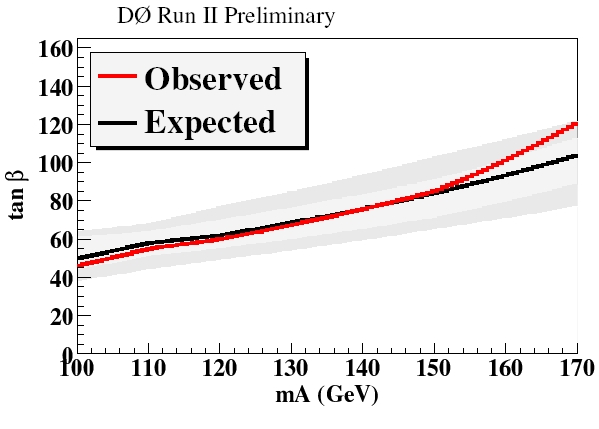
In an experiment called DZero... Scientists recently found that collisions of protons and antiprotons produced pairs of matter particles more often than pairs of antimatter particles.   The difference... can't be explained by a standard model that assumes the existence of a single Higgs boson...
The DZero results can, however, be explained if scientists assume the Higgs boson is actually five particles...
Now, when I first heard these results I thought "What's really interesting here isn't that there may be 5 Higgs Bosons, but that this sounds an awful lot like supersymmetry." Luboš Motl agrees.  (Read his post for more details.)

Here's why this is interesting from the supersymmetry perspective: In the traditional non-supersymmetric standard model the Higgs Boson is a "doublet", meaning in semi-layman's terms it consists of two complex fields. (A double of the Lie Group SU(2) to be more precise.)  But each complex field can be decomposed into two fields representing the real and imaginary parts. (Just like the complex number z can be decomposed into numbers a and b such that z = a + ib.)

After symmetries are broken, three of the four fields go into giving the W+, W- and Z Bosons mass.  The single degree of freedom left over becomes the long sought after Higgs.

In supersymmetry you need the Higgs to really be two Higgs doublets to avoid anomalies. (Or in lay terms, to get the math to work out right.)  Therefore, there are 4+4 = 8 particles that after symmetry breaking become 8 - 3 = 5 particles.  Again, the 3 like the above were "eaten" to give the W+, W- and Z bosons mass.

So, data where five Higgs particles is a better fit isn't interesting because there may be five God particles, but because this could be hinting at supersymmetry!  However, before I count my chickens before they hatch, let me repeat the famous mantra: Half of all three sigma detections are false.  In other words, this five particle best fit may or may not be real.

This is the article: Bogdan A. Dobrescu, Patrick J. Fox, Adam Martin: CP violation in B_s mixing from heavy Higgs exchange, arXiv:1005.4238.

Tuesday, May 25, 2010

Could The Higgs Boson Be A Composite? (Composed of Many Particles)

As most you you know, the Higgs Boson is probably the most sought after un-discovered particle.  Currently, the Large Hadron Collider and the Tevetron ar busy trying to find this particle.   This particle is thought to hold the whole standard model of particle physics together.  (Take the Higgs out of the standard model and all kinds of problems arise like: how do particles have mass?)

Interestingly, the Higgs is best described mathematically as what is known as a scalar field.  We've never found a scalar field that actually exists fundamentally!  Will the Higgs be the first or will the Higgs turn out to be like the Pion?

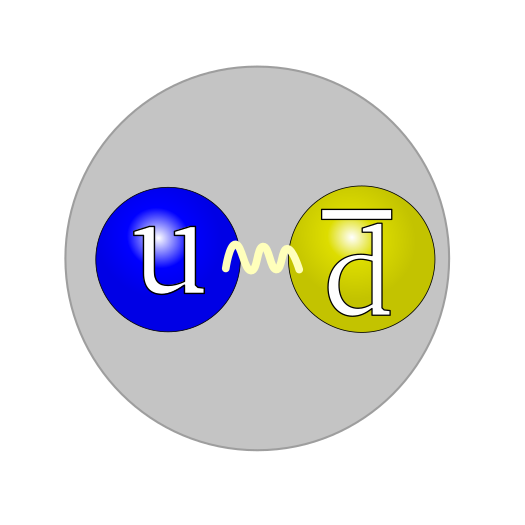
The Pion is a particle that "at low energies" is well described by a scalar field.  However, fundamentally we have discovered the Pion is actually composed of more fundamental particles called quarks.  This composition is pictured above.  These quarks themselves are not scalar fields but are fermions best described mathematically by spinor fields. (Not scalar fields)

Reasons like these (plus the fact that the best fit mass for the scalar Higgs, assuming only the standard model, has been ruled out by nearly 2 sigma) have caused many physicists to come up with models where the Higgs is more like the pion: best described as a scalar at low energies but fundamentally a composite particle made up of more fundamental non-scalar particles.   Only time will tell.

Friday, May 21, 2010

LHC Still On Track. (Possible Z Boson Events?)


As mentioned here, the LHC should begin "re-discovering" the W and Z bosons if all goes well in the near future.  This is yet another step toward discovering the theoretical Higgs. (The W and Z masses are around 80-90 GeV and the Higgs should be somewhere between 115-150 GeV.)

Today I had a fellow grad student email me pictures of events they think may be the Z boson.  If so, the machine is right on track.  Pictured above are the events.

However, though things are on track, several people have told me it will still be a few years before we can definitively say the Higgs has been discovered.

Monday, March 15, 2010

The 120 Order Of Magnitude Problem.

(The forth post in the dark energy series.)

Now to address the concern the that value of the cosmological constant is off by 120 orders of magnitude from what we expect from theory.  To start off with, let's talk about the Higgs Boson.

The public, media, and many scientists, are greatly anticipating the detection if the Higgs.  Nobody seems to be claiming the Higgs is some mysterious thing scientists seem to know nothing about.  It makes predictions.  It fits the physics well.  It makes the standard model work.  But, like the cosmological constant, it seems experimentally confirmed theory (things like supersymmetry is not confirmed yet.) and experiment disagree by several orders of magnitude about what it's mass should be.

The Hierarchy Problem
This is the famous Hierarchy problem.   Scientists admit to it's existence, but none seem to treat the Higgs as being mysterious. Here's the problem:
  1. You calculate the Higgs mass using standard understood QFT.
  2. You find that the Higgs mass should be up at the Planck scale because of loop divergences at energy scales we don't understand.
  3. From experiment you find that the Higgs mass should be at the 100 GeV scale, (this is several orders of magnitude too small).
  4. You invent some unobserved machinery, like supersymmetry, that explains why the Higgs mass should be at the 100 GeV scale after all. (Seriously, string theory and the hierarchy problem are the real reasons why we have supersymmetry.)
  5. The media, even the Wikipedia, now nicknames the Higgs as the God Particle and people don't seem to take much issue with it.
Now let's look at the cosmological constant's size.  (Do these divergences make me look fat?)

Back to the paper:
The problem [of the cosmological constant's value] is similar (but worse) to the problem given by the Higgs mass, which scales quadratically in the standard model, and can be taken as an indication that “there is something we have not yet understood” in Higgs physics.
 How similar.  This is how we find the discrepancy:
  1. You calculate the value of lambda (the cosmological constant) using standard understood QFT.
  2. You find that the lambda should be a "Planck-scale vacuum energy" from loop divergences at energy scales we don't understand.
  3. From experiment you find it is very small, about 120 orders of magnitude smaller than this Planck-scale value.
  4. You successfully invent some unobserved machinery,  like string theory, that can explain the discrepancy.
  5. Everyone maintains the cosmological constant is dark and mysterious.
Maybe it's high energy particle physics that is the real problem.

The problem of the cosmological constant being off by 120 orders of magnitude is analogous to the Higgs' mass being off by several orders of magnitude.   The real problem may have nothing to do with the Higgs or the cosmological constant being weird or mysterious, but may be that we just don't understand physics at high energies.

Now, just to be honest, the machinery needed to fix the cosmological constant problem needs to be more sophisticated than what is needed for the Higgs.

Still, given its analogous nature, in this context, I wonder if the cosmological constant is being treated unfairly.

Saturday, February 6, 2010

Probably No Higgs Discovery Before 2013.

I said earlier on this blog it will take years before the LHC can actually discover big things.  To echo my claims I point you to a much more knowledgeable person on this subject Tommaso Dorigo.

After a very enlighting post he concludes like this:
The LHC experiments will be unable, in my opinion, to make up in two years of data taking, and with the 3.5 times larger energy, for the 8-year advantage in running time of the Tevatron. The Higgs boson will be unlikely to be discovered before 2013, and it will probably be a sole LHC business; however, until then the Tevatron will retain the better results as far as the mass exclusion range is concerned.
I've said it before and I will say it again: new discoveries from the LHC realistically are years away.

But at least there are lots of other experiments to be excited about in the meantime.  We'll keep our readers up to date with this information s well.

Tuesday, October 13, 2009

The Future Preventing The LHC From Working?


Two authors, Holger Nielse and Masao Ninomiya, have been cooking up a crazy theory which can be read in detail from their articles here, here and here.

Basically, they put forward the idea that perhaps the reason we keep failing to find the Higgs boson is that something from the future is stopping us from doing it.  From their latest article:
This previous work was concerned with looking for backward causation [noting] bad luck for large Higgs producing machines, such as LHC and the never finished SSC (Super- conducting Super Collider) stopped by Congress because of such bad luck, so as not to allow them to work.
So, in other words, perhaps the "bad luck" of the SSC being stopped by congress and the more recent bad luck in getting the LHC working comes from causing originating from the future.

Dennis Overbye has this puts it like this:
[Perhaps] the troubled collider is being sabotaged by its own future. A pair of otherwise distinguished physicists have suggested that the hypothesized Higgs boson, which physicists hope to produce with the collider, might be so abhorrent to nature that its creation would ripple backward through time and stop the collider before it could make one, like a time traveler who goes back in time to kill his grandfather...“It must be our prediction that all Higgs producing machines shall have bad luck,”
Now, I know of scientists that think this is such crack-pottery that they are furious such papers have been successfully posted on arXix.org.  This is really crazy stuff.

But, if it is forever the case that potential Higgs producing machines have such bizarre bad luck at least we will have one theory why. :)

Friday, March 6, 2009

The Higgs and Inflaton: Two Peas in a Pod

The Higgs Boson is an scalar particle that single handedly makes the whole standard model of particle physics make sense. One problem: nobody has detected that it actually exists.

The Inflaton is an scalar particle that single handedly makes the whole standard model of Cosmology/Big Bang make sense. One problem: nobody has detected that it actually exists.

Isn't it amazing that a fundamental ingredient of two of the most experimentally successfully theories is a scalar particle which has never been detected? It is as if scalar particles have a Dr. Jekyll Mr. Hyde personality: The want to solve all our problems while at the same time cause everyone endless grief/time/money by escaping our detection!!!

They truly are two peas in a pod. :)

Thursday, April 10, 2008

Does Higgs Have Insider Information?

Okay, before I go into it, I have to say it drives me crazy that the "popular" media continues to refer to the Higgs Boson as the "God particle." I know why they do it but it is a pet peeve of mine. I just don't like it.

With that said, I have been interested in the recent reporting that Dr. Peter Higgs, whom the particle was named after, is claiming he think it will be discovered within the next year. Furthermore, he says that his recent trip to CERN convinced him of this and also suspects evidence of the Higgs may exist in data at Fermilab but the data is to difficult to bring it out as of now.

I have no evidence of this, but all these statemements make me wonder if he has some insider information on what people are seeing. It could be the media is playing his comments up too much, but a part of me wonders if some groups have some interesting data where the details just need to be worked out. If he is correct we should find out in the next year or so.

One reason I question if he has insider information is there are several people at Irvine with ties to many experimental groups and they don't seem to claim anything special is being seen. So, I don't know.

From the USA Today:

GENEVA — The father of a theoretical subatomic particle dubbed "the God particle" says he's almost sure it will be confirmed in the next year in a race between powerful research equipment in the United States and Europe.

British physicist Peter Higgs, who more than 40 years ago postulated the existence of the particle in the makeup of the atom, said his visit to a new accelerator in Geneva last weekend encouraged him that the Higgs boson will soon be seen...

Higgs said Monday the particle may already have been created at the rival Fermi National Accelerator Laboratory outside Chicago, where the Tevatron is currently the world's most powerful particle accelerator.

"The Tevatron has plenty of energy to do it," Higgs said. "It's just the difficulty of analyzing the data which prevents you from knowing quickly what's hiding in the data."

Thursday, January 24, 2008

Higgs Hiding in Plain Sight?

I don't want to go into the details, since I don't have time and you probably aren't completely interested, but, one interesting result of supersymmetry is that it is possible for the Higgs field to be made of several particles. In this case, you could have a lower and higher mass Higgs.

If this is the case, it could be the low mass sector of the Higgs field is right under our noses in the current particle data. It was recently proposed how this could be the case and urges the physics community to look for it. If found to be correct it would be a good day for supersymmetry! :) From Science:

Thousands of particle physicists are spending billions to try to spot the elusive Higgs boson, which is key to explaining the origins of mass. But evidence of the Higgs boson--or at least a Higgs boson--may already be lying unnoticed in data from previous experiments, new calculations suggest.

All matter is made up of indivisible bits or particles, and at first blush, the prevailing theory--the Standard Model--seems to predict that all of them have no mass. Of course, that doesn't make sense--even electrons weigh something. But if theorists simply assign masses to the particles, the theory goes mathematically haywire.

Enter the Higgs boson. Physicists suspect that empty space is permeated by a Higgs field, which is a bit like an electric field. And just as an electric field consists of particles called photons, the Higgs field consists of particles called Higgs bosons. The Higgs field drags on particles to give them mass, akin to molasses tugging on a spoon. In particular, the field gives mass to subatomic particles called the W and Z bosons, which convey the weak nuclear force and weigh in at a staggering 86 and 97 times as much as a proton, respectively.

Finding the Higgs would complete the Standard Model, but physicists hope many more particles exist, too. A favorite scheme called supersymmetry predicts that every known particle has a much more massive partner that scientists haven't yet seen. Many versions of supersymmetry exist, and each requires at least five kinds of Higgs bosons. All those extra particles might seem like needless embellishments, but their presence would solve some technical and conceptual problems in the Standard Model. Physicists hope these particles might start to appear in experiments either at the Tevatron collider at Fermi National Accelerator Laboratory (Fermilab) in Batavia, Illinois (Science, 2 June 2006, p. 1302), or at the more-powerful Large Hadron Collider (LHC) at the European lab, CERN, near Geneva, Switzerland, which will power up this summer (Science, 23 March 2007, p. 1652).

But experimenters may have already overlooked a Higgs particle, argues theorist Chien-Peng Yuan of Michigan State University in East Lansing and his colleagues. They considered the simplest possible supersymmetric theory. Ordinarily, theorists assume that the lightest of theory's five Higgses is the one that drags on the W and Z. Those interactions then feed back on Higgs and push its mass above 121 times the mass of the proton, the highest mass searched for at CERN's Large Electron-Positron (LEP) collider, which ran from 1989 to 2000. But it's possible that the lightest Higgs weighs as little as 65 times the mass of a proton and has been missed, Yuan and colleagues argue in a paper to be published in Physical Review Letters.

How could that happen? The key is in how strongly the lightest Higgs interacts with the W and Z. The theorists show it's possible to make that interaction very weak. In that case, the lightest Higgs can be very light indeed, but it would not have been seen at LEP, because LEP experimenters were looking for an energetic collision that made a Z that then spit out a Higgs. That wouldn't happen very often if the lightest Higgs and the Z hardly interact. "Just within the simplest supersymmetric model, there's still room for Higgs that is missed," Yuan says.

However, this lightweight Higgs is not exactly the Higgs everyone is looking for, says Marcela Carena, a theorist at Fermilab. "The Higgs they are talking about is not the one responsible for giving mass to the W and Z," she says. It can't be because it hardly interacts with those particles, Carena says. Indeed, in Yuan's model, the role of mass-giver falls to one of the heavier Higgses, which is still heavier than the LEP limit, she notes.

Nevertheless, the new analysis has implications for current experiments, Yuan says. For one, evidence for the very light Higgs could be in data already in the can at Fermilab. And if the scheme isn't the one nature plays by, Yuan says, then the LHC will be able to prove that conclusively. "We're not saying the model is correct," he says. "We're saying it's possible and should be checked."
Saturday, June 2, 2007

More Exciting Particle Rumors!

Tommaso Dorigo, a collider physicist and blogger, is letting out a rumor that there may have been a 4-5 sigma detection of a particle around 180 GeV of mass. If tis is the case, as he explains, it could very well be a supersymmetric particle. I am excited to see if this is more than a rumor since 4-5 sigma is serious business.

Tuesday, May 15, 2007

Major Article In New York Times On CERN

The New York Times is running an article called "A Giant Takes On Physics’ Biggest Questions" which takes up 3 whole pages starting on D1 and 6 internet pages here. They have a lot of nice pictures, diagrams and explanations of what will be going on at CERN. It is really a great article. (There are more pictures/diagrams in the paper version. Really good ones too.) I'm glad we get the New York Times here at BYU for free. (BYU foots the bill)

Monday, April 9, 2007

CERN Blows Up

You probably heard about this by now, it's kind of old news, but I found a rather humerus article about it. Actually the article was uninteresting, but the comments were rather funny. Oh, the things people don't know. Also I find it interesting how the article is blaming Fermilab for the whole mess (are they implying a kind of cloak and dagger secret sabotage?).

Friday, March 9, 2007

Musser's 10 Predictions by 2017

George Musser works for the Scientific American. He recently made a prediction of what he expects to see discovered in physics over the ten years.

Though they are just predictions, the fact of the matter is these predictions are all theoretically possible to have via the LHC at CERN, the Plank Satellite, Ligo, Lisa and other experiments going up over the next decade. If all goes well most and maybe all ten of these may in reality happen! We really are living in an interesting time in physics. Here is his list:
  1. HIGGS
  2. SUPERSYMMETRY
  3. WHAT DARK MATTER IS
  4. DARK ENERGY
  5. HOW INFLATION HAPPENED (ie... was it an eternal inflation model or other)
  6. GRAVITATIONAL WAVES
  7. PROTON DECAY
  8. LITTLE BLACK HOLES (Formed in particle accelerators)
  9. ANTHROPIC PRINCIPLE (How the Universe began, like #5. String Landscape?)
  10. OTHER EARTHS (Other earths with life. This one is the most far fetched but who knows)
Only time will tell. I hope to be working on a few of those at graduate school.

Thursday, March 8, 2007

Minimal Supersymmetric Standard Model (MSSM)

(Click on image to read)
Today in our theory meeting we again brought up the Minimal Supersymmetric Standard Model (MSSM). Being as it is one of the three main areas I want to vigorously study in graduate school I thought I would write a post in tribute to it.

The MSSM is the minimal extension of the standard model which allows for supersymmetry. If it turns out to be correct it may solve three major problems:
  • The Hierarchy Problem: The Higgs Boson is so much lighter than the Plank mass. For details for this problem see the Wikipedia.
  • Helps work out the Grand Unification Details.
  • It may solve the Dark Matter Problem: the lightest supersymmetric particles should be stable and have the properties of dark matter! :)
What's great about MSSM is not only will it probably solve a lot of problems, but it should be apparent at energy levels achieved at CERN. (I am going to love graduate school). This is both very theoretical and very testable. If the don't find it at CERN it will be back to the drawing board. (For all our string theorists out there, it could be bad news for string theory if supersymmetry is not found.)

In graduate school I want to apply MSSM physics to accelerator physics, dark matter and early universe physics.

Speaking about string theory, if the MSSM model holds then there would be more motivation for studying string theory. I would like to investigate any string phenomenology at the MSSM or MSSM+1 energy ranges if such phenomenology exists.

Thursday, March 1, 2007

100 TeV Accelerator in Our Backyard

As many of you know there is something special about the TeV range: at this energy we should start to see the Higgs, supersymmetric particles and other beyond the standard model physics. Because of this CERN will operate at 14 TeV and hopefully find all of the above.

However, according to researchers, the black hole in the center of our galaxy is accelerating particles at 100 TeV and smashing them into each other giving off a colossal display of gamma rays and other things. Perhaps one day we will have the technology to study these collisions in such a way that we will be able to harness a 100 TeV accelerator nature was nice enough to give to us. And if not it is still a cool thing.

Friday, January 26, 2007

News on the Higgs

I may get this slightly wrong, but I wanted to report on some interesting blog entries here and here, from Cosmic Varience.

It appears that this bump may be the Higgs. Unfortunately, I gather in particle physics you need a 5-sigma confidence to claim discovery. This was only a 2.5-sigma confidence. In other words we are 98% confident but need to be 99.9999427% confident to claim discovery in the world of particle physics.

None the less, it is a really exciting result. Perhaps we are really homing in on the 5-sigma confidence we need. That is exciting! Supersymmetry barrier, here we come!

Thursday, January 18, 2007

W Boson, and Higgs Just Around the Corner?

Well, I threatened to blog about this, and now I am. Before I do I want to say people should consider taking a look at Science Daily every once and a while since they stay on top of really cool recent physics being published.

With that said, according to the report by Science Daily:
Scientists of the CDF collaboration at the Department of Energy's Fermi National Accelerator Laboratory have announced the world's most precise measurement by a single experiment of the mass of the W boson, the carrier of the weak nuclear force and a key parameter of the Standard Model of particles and forces. The new W-mass value leads to an estimate for the mass of the yet-undiscovered Higgs boson that is lighter than previously predicted, in principle making observation of this elusive particle more likely by experiments at the Tevatron particle collider at Fermilab. Scientists working at the Collider Detector at Fermilab measured the mass of the W boson to be 80,413 +/- 48 MeV/c2, determining the particle's mass with a precision of 0.06 percent.
What is so interesting to me is this suggests the Higgs Boson may be light enough to be detected by FermiLab! This also means the needed energy level is likely to be in the crosshairs of CERN. Just any day now and we will be overturning cars in the streets over some monumental news.

Monday, November 27, 2006

What Would I Like to See in Graduate School?

As many of you may know I hope to be off to graduate school next year. If I am like the average graduate student I will be there 5-6 years meaning I may be there until 2012-2013.(Yikes!) I happen to be going at perhaps the best time in history. In the next 5-6 years we may come up with some of our most profound discoveries ever. Here is what I hope to see.

1. The Higgs field and Supersymmetry: We all have been thankful for the success of the Standard Model, but I believe we are ready to move on. One major particle that I am desperately hoping CERN finds is the Higgs Boson. Come 2007, the LHC, at CERN will be operating at energies higher then currently being achieved anywhere else; on the order of of 14 TeV. In addition to finding the Higgs, I am really crossing my fingers that we will find strong evindence for supersymmetry. Not only will supersymmetry give us a huge slew of new particles to explore, it will hopefully resolve some of our issues such as the vacuum energy problem and candidates for dark matter.

2. Gravitational Waves: Being able to detect light we cannot see visually, like infrared and microwaves, has greatly furthered our understanding of nature. I hope we will soon add to that gravitational waves. Gravitational waves will greatly enhance our ability to study the universe. We will better understand centers of Galaxies, neutron stars and black holes. In addition, many are very excited on what light gravitational waves will shed on the initial stages of the universe. That will help us further understand not only large stellar objects, but also the small particles which formed in the early stages of the universe. Hopefully LIGO and LISA will be successful which I am at graduate school.

3. Neutrino Background: Many are familiar with the CMB or cosmic microwave background radiation but not as many people are familiar with the theoretical neutrino background. It turns out, there should be a huge collection of neutrinos left over from the big bang era which haven't interacted with anything. We should be able to study this collection much as we can study the CMB to determine truths about the universe. Surely there will be much learned from the neutrino background, and this is yet another discovery I hope we make soon.

4. Pop III Objects: Stars and planets today have lots of elements heavier then hydrogen and helium. During the initial stages of the universe, it was practically all hydrogen and helium. Because of this the physics of the cosmos was very different then it is today. These differences make all the difference in the world if you are trying to understand the universes history. Understanding the universe's history is very important in uncovering how and why the universe is the way it is. Hopefully the Hubble, or more realistically the new James Webb Telescope which will launch in 2013, will detect these objects.

5. Dark Matter and Dark Energy: This may be asking a little much, but with some luck the above things will set straight what is dark matter and dark energy. Maybe supersymmetry is responsible, or maybe something else.

6. The Stage Set for the Theory of Everything: Okay, I have to realistically believe quantum gravity, etc... will not be solved in the next 5-6 years. However, if we can understand the basics of supersymmetry, information coming from gravitational waves, the neutrino background, early population III objects and the higgs field, we might be able to have enough cosmological data to really get somewhere. I've said it before, and I will keep saying it, string theorists are demanding particle accelerators the size of the solar system to test things that will result in understanding quantum gravity. We may never have such accelerators, but we do have an event about 13.7 Billion years ago with energies high enough that if we could examine it close enough we may be knocking on the door to understanding quantum gravity and more. These are the events I hope to see which I believe will lead up to that.