Pages

Showing posts with label Particle Accelerator. Show all posts

Monday, October 3, 2011

Final Tevatron Shutdown

In addition to a great conference weekend, there was another item of note this last weekend. This weekend, the Tevatron, Fermilab's principle accelerator had its final shutdown. The Tevatron, completed in 1983, held the record for the highest energy particle accelerator in the world until 2009, when it was surpassed by the LHC.


The accelerator's list of milestones is impressive by any standards. The Tevatron announced the discovery of the top quark in 1995, with a measurement of its mass by 2007. The BC meson was detected in 1998, the tau neutrino in 2000, and the Sigmab, Cascade-b, Omegab and Xib baryons detected in 2006, 2007, 2008 and 2011, respectively.

In the Discovery News article reporting the shutdown, Jennifer Ouellette gives an impressive quote from Robert Wilson, the first director of Fermilab. When asked before a congressional committee what the new, proposed Fermilab would be good for, he responded,

It has only to do with the respect with which we regard one another, the dignity of man, our love of culture. It has to do with: Are we good painters, good sculptors, great poets? I mean all the things we really venerate in our country and are patriotic about. It has nothing to do directly with defending our country except to make it worth defending.

Tuesday, January 18, 2011

How Particle Accelerators Like The LHC Work.


The above video shows the best "layman" explanation for how particle accelerators, like the Large Hadron Collider (LHC), work that I have ever seen. I highly encourage you to watch it as it is very clear and straight forward.

Just remember, and this may be the most confusing part of the whole video, words like GeV and TeV refer to how much energy the particles have. Lets just say for particles to have that much energy is extraordinarily!

Wednesday, December 29, 2010

What Would Happen To Particle Physics If The LHC Finds Nothing?

Apparently Tommaso Dorigo, bet $1000 in 2006 that no physics will be found at the TeV scale (the energy scale the LHC is shooting for) before 2011 and even titled that post This 1000$ says there ain’t new physics at the TeV scale.  Back in 2006 that probably would have been seen as a pretty bold bet.  (Now less then a week away, not so much. :) )  It also appears he is still convinced there may not be much to look forward to in 2011 by way of new discoveries.

All this has got me thinking: what would happen to particle phsyics if the LHC finds no new physics beyond the standard model?  Or: what if the LHC finds nothing new except the standard model Higgs? :)

A few things come to mind:

First:  I wonder if that would spell the end of accelerator physics for some time to come do to a withdrawal of funding.  The US and UK already appear to have taken some steps to cut funding for future accelerator experiments even in the face of the potential discoveries of the LHC.  In fact, the UK may still cut some funds for the LHC itself.  How can this funding landscape do anything but get worse if the LHC finds nothing?

It will be difficult to appear before governments and argue "Funny thing HaHa... moving up in energy with the Tevetron yielded no new physics beyond the standard model despite claims that it might... Then moving up in energy even further with the LHC yielded no new physics beyond the standard model despite a barrage of theory papers arguing it should... But, interestingly enough it turns out that if we build an even more expensive/elaborate accelerator then we really believe this time we will find something. :) "

Second:  All the theory papers will be rewritten to demonstrate that the natural energy scale for new physics beyond the standard model is really just above the TeV scale. :)

Now don't get me wrong, I sincerely hope that the LHC (and perhaps still the Tevatron) finds new physics beyond the standard model.  The world would be too boring if the standard model is all us humans can ever uncover with accelerators.  Furthermore, I have a hard time thinking we can go up orders of magnitude in more energy and find nothing. (Although my personal opinions don't effect the reality of the universe.)

Nevertheless, I still wonder what will happen to particle physics if the LHC finds nothing beyond the same standard model that has been around for decades.

Any of you have a any thoughts/guesses?  More money for Cosmology? :)

Tuesday, December 28, 2010

Why Raw Data From Science Experiments Can Scare Me.


Cosmology as a field has become precise enough that we may measure theoretical features at the 1/10 of 1% level or better.  For example, one of Planck's greatest successes could be a detection of what is known as primordial non-Gaussianity that, if it exists, is at most a deviation of less than 0.1% from a pure Gaussian spectrum.


With that in mind, let's look at some raw Planck data.  The image above left (black curve) shows raw data recorded by Planck as time goes by.   It has these features:
  1. You see the dipole of the CMB as a "sine-wave" signal as Planck rotates and scans the sky. (See video above for an illustration of this scanning pattern.)
  2. If you look closely,  you see a sharp peak at the same spot in each sine-pattern.  This is Planck observing the galactic plane.
  3. You also see hundreds of spikes that represent cosmic rays hitting the instrument.  
Now here is the point, all those spikes and other large anomalies are much more significant than deviations from a clean Gaussian signal on the order of 0.1%!  Here we are trying to find deviations on the level of 0.1% and the anomalies from false signals are significantly greater that this!

And so, Planck has to somehow remove them.   The graph on the top right shows what their data looks like when these known anomalies/systematics are accounted for.  It looks decent and gives what looks like a near-Gaussian spectrum modulo the peak from the galactic plane.  Hence, naively/hopefully in such data you can now go searching for 0.1% deviations.

But wait!!!

That clean signal assumes at least the following:
  1. That the simulations of the anomalies and the templates and models used for the removal of this stuff are more accurate that the 0.1% level.
  2. That the removal actually worked... beyond what looks good by eye.
  3. That in the process of removing garbage, Planck didn't inadvertently introduce other false signals.
  4. Etc...
And this "scariness" does not just exist for cosmology data.  For example, I have talked with many people working at the LHC who have admitted that their background issues they have to deal with in the data can be frightening in similar ways. 

Conclusion: Now, don't get me wrong, I have a lot of trust in the Planck team/LHC/whoever.  I really do.  But let's just say this still scares me a little.  Some of the most important results from in physics hinge on better that 1/10 of 1% accuracy in both removing false signals and in not introducing fictitious ones during such a removal process.  (And everyone in the trenches knows this can be really hard to get right!) Therefore, this sometimes seems like a scary business... but at the same time it is also a testament to how far we have come in science. :)

Tuesday, June 22, 2010

Could Latest Particle Finding Hint At Supersymmetry?

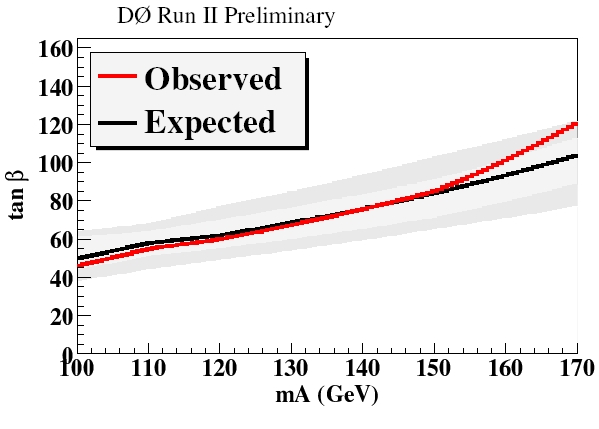
You may have heard the media throwing out headlines like the "God Particle" May Be Five Distinct Particles", referring to the latest findings that five Higgs Bosons may fit the data better than one.
In an experiment called DZero... Scientists recently found that collisions of protons and antiprotons produced pairs of matter particles more often than pairs of antimatter particles.   The difference... can't be explained by a standard model that assumes the existence of a single Higgs boson...
The DZero results can, however, be explained if scientists assume the Higgs boson is actually five particles...
Now, when I first heard these results I thought "What's really interesting here isn't that there may be 5 Higgs Bosons, but that this sounds an awful lot like supersymmetry." Luboš Motl agrees.  (Read his post for more details.)

Here's why this is interesting from the supersymmetry perspective: In the traditional non-supersymmetric standard model the Higgs Boson is a "doublet", meaning in semi-layman's terms it consists of two complex fields. (A double of the Lie Group SU(2) to be more precise.)  But each complex field can be decomposed into two fields representing the real and imaginary parts. (Just like the complex number z can be decomposed into numbers a and b such that z = a + ib.)

After symmetries are broken, three of the four fields go into giving the W+, W- and Z Bosons mass.  The single degree of freedom left over becomes the long sought after Higgs.

In supersymmetry you need the Higgs to really be two Higgs doublets to avoid anomalies. (Or in lay terms, to get the math to work out right.)  Therefore, there are 4+4 = 8 particles that after symmetry breaking become 8 - 3 = 5 particles.  Again, the 3 like the above were "eaten" to give the W+, W- and Z bosons mass.

So, data where five Higgs particles is a better fit isn't interesting because there may be five God particles, but because this could be hinting at supersymmetry!  However, before I count my chickens before they hatch, let me repeat the famous mantra: Half of all three sigma detections are false.  In other words, this five particle best fit may or may not be real.

This is the article: Bogdan A. Dobrescu, Patrick J. Fox, Adam Martin: CP violation in B_s mixing from heavy Higgs exchange, arXiv:1005.4238.

Friday, May 21, 2010

LHC Still On Track. (Possible Z Boson Events?)


As mentioned here, the LHC should begin "re-discovering" the W and Z bosons if all goes well in the near future.  This is yet another step toward discovering the theoretical Higgs. (The W and Z masses are around 80-90 GeV and the Higgs should be somewhere between 115-150 GeV.)

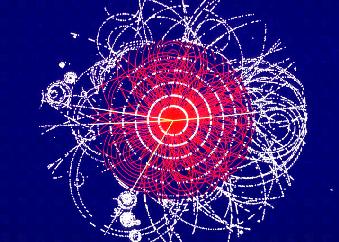
Today I had a fellow grad student email me pictures of events they think may be the Z boson.  If so, the machine is right on track.  Pictured above are the events.

However, though things are on track, several people have told me it will still be a few years before we can definitively say the Higgs has been discovered.

Wednesday, May 12, 2010

Re-Discovering J/Psi Shows LHC On Right Track.


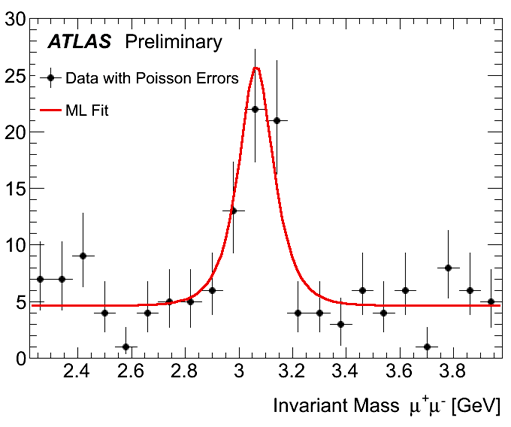
ATLAS, a detector at the largest particle accelerator in the world, the LHC, has "rediscovered" the particle J/Ψ.  From ATLAS news site:

In 1974 the J/Ψ meson was first discovered, heralding a new era of understanding in particle physics. Now again, in 2010, it's ‘rediscovery’ in ATLAS and the other LHC experiments’data signals an important stage towards what will hopefully also become an historic milestone in high energy physics.
In the plot above we see a particle is detected in just the right spot to be J/Ψ.  Its nice to see that withen a few months of collisions the LHC is already able to rediscover particles that took years to discover a few decades ago.  So, it appears things are moving forward nicely.

On to the Higgs?

Saturday, February 6, 2010

Probably No Higgs Discovery Before 2013.

I said earlier on this blog it will take years before the LHC can actually discover big things.  To echo my claims I point you to a much more knowledgeable person on this subject Tommaso Dorigo.

After a very enlighting post he concludes like this:
The LHC experiments will be unable, in my opinion, to make up in two years of data taking, and with the 3.5 times larger energy, for the 8-year advantage in running time of the Tevatron. The Higgs boson will be unlikely to be discovered before 2013, and it will probably be a sole LHC business; however, until then the Tevatron will retain the better results as far as the mass exclusion range is concerned.
I've said it before and I will say it again: new discoveries from the LHC realistically are years away.

But at least there are lots of other experiments to be excited about in the meantime.  We'll keep our readers up to date with this information s well.

Saturday, December 19, 2009

Primer On WIMP Dark Matter.

First, let's state that dark matter could be all sorts of things, but there is a lot of motivation to believe they are weakly interacting massive particles. (WIMPS)  It turns out our own Jonathan Feng at UC Irvine is considered one of the world's greatest experts on WIMPS and has some accessible review articles on dark matter collider physics here and here.  (The first especially should be assessable all physicists. I took images from them.)

I Think Therefore I Am


The fact that a particle exists should tell you it must somehow interact with other particles.  All particles are created and destroyed in interactions with other particles.  It turns out, using arguments from cosmology taking the expansion on the universe into account, how abundant a particle is is directly related to it's typical cross section, or likelihood that it interacts with other particles.  (See equation above.)


The graph on the right demonstrates this.  The higher the cross-section, the lower its abundance in the universe.  If it interacts too much, it won't be abundant enough.  It it interacts too little, it will be too abundant enough.

However, if a non-relativistic particle interacts with typical weak scale cross sections, its relative abundance to rest of the matter is just right to be dark matter.  This is called the "WIMP Miracle".

How Can We Detect it?


We know the the particle has to be non-relativistic because dark matter must be cold.  The typical non-relativistic weak scale cross section is given in the equation above.  Alpha is the hyperfine structure constant, m is the mass and k is a parameterizing allowed small deviations from from the weak scale to still work.  The graph on the right shows masses that work.

In some sense that's it!  If we can find any non-relativistic particle dominated by weak interactions with the right mass, 100 GeV - 1TeV, supersymmetric or not, we can feel fairly confident we have discovered dark matter.

At this point you may ask: "Wait, we know of particles whose dominate interaction is at the weak scale, like say neutrinos.  Why aren't they the dark matter?".  Well, the relativistic nature of these particles changes enough so that they don't work anymore.  (For example they have a different cross section.)

But How Do We Know If It Is Supersymmetric?


(I think) Most non-collider surveys will have a hard time answering this question.  They can answer the more important question: "Is this a non-relativistic particle dominated by weak interactions with a mass on the order of 100 GeV -1TeV?".  If yes, we have our dark matter.


Every different dark matter candidate, such as the supersymmetric ones, have specific ways they interact with other particles.  These ways are described by Feynman Diagrams.  The plot to the right shows the interactions specifically for the neutralino.  Colliders can test these diagrams better than anything else.

So here is the oversimplified formula:

  1. Find a particle dominated by weak interactions.  (Like a neutrino except non-relativistic.)
  2. Ensure the mass is on the order 100 GeV -1TeV. (You've discovered dark matter!!!)
  3. Run an experiment at the LHC for a particle of just that mass interacting mostly through weak interactions. 
  4. Compare the findings with the proposed models of such particles.
  5. If one lines up perfectly you know what particle you are dealing with. (Ie... some like a supersymmetric neutralino)
Smarter people than me may be able to pinpoint the exact particle without a collider, but as far as I know it may take the LHC to do this.  It's initial discovery however should be able to be accomplished without the LHC however.

Tuesday, October 13, 2009

The Future Preventing The LHC From Working?


Two authors, Holger Nielse and Masao Ninomiya, have been cooking up a crazy theory which can be read in detail from their articles here, here and here.

Basically, they put forward the idea that perhaps the reason we keep failing to find the Higgs boson is that something from the future is stopping us from doing it.  From their latest article:
This previous work was concerned with looking for backward causation [noting] bad luck for large Higgs producing machines, such as LHC and the never finished SSC (Super- conducting Super Collider) stopped by Congress because of such bad luck, so as not to allow them to work.
So, in other words, perhaps the "bad luck" of the SSC being stopped by congress and the more recent bad luck in getting the LHC working comes from causing originating from the future.

Dennis Overbye has this puts it like this:
[Perhaps] the troubled collider is being sabotaged by its own future. A pair of otherwise distinguished physicists have suggested that the hypothesized Higgs boson, which physicists hope to produce with the collider, might be so abhorrent to nature that its creation would ripple backward through time and stop the collider before it could make one, like a time traveler who goes back in time to kill his grandfather...“It must be our prediction that all Higgs producing machines shall have bad luck,”
Now, I know of scientists that think this is such crack-pottery that they are furious such papers have been successfully posted on arXix.org.  This is really crazy stuff.

But, if it is forever the case that potential Higgs producing machines have such bizarre bad luck at least we will have one theory why. :)

Monday, February 9, 2009

Fwd: Update on the LHC start-up plans and schedule

I got this email today. I thought someone out there might enjoy it:
Dear Colleagues,

The CERN Director-General has released a follow-up note on
the Chamonix LHC workshop (see mail distributed last Friday).
The note is copied below in full. Its basic message is that
a plan has been adopted which implies a schedule with first
collisions end of October 2009, followed by a long physics run
until autumn next year. Please read the DG's message below which
gives more details about this plan. The impact of this new LHC
schedule on our own ATLAS plans will be a central topic for the
forthcoming ATLAS Week.

These good news emphasize the first LHC physics to which we
are all looking forward!

Kind regards,

Peter Jenni


Subject: Message from the Director-General on the LHC schedule

The CERN Management today confirmed the restart schedule for the Large
Hadron Collider resulting from the recommendations from the Chamonix
workshop. The new schedule foresees first beams in the LHC at the end
of September this year, with collisions following in late October. A
short technical stop has also been foreseen over the Christmas period.
The LHC will then run through to autumn next year, ensuring that the
experiments have adequate data to carry out their first new physics
analyses and have results to announce in 2010. The new schedule also
permits the possible collisions of lead ions in 2010.

This new schedule represents a delay of 6 weeks with respect to the
previous schedule which foresaw LHC "cold at the beginning of July".
The cause of this delay is due to several factors such as implementation
of a new enhanced protection system for the busbar and magnet splices,
installation of new pressure relief valves to reduce the collateral
damage in case of a repeat incident, application of more stringent
safety constraints, and scheduling constraints associated with helium
transfer and storage.

In Chamonix there was consensus among all the technical specialists
that the new schedule is tight but realistic.

The enhanced protection system measures the electrical resistance in
the cable joints (splices) and is much more sensitive than the system
existing on 19 September.

The new pressure relief system has been designed in two phases. The
first phase involves installation of relief valves on existing vacuum
ports in the whole ring. Calculations have shown that in an incident
similar to that of 19 September, the collateral damage (to the
interconnects and super-insulation) would be minor with this first
phase.

The second phase involves adding additional relief valves on all the
dipole magnets and would guarantee minor collateral damage (to the
interconnects and super-insulation) in all worst cases over the life
of the LHC. One of the questions discussed in Chamonix was whether to
warm up the whole LHC machine in 2009 so as to complete the installation
of these new pressure relief valves or to perform these modifications
on sectors that were warmed up for other reasons. The Management has
decided for 2009 to install relief valves on the four sectors that were
already foreseen to be warmed up. The dipoles in the remaining four
sectors will be equipped in 2010.

Thursday, September 11, 2008

The LHC turns on. We're Still Alive!

Though I am late, you know I had to post about the start up of the LHC.

The LHC should become a very exciting experiment. We have never, as humans, gone up a magnitude in energy scale without seeing new physics. The only question is what will the new physics be. (If this becomes the first time we went up a magnitude in energy and see nothing that would really be depressing.)

As you might have guessed, I really am pulling for some verification of supersymmetry. That alone will clear up volumes of theoretical problems. Sure I welcome any new physics, but something as elegant as supersymmetry with incredible explanation power is something I am really pulling for.

One exciting thing, which few people outside of particle physics talk about, is the LHC will have nearly 100 times the luminosity of the Tevetron at Fermilab. To first order this means, in a perfect world, that the LHC will see as much in one year as the Tevetron would see in a century! There is hope for a upgrade in the future that will boost the LHC's luminosity even another order of magnitude.

This experiment should run for decades to come. (It fact, the upgrade is probably about a decade away.) Between the extra order of magnitude in energy, and the extra 2-3 orders of magnitude in luminosity, we should expect great things.

*Note*: The experimentalists I talk to here think the experiments won't really be going full steam for another 6 months. Sure the beam is circulating now, but the detector is still not 100% completed, software is still being written and there is a good chance as they observe the current data they will find things are misaligned etc... Plus, the machine itself is not yet running at full capacity. So, hopefully, some time in the next year or two the discoveries will begin.

Tuesday, June 24, 2008

The LHC is Declared Safe

The LHC Safety Assessment Group (LSAG), (seriously that's what 's called) has released their report that is an update of an earlier report released in 2003. A summary by the European Organization for Nuclear Research can be found here. The report addresses concerns ranging from the creation of mini-black holes that could "gobble up the earth" to the creation of strangelets.

Their basic argument comes down to this: "Over the past billions of years, Nature has already generated on Earth as many collisions as about a million LHC experiments – and the planet still exists. Astronomers observe an enormous number of larger astronomical bodies throughout the Universe, all of which are also struck by cosmic rays. The Universe as a whole conducts more than 10 million million LHC-like experiments per second. The possibility of any dangerous consequences contradicts what astronomers see - stars and galaxies still exist."

In other words: The universe has not ceased to exist, therefore it will continue to exist. Hmmm, novel thought.

The release of this report has given the Department of Energy some ammunition to respond to a lawsuit filed in Hawaii back in March to force the Federal Government to cease operations at CERN. A news article about the lawsuit can be read here. Basically their response is that the federal government does not have jurisdiction in this case and cannot force CERN to not turn on the LHC, and also there has been no credible objection to conducting the experiment as "the claims of potential injury are 'overly speculative and not credible'".

So the LHC can go ahead and do its stuff and we can rest easy knowing that if the earth is destroyed because of the LHC someone somewhere will get some pleasure thinking "I told them so!" milliseconds before they are sucked into a black hole, or converted into a strangelet.

Sunday, May 4, 2008

ATLAS@CERN

ATLAS is a project at CERN that will preforms several experiments, including searching for the Higgs Boson and other new particles.

ATLAS is detector at the LHC.

There are several people here at UC Irvine working on the ATLAS project. Here is a youtube video giving more details of ATLAS itself:


Part two can't be embedded for some reason. Here is the link for Episode 2 Part One. Here is the link for Episode 2 part two.

Thursday, April 10, 2008

Does Higgs Have Insider Information?

Okay, before I go into it, I have to say it drives me crazy that the "popular" media continues to refer to the Higgs Boson as the "God particle." I know why they do it but it is a pet peeve of mine. I just don't like it.

With that said, I have been interested in the recent reporting that Dr. Peter Higgs, whom the particle was named after, is claiming he think it will be discovered within the next year. Furthermore, he says that his recent trip to CERN convinced him of this and also suspects evidence of the Higgs may exist in data at Fermilab but the data is to difficult to bring it out as of now.

I have no evidence of this, but all these statemements make me wonder if he has some insider information on what people are seeing. It could be the media is playing his comments up too much, but a part of me wonders if some groups have some interesting data where the details just need to be worked out. If he is correct we should find out in the next year or so.

One reason I question if he has insider information is there are several people at Irvine with ties to many experimental groups and they don't seem to claim anything special is being seen. So, I don't know.

From the USA Today:

GENEVA — The father of a theoretical subatomic particle dubbed "the God particle" says he's almost sure it will be confirmed in the next year in a race between powerful research equipment in the United States and Europe.

British physicist Peter Higgs, who more than 40 years ago postulated the existence of the particle in the makeup of the atom, said his visit to a new accelerator in Geneva last weekend encouraged him that the Higgs boson will soon be seen...

Higgs said Monday the particle may already have been created at the rival Fermi National Accelerator Laboratory outside Chicago, where the Tevatron is currently the world's most powerful particle accelerator.

"The Tevatron has plenty of energy to do it," Higgs said. "It's just the difficulty of analyzing the data which prevents you from knowing quickly what's hiding in the data."

Sunday, April 6, 2008

Why Give Money To Particle Physicists?

We had a post a while back musing over different reasons to give for demanding our research is funded.

Here you go: If you give money to particle physicists they will do something like create the internet. Why do I say that? Well: Particle Physicists at CERN created the internet!

*One reason you know it was scientists and not some free market company is the world wide web was released for free to the public. (See below.) Would we better off if some company patented it and controlled it? I think not. Go open source!*

Back in the 80s particle physicists wanted to create something that would send their data to people all over the world. They created the world wide web. Recently, CERN has created a "new version of the internet" that is 10,000 times faster.

From the new Times story:
"THE internet could soon be made obsolete. The scientists who
pioneered it have now built a lightning-fast replacement capable of
downloading entire feature films within seconds.

At speeds about 10,000 times faster than a typical broadband
connection, "the grid" will be able to send the entire Rolling Stones
back catalogue from Britain to Japan in less than two seconds.

The latest spin-off from Cern, the particle physics centre that
created the web, the grid could also provide the kind of power needed
to transmit holographic images; allow instant online gaming with
hundreds of thousands of players; and offer high-definition video
telephony for the price of a local call."

From the Wikipedia:

The World Wide Web began as a CERN project called ENQUIRE, initiated by Tim Berners-Lee and Robert Cailliau in 1989. Berners-Lee and Cailliau were jointly honored by the ACM in 1995 for their contributions to the development of the World Wide Web.

Based on the concept of hypertext, the project was aimed at facilitating sharing information among researchers. The first website went on-line in 1991. On 30 April 1993, CERN announced that the World Wide Web would be free to anyone. A copy of the original first webpage, created by Berners-Lee, is kept here

Prior to the Web's development, CERN had been a pioneer in the introduction of Internet technology in Europe, beginning in the early 1980s. A short history of this period can be found here.

So, again, if you give money to particle physicists they will do something like create the internet.

Tuesday, July 24, 2007

New New York Times Post On Fermilab

From The New York Times: (A Long Article, click the link to read it)

Saturday, June 2, 2007

More Exciting Particle Rumors!

Tommaso Dorigo, a collider physicist and blogger, is letting out a rumor that there may have been a 4-5 sigma detection of a particle around 180 GeV of mass. If tis is the case, as he explains, it could very well be a supersymmetric particle. I am excited to see if this is more than a rumor since 4-5 sigma is serious business.

Monday, April 9, 2007

CERN Blows Up

You probably heard about this by now, it's kind of old news, but I found a rather humerus article about it. Actually the article was uninteresting, but the comments were rather funny. Oh, the things people don't know. Also I find it interesting how the article is blaming Fermilab for the whole mess (are they implying a kind of cloak and dagger secret sabotage?).

Friday, March 9, 2007

Musser's 10 Predictions by 2017

George Musser works for the Scientific American. He recently made a prediction of what he expects to see discovered in physics over the ten years.

Though they are just predictions, the fact of the matter is these predictions are all theoretically possible to have via the LHC at CERN, the Plank Satellite, Ligo, Lisa and other experiments going up over the next decade. If all goes well most and maybe all ten of these may in reality happen! We really are living in an interesting time in physics. Here is his list:
  1. HIGGS
  2. SUPERSYMMETRY
  3. WHAT DARK MATTER IS
  4. DARK ENERGY
  5. HOW INFLATION HAPPENED (ie... was it an eternal inflation model or other)
  6. GRAVITATIONAL WAVES
  7. PROTON DECAY
  8. LITTLE BLACK HOLES (Formed in particle accelerators)
  9. ANTHROPIC PRINCIPLE (How the Universe began, like #5. String Landscape?)
  10. OTHER EARTHS (Other earths with life. This one is the most far fetched but who knows)
Only time will tell. I hope to be working on a few of those at graduate school.