Pages

Showing posts with label cosmology. Show all posts

Friday, April 27, 2012

I Think To Myself, What A Wonderful World.


I was listening to the song What a Wonderful World sung by Louis Armstrong the other day and was really touched by the truth of these lines:
I hear babies cry and I watch them grow,
They'll learn much more than I'll know,
And I think to myself, what a wonderful world
And how true this is!  Especially in cosmology. (And physics in general for that matter.)  When I was just being born, physicists didn't know things that these days are considered common knowledge by many even layman: that the universe is flat, that it is accelerating, that it is dominated by dark matter and dark energy, (didn't even know about dark energy at all for that matter!),  that there were initial perturbations left over after the big bang that seeded the large scale structure like stars and galaxies we see today, etc...

And forget going all the way back to my birth, many of these things were even unknown in the graduate school days of my thesis advisor who obtained his PhD just 11 years ago! While he was a grad student they discovered the universe was flat for the first time.  While he was a grad student confirmations started coming in that it was accelerating and dominated by dark energy.  And this is evident in his papers which are full of very different cosmology models that today graduate students like me get a kick out of reading knowing how wrong those models fit current data and yet are only 10-15 years old!

And so it continues to be the case.  By the time I am a thesis advisor (a big *if* that that will ever happen mind you) we may know what kind of particles make up dark matter... and it may be common knowledge.  What dark energy is may be common knowledge.  Heck, it was just reported today we may have found a habitable planet other then our own!  By the time I am a thesis advisor, who knows what we will know about life in the universe!

And finally, what is great about this song it that it concludes: what a wonderful world.  How easy is it for us to have a hard time with someone being "better" or "smarter" then we ever will be? And yet Louis feels perfectly happy marveling that the little children of his day may learn so much more they he'll ever know.

And so it is, and I agree.  And I think to myself, what a wonderful world!

Tuesday, October 4, 2011

Nobel for Supernovae and Dark Energy

The Nobel Prize in Physics this year will go to Saul Perlmutter of UC-Berkeley, Adam Riess of the Space Telescope Science Institute at Johns Hopkins, and Brian Schmidt of the Austrialian National University for their co-discovery of the accelerating expansion of the universe caused by dark energy.  Perlmutter founded the Supernova Cosmology Project, while Riess and Schmidt founded the High-Z Supernova Search Team.  These two group announced in 1998 that observations of extremely distant supernovae showed that the expansion of the universe was accelerating through a still mysterious force known as dark energy

This has to go down as one of the least surprising Nobel announcements in recent history.  The discovery that 3/4 of the mass energy of the universe is in some mysterious form that behaves as a sort-of anti-gravity was a block-buster from the day it was announced.  The fact that subsequent work has confirmed this discovery continues to emphasize its importance.  Good call on this one, Nobel committee.

Tuesday, May 17, 2011

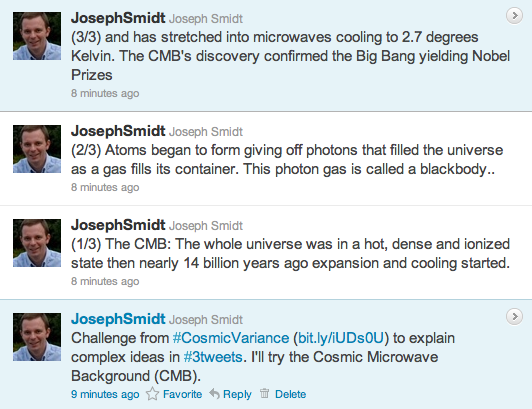
Complex Ideas in 3Tweets. (The CMB)

Sean Carroll has challenged people to describe complex ideas in 3 Twitter Tweets.  With that being said, I decided to tackle the Cosmic Microwave Background (CMB):

I encourage everyone to try do this with some complex idea as it is both fun and a useful skill to be able to boil down complex ideas to short simple explanations.   And even if you don't have a Twitter account you should try it. If nothing else, you can post three 140 character descriptions of any complex topic here in the comments.

Good luck!

Thursday, March 3, 2011

More Problems With SUSY... and MOND Humor.

Two things.  First, back to problems with supersymmetry.   Tommaso Dorigo has posted this very helpful plot that explains what is meant by "The LHC sees no signs of SUSY".  If you squint closely, on top of all the colors you will see a small red line. That red line represents the prediction for what the LHC should see in the data if only the standard model particles existed at the energies being probed. The dotted black line is the prediction if supersymmetry is real at the energies being probed. The black dots with error bars are what was measured.

As you can see, there is thus far no reason to believe anything but the standard model is happening at these energies from this search optimized for the detection of supersymmetry.  It's still pre-mature as only a small portion of the total data is in. Still, if I was hoping for SUSY I would be a little worried at this point that nothing is leaving a hint anywhere in any bin whatsoever!

Question I have For Particle Experimentalists:  (And here is the reason I said that last sentence.)  My experience with cosmology data is, as more data comes in, the confidence regions change a little but not by several sigma in every bin! Take WMAP for example. Has the confidence intervals for the 7 year data changed in every bin by several sigma from the first year data? No way! Changes are made, but the entire power spectrum has not shifted in every bin by several sigma.

Why would I expect particle data to be any different?  Can anyone help me out here?  I mean, if WMAP came back with every bin being inconsistent with a Lambda-CDM universe would 6 more years of data have changed that!

Now, what it may be is that you only need a detection in one bin, not all bins.  Fine, but again, from my cosmology experience, the error bars will shrink and midpoint change a little over time, but very seldomly have I ever seen the midpoint to change so much that what is initially excluded by a sigma or two is now verified at a 5 sigma level!

So any help here by those who know more is appreciated.


Now to MOND.  By now many of you have read Sean Carroll's post debunking MOND. (A theory that attempts to replace dark matter).  Let's just say MOND doesn't work.  So in commemoration I wanted to post the image above reminding ourselves why some gave MOND a chance at all while at the same time reminding ourselves why nobody pays attention to it any more.

For mor information read Sean's post.

Wednesday, February 9, 2011

Current Cosmology From Supernova Data.


Ariel Goobar and Bruno Leibundgu have recently submitted an article to Annual Review of Nuclear and Particle Science summing up our current understanding of physics from the current set of supernova data. We have accrued quite a lot of supernova data over the years and so it is interesting to take a look at how much we have learned. I will not report everything but will post a few interesting plots.

Above is the original diagram/scatter plot Hubble used to show the universe is expanding in a way that fits Hubble's law. This is that same diagram today using current supernova data (not a scatter plot any more!): (showing the distance modulous versus redshift.)


As you can see Hubble's law is confirmed by quite a few supernova today. :) Furthermore, the lower plot shows a blue line representing a universe containing cold dark matter and a cosmological constant and a flat dotted line assuming a universe empty of cold dark matter or dark energy/cosmological constant. As can be seen, the supernova data *strongly* favors a universe with dark matter and dark energy/cosmological constant.
The next plot above shows how well we can constrain the percentage of dark matter and dark energy in the universe using supernova, CMB and BAO data. (click on the image to see better.) As you can see the data fits a flat universe with an accelerated expansion very well
The last plot I want to display shows the current constrains we have on the type of beast dark energy is. As a reminder, the prediction we get from dark energy being the cosmological constant is w = -1. As you can see w = -1 still fits the data very well.

Conclusion: It is nice to see as more and more cosmological data pours in the standard flat universe containing dark energy, cold dark matter, accelerated expansion and dark energy best described by a cosmological constant is verified. Cosmology has truly become a precision science.

ResearchBlogging.orgAriel Goobar, & Bruno Leibundgut (2011). Supernova cosmology: legacy and future To Appear In Annual Review of Nuclear and Particle Science arXiv: 1102.1431v1

Tuesday, February 8, 2011

How Do We Know The Universe Is Flat?


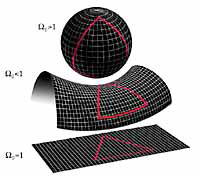
This video does a wonderful job explaining why we think the universe is flat. It all comes down to triangles. In a flat space, the angles of a triangle add up to 180 degrees. In a curved space, the sum of the angles is not 180 degrees.

So, using standard trigonometry, and the fact that tan(θ) = opposite/ adjacent in flat space, you first calculate the size fluctuations should have grown in the universe when the CMB was emitted ~380,000 years after the big bang. (The opposite). Then you calculate the distance to those fluctuations from us. (The adjacent). And then, assuming all angles add up to 180 degrees and therefore tan(θ) = opposite/ adjacent applies, you solve for the angle θ that those fluctuations should make and then look at the CMB and ensure that the fluctuations are that size.

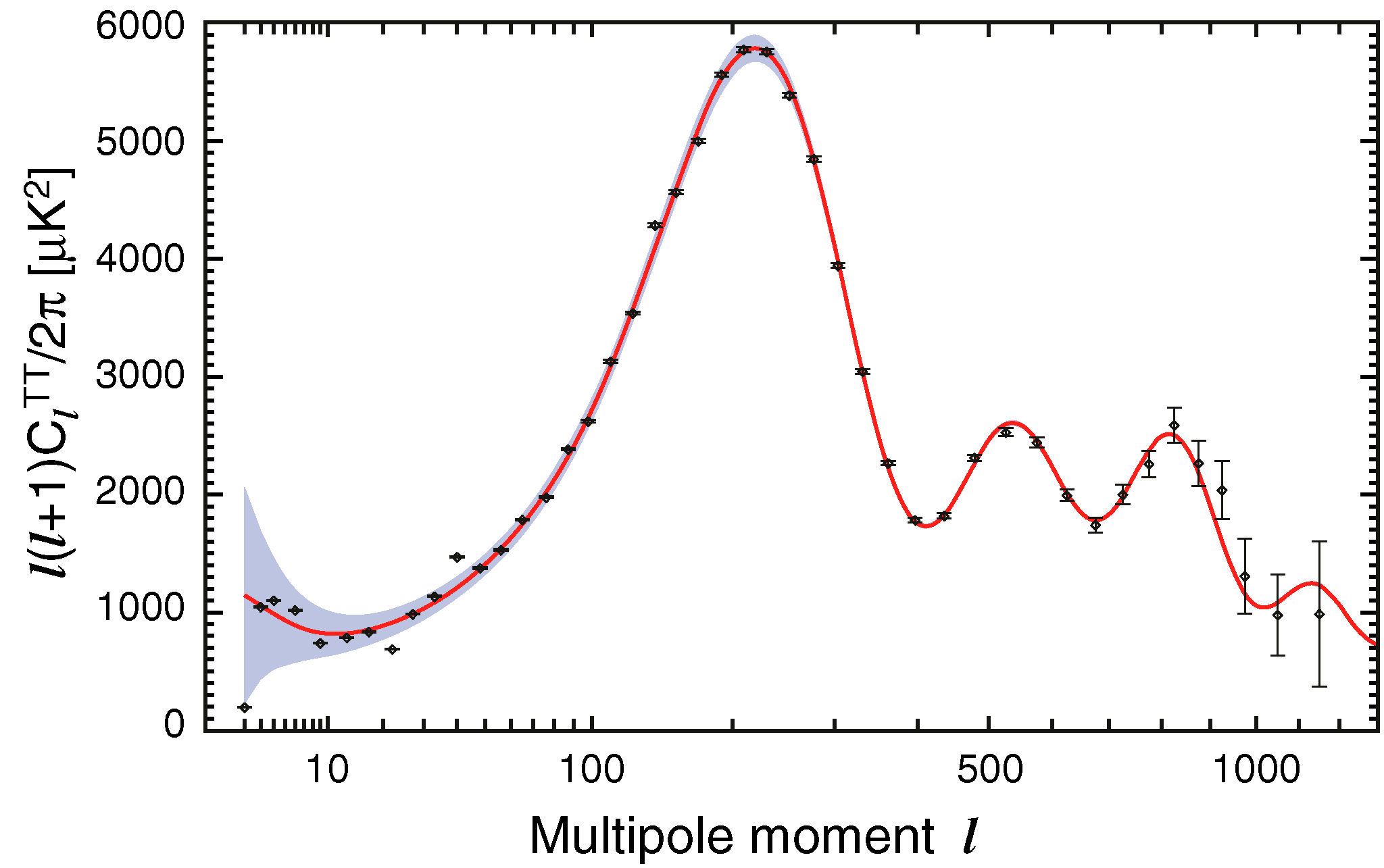
Then you make your measurement even more precise by turning again to our friend the power spectrum. The first peak in the power spectrum should be at the scale of the largest fluctuations in the CMB. The important formula is the peak at multiple l means the largest fluctuations are on the order of 180/l degrees.

The calculation: Anyways, using Ned Wright's Calculator I get the biggest fluctuation at the time of the CMB is about 0.64x10^6 light years across (opposite) and was emitted 41.5x10^6 light years away from us (adjacent) giving θ = 0.88 degrees which corresponds to a flat universe prediction is that the first peak should be at l ~ 205. (If you do this 100% correct and not just back of the envelop you should get l ~ 220)

Anyways, as you can see from the power spectrum this is exactly where we see the first peak showing triangles in the space-time of our universe add up to 180 degrees and thus demonstrating our universe is flat!

Tuesday, January 25, 2011

What If Dark Energy Were A Phantom Energy?

Before we get too far ahead of ourselves, let's remember that dark energy being a cosmological constant fits the data very well and has for years. That said, experimental constraints allow for dark energy actually being an exotic form of phantom energy. (So for the time being we have to allow for the possibility and work out the details.) This was recently done by Dabrowski and Denkiewicz.

What Is Phantom Energy?  Normal matter/energy in cosmology is classified according to the equation of state:

where p is the pressure and ρ the energy density of the matter/energy.  For radiation w = 1/3, for matter/dust w = 0 and for the cosmological constant w = -1.  What's interesting to note, looking at the image at the top, is the larger (more positive) w is, the faster it dilutes in the universe as the universe expends.  The cosmological constant is right at the point where it's density remains constant throughout the expansion of the universe.

Phantom energy is energy that has w less than -1.  If this form of energy existed, it would actually increase in density as the universe expanded!

Does It Fit The Data?  The best constraints on w for what is driving the dark energy is w = -1.05 +/- 0.29 from supernovae, CMB and 2dFGRS data and w = -1.001 +/- 0.0129 which hardly rules out dark energy actually being a form of phantom energy.

Furthermore, as the above plot shows, certain phantom energy models do fit current data, such as the supernova observations shown in this plot, and so we have to be willing to probe these models especially if they further go on to make experimental predictions. But do they?


Possible Experimental Prediction: A Sudden Big Rip.  First, as stated above, phantom energy models by definition predict w to be less than -1.  This itself can be measured and therefore tested.  Second, if we can somehow demonstrate that the energy density of the universe is is increasing with expansion, that would be a tale tale sign.

But lastly I want to discuss the big rip. It turns out, that if dark energy is driven by phantom energy, the universe gets ripped apart in finite time. More technically, the scale factor "a" controlling the expansion of the universe becomes infinite in finite time.  This means the distance between you and everything else in the universe goes to infinity without having to wait an infinite amount of time for this to happen.

In fact, a model discussed in this paper predicts the universe will experience this big rip in only 8.7 million years from now!

No wonder the authors call this model the "sudden future singularity" model. If the universe becomes singular, the scale factor "a" becoming infinite in only 8.7 million years, compared to the age of the current universe that will be one sudden singularity!

Conclusion.  I do want to remind people that the standard cosmology scenario where dark energy is a cosmological constant has worked so well for so many years that we have no reason to abandon it.  That said, dark energy being driven by phantom energy is technically a possibility and so we are justified looking into it, especially since it's existence may be experimentally verified/falsified.

Basically if we ascertain w is less than -1, see the energy density of dark energy increase with expansion, or find our universe suddenly being ripped apart we will know the dark energy is actually a form of phantom energy.

Let's hope that last one doesn't happen any time soon. :)

Mariusz P. Dabrowski, & Tomasz Denkiewicz (2009). Exotic-singularity-driven dark energy AIP Conference Proceedings, 1241 arXiv: 0910.0023v1

Wednesday, January 19, 2011

Evidence Against The Universe Being Fine Tuned For Life.


Many people will tell you that the universe appears fine tuned for life.  Don Page has decided to address this issue scientifically by calculating the best value for the cosmological constant needed to support life in the universe and then comparing it to our own.  His conclusion is that the cosmological constant is actually an example that our universe is not fine tuned for life.

The cosmological constant is like a knob that affects how quickly the universe's expansion is accelerating or decelerating.  As a rule of thumb, the more positive the constant is the faster the expansion accelerates and the more negative the more it decelerates.  If it is zero, and there is just the right amount of matter, the universe just stays flat and we never experience a rapid acceleration or deceleration in expansion.

First, all positive values are bad.  Now, what does this have to do with life?  It turns out a positive cosmological constant, like our own, actually dilutes matter and prevents a lot of gravitational collapse making our universe less likely for life than if the constant were not positive.  From the paper:
The reason is that a positive cosmological constant gives a repulsion between separate particles that reduce the ordinary gravitational attraction and leads to less gravitational condensation of matter. Therefore, other factors being equal, any positive cosmological constant decreases the fraction of baryons that condense to form galaxies and other structures that eventually form living substructures.
As an immediate consequence, no positive value of the cosmological constant (such as the observed value Λ) can maximize the fraction of baryons in life 
But wouldn't a negative value also be bad? Yes, because if the value is too negative the universe recollapses and life doesn't have time to form.  Page keeps this in mind while calculating the best value to find that Goldilocks region that is most optimal for life.  That said, he does find that the optimal values for life in the universe are slightly negative on the order of Λ ~ -10-120.

So God created a Multiverse?  Interestingly enough Page is very religious and so does not conclude this is evidence against God but actually evidence that God must have created a multiverse where each pocket universe has a different cosmological constant like most modern cosmology theories predict.  From the paper:
It might be appropriate to note that although this paper has focused on the scientifically testable question of whether the constants of physics maximize a particular measure for life, it obviously also has theological implications. It could be taken as negative evidence for theists who expect God to fine tune the constants of physics optimally for life. However, for other theists, such as myself, it may simply support the hypothesis that God might prefer a multiverse as the most elegant way to create life and the other purposes He has for His Creation.
I for one am a big fan of the multiverse because all modern cosmological theories with inflation lead to a multiverse.

And religion aside, given our cosmological constant is such a bizarre value and currently seems to be best explained by multiverse models I will agree with Page that the cosmological constant seems to hint at a multiverse. (Which is why many respected theoretical physicists suggest the peculiar value for the cosmological constant is the best evidence so far for crazy multiverse models like the string landscape.)

Thoughts?

Don N. Page (2011). Evidence Against Fine Tuning for Life E-Print arXiv: 1101.2444v1

Wednesday, January 12, 2011

First Planck Results: The Sunyaev-Zeldovich Effect.


There's been many bloggers writing about the first Planck results presented here at AAS and in Europe but I would like to write a little more than has been written on the Sunyeav-Zeldovich results as I think they are impressive.  Impressive both in terms of the science we get as well as well as this particular example shows how precise CMB experiments have become.  I will focus on the results from this paper.

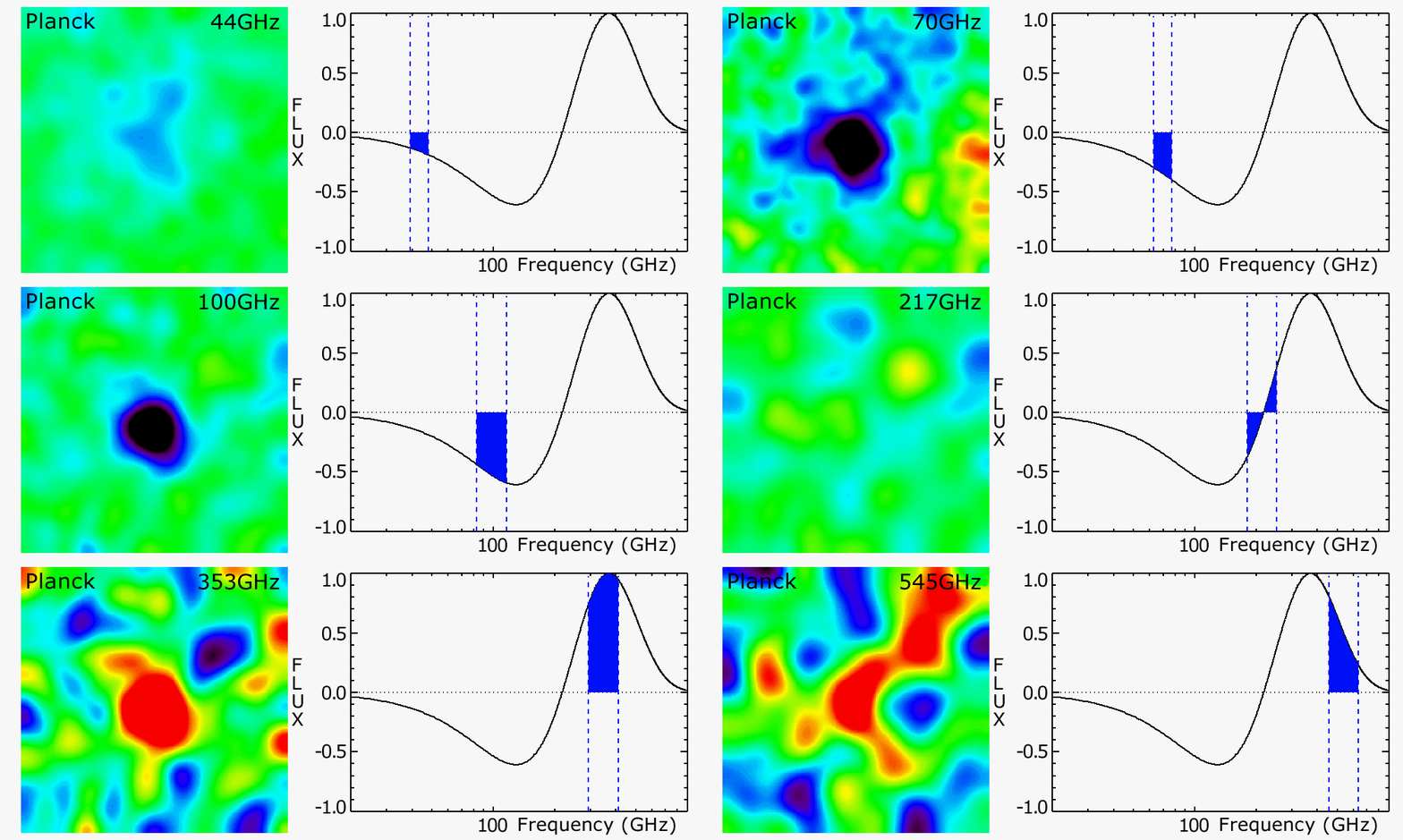
Okay, what is this effect anyways? The Sunyaev–Zel'dovich effect: "is the result of high energy electrons distorting the cosmic microwave background radiation (CMB) through inverse Compton scattering, in which the low energy CMB photons receive an energy boost during collision with the high energy cluster electrons."  And the thing is, clusters of galaxies are filled with high energy electrons in what is known as the intra-cluster medium (ICM).

This means that we can use specific distortions in the CMB to both locate clusters of galaxies and infer science from them from estimating the Hubble constant to extracting information on the physics driving galaxy and structure formation.

Look at the image above: it shows the precision at which Planck can observe this "SZ" effect.  (And it is just amazing!)  In this image you should note several things.  First, Planck intentionally is observing the sky at many frequency bands to see this stuff. (And watch the frequency change with tie in the image.)  At the lowest frequencies the boost on CMB photons yields a diminished flux, at higher frequencies it is an enhanced flux, and right at 217 GHz there is should be flux.

And if you look closely at the image up top you can see that Planck is seeing this!  The cluster in the center has diminished flux at low frequencies, denoted by the blue smudge,  no flux at 217 GHz and enhanced flux for high frequencies. (Now the smudge turns red.)  So Planck can see this effect really well and the science going into this effect can be studied in detail.

The next two plots to the right show how the mass and luminosity of these clusters relate to redshift. Redshift again being a measure of how far away these objects are from us.   These relations can now be compared to physical models and tell us a lot of science about the universe. Again, what is so great is Planck is seeing a lot of clusters and is able to see how the physical properties of these clusters relate with redshift. (Or as time progressed throughout the universe.)

Now, this stuff is all interesting but the really cool stuff, the main stuff Planck was built for, won't be released until next year. That should be a good day for cosmology and I for one am very excited! Cosmology has become a very precise science indeed!

Come in B-modes.... Come on! :)
ResearchBlogging.org
The Planck Collaboration. (2011). Planck Early Results: The all-sky Early Sunyaev-Zeldovich cluster sample Submitted to A&A. arXiv: 1101.2024v1

Friday, January 7, 2011

The Scale Of The Universe and And It's "Best Theory".


Many of you have heard the phrase "use the right tool for the right job", and when it comes to physical theories the story is no different.  For example, I often hear that quantum mechanics is more fundamental and thus a better theory than Newtonian physics.  But is it always the better theory?  For example, does quantum mechanics describe the solar system better than Newtonian physics?  For all practical purposes the answer is a big "No Way!".

And, further, can Newtonian physics describe the large scale properties of the universe as well and general relativity?  Again the answer is no.

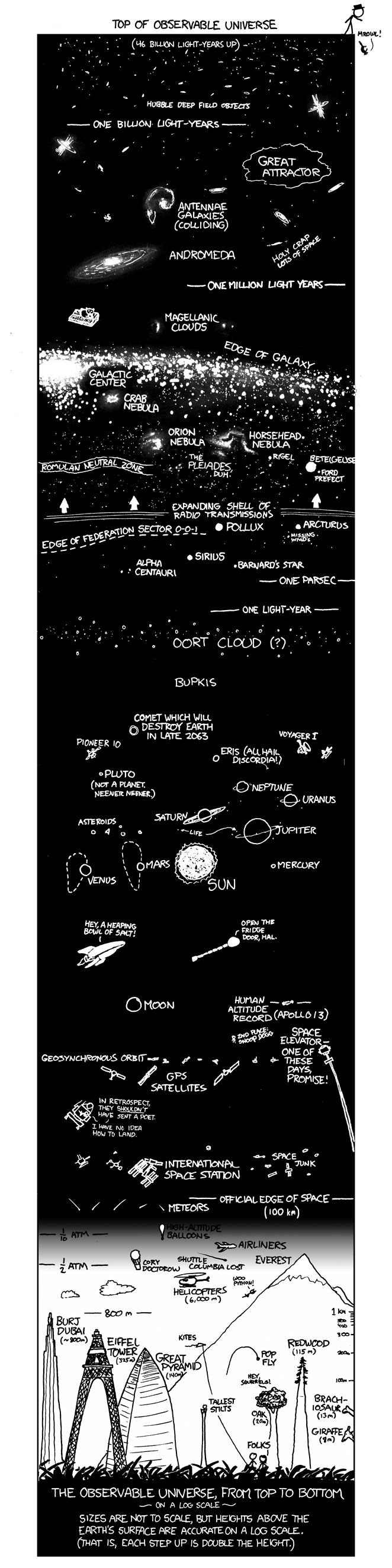
Look at the flash game above.  As you move the cursor back and forth, you see the universe at different scales.  And for each separate scale, a different physical theory becomes the best theory to use to describe that scale.  It really is the case that scientists are well advised, when describing the universe, to use "the right tool for the right job."

Question: But aren't the more fundamental theories are telling more about what is really going on?

Actually, it's hard to say!  For example, I've already posted on how some of the theoretical machinery going into our most fundamental theories of nature could just be clever mathematical models that just so happen to fit nature.  Not necessarily what is actually going on.   Furthermore: I'll give another example: is spacetime really curved, like general relativity says, or is something else going on like the interaction of a spin-2 graviton?  (Or something else entirely and yet the math just happens to work out making them clever models as opposed to the true reality!)

So, my advice to those who want to classify (and many do!) which physical theory is most superior or "most correct": I advise you to first ask what scale of the universe you are trying to describe.  Because, it turns out that each scale of the universe has it's own best theory.

A best theory for describing the cosmos at large... a different best theory for describing how a planes and rockets fly through the air or how bridges stand... a different best theory for describing how elementary particles interact... a different best theory etc...

Finally: It is this observation that allows cosmologists to think there may be a better theory than general relativity for describing scales larger then have been examined thus far.   Or: one reason why string theorists have good case for why there might be a better theory than standard quantum theories for describing the smallest of scales.

In short: the idea of a best theory is really scale dependent!

Click on the image to the right from XKCD.

Tuesday, December 28, 2010

Why Raw Data From Science Experiments Can Scare Me.


Cosmology as a field has become precise enough that we may measure theoretical features at the 1/10 of 1% level or better.  For example, one of Planck's greatest successes could be a detection of what is known as primordial non-Gaussianity that, if it exists, is at most a deviation of less than 0.1% from a pure Gaussian spectrum.


With that in mind, let's look at some raw Planck data.  The image above left (black curve) shows raw data recorded by Planck as time goes by.   It has these features:
  1. You see the dipole of the CMB as a "sine-wave" signal as Planck rotates and scans the sky. (See video above for an illustration of this scanning pattern.)
  2. If you look closely,  you see a sharp peak at the same spot in each sine-pattern.  This is Planck observing the galactic plane.
  3. You also see hundreds of spikes that represent cosmic rays hitting the instrument.  
Now here is the point, all those spikes and other large anomalies are much more significant than deviations from a clean Gaussian signal on the order of 0.1%!  Here we are trying to find deviations on the level of 0.1% and the anomalies from false signals are significantly greater that this!

And so, Planck has to somehow remove them.   The graph on the top right shows what their data looks like when these known anomalies/systematics are accounted for.  It looks decent and gives what looks like a near-Gaussian spectrum modulo the peak from the galactic plane.  Hence, naively/hopefully in such data you can now go searching for 0.1% deviations.

But wait!!!

That clean signal assumes at least the following:
  1. That the simulations of the anomalies and the templates and models used for the removal of this stuff are more accurate that the 0.1% level.
  2. That the removal actually worked... beyond what looks good by eye.
  3. That in the process of removing garbage, Planck didn't inadvertently introduce other false signals.
  4. Etc...
And this "scariness" does not just exist for cosmology data.  For example, I have talked with many people working at the LHC who have admitted that their background issues they have to deal with in the data can be frightening in similar ways. 

Conclusion: Now, don't get me wrong, I have a lot of trust in the Planck team/LHC/whoever.  I really do.  But let's just say this still scares me a little.  Some of the most important results from in physics hinge on better that 1/10 of 1% accuracy in both removing false signals and in not introducing fictitious ones during such a removal process.  (And everyone in the trenches knows this can be really hard to get right!) Therefore, this sometimes seems like a scary business... but at the same time it is also a testament to how far we have come in science. :)

Monday, September 27, 2010

Distinguishing Our Universe From Other Similar Universes In The Multiverse.

Srednicki and Hartle have raised an interesting concern recently about a limitation on the predictive power of multiverse theories. They observe that in multiverse theories, exact snapshots of our universe happen several times in different places. So if we want to have a physical theory that describes our universe, the one we live in, then the question arises: how can we tell which one it is from all the others?

From the paper:
Theories of our universe are tested using the data that we acquire. When calculating predictions, we customarily make an implicit assumption that our data D0 occur at a unique location in spacetime. However, there is a quantum probability for these data to exist in any spacetime volume. This probability is extremely small in the observable part of the universe. However, in the large (or infinite) universes considered in contemporary cosmology, the following predictions often hold. 
  • The probability is near unity that our data D0 exist somewhere. 
  • The probability is near unity that our data D0 is exactly replicated elsewhere many times.  An assumption that we are unique is then false.
This paper is concerned with the implications of these two statements for science in a very large universe... 
The possibility that our data may be replicated exactly elsewhere in a very large universe profoundly affects the way science must be done.
In order to solve this problem, the authors propose creating a "xerographic distribution" ξ.  Given the set X of all the similar copies of our universe in the multiverse, this xerographic distribution ξ gives a probability that we are the specific snapsot Xi of that set.

The authors claim that this distribution cannot be derived from the fundamental theory.  The fundamental theory can only predict the structure of the whole universe at large, not which snapshot in it we happen to be.  However, given a certain ξ, we can use Bayes Theorem to test which ξ appears to be most correct, and once that ξ is established, we have now a statistical likelihood hinting at which universe in the whole multiverse is ours.

So, given a fundamental physical theory T and a xerographic distribution ξ, the authors say:
We therefore consider applying the Bayes schema to frameworks (T,ξ). This involves the following elements: First, prior probabilities P(T,ξ) must be chosen for the different frameworks. Next, the... likelihoods P(1p)(D0|T,ξ) must be computed. Finally, the... posterior probabilities are given by
The larger these are, the more favored are the corresponding framework.
The authors then go on to give some examples of how this might work and solve issues with Boltzman Brains etc...

So, just to repeat:
  1. One glaring problem with multiverse theories is our universe happens several times in several places throughout the multiverse.
  2. However, we would like a good physical theory to make predictions about the snapshot we happen to live on.
  3. The fundamental theory of the multiverse cannot tell us which snapshot we are.
  4. However, creating a xerographic distribution ξ we may be able to put probability estimates of which copy is ours using Bayes Theorem.
Some further thoughts and Questions.  I remind the readers, as crazy of a topic this paper covers, it did get published in a respectable journal: Physical Review D.  However, while reading the paper I had several thoughts come to mind and I would appreciate your own thoughts on these issues:
  1. How should we feel about multiverse theories given issues like this arise?
  2. Can only tenured professors get away with writing such articles?  IE... if a grad student wrote papers like these will universities take him/her seriously when applying for a faculty position?
  3. What is your "exact other" in the "other snapshots" doing right now? :) 
Srednicki, M., & Hartle, J. (2010). Science in a very large universe Physical Review D, 81 (12) DOI: 10.1103/PhysRevD.81.123524

Friday, September 17, 2010

Cosmology Can Possibly Solve the Neutrino Hierarchy Problem.

ResearchBlogging.orgThere are three neutrino species in the standard model, hereafter refereed to as 1, 2, and 3, that we know have mass from atmospheric and solar neutrino oscillation experiments. Furthermore, data from these experiments put constraints on the mass-splittings between these three neutrinos.  From atmospheric experiments we know the mass differences between 2 and 3 is |M223| ~ 1.4x10⁻³ eV2 and from the solar neutrino experiments we know the mass splitting between 1 and 2 is M212 ~ 7.9x10⁻⁵ eV2.

So here is the problem: We know that the neutrinos have mass and we know what their mass splittings are but we don't know their hierarchy or in other words the order of their masses as shown in the figure to the right. For example, it could be that neutrino 3 is the most massive of the three... but it can also be the case that it is the least massive.  This is what I mean by the neutrino hierarchy problem I used in the title.

Cosmology To The Rescue!

Fortunately, there are cosmological measurements that can be made that may solve this issue in the future. In this post I will discuss a wonderful paper that pioneered these details was written by Jimenez et al.  The solution goes like this:

1.  CMB and large scale structure experiments give us a bound on the sum of the neutrino masses denoted as Σ = m1+m2+m3.  The current bound is that  Σ  is between 0.05eV and 0.3eV.


2. After Σ is better constrained in the future, the mass splitting Δ = m- m1, importantly with sign!, can be be measured from the matter power spectrum of large scale structure for the given Σ.  The plot above shows how the matter power spectrum, P(k), is altered by the different values of Δ.  Once Δ is known with confidence, including sign, the problem is solved.


3. The plot above shows forecasts for how well we will be able to tell the difference between the normal inverted hierarchy given future experiments. (Normal being where m3 is larger and invereted when it is smaller.)

4.  Furthermore, cosmolgy should be able to shed light on whether neutrinos are Dirac or Majorana particles. (If Majorana they are their own anti-particle and if Dirac they are not.) The below flow chart shows how this works.  First, double beta-decay experiments may be able to determine directly if neutrinos are their own anti-particle.  But if future experiments fail to see a signal, cosmology may help answer if this is because the signal is just too weak or whether it is because neutrinos really are Dirac. As you can see, if Σ is just right and if the hierarchy is inverted or degenerate, cosmology will be able to demonstrate neutrinos are in fact Dirac.


So in conclusion: It appears cosmology may be able to provide a wealth of insight into neutrino physics in the coming years.  Through cosmology we may solve the neutrino hierarchy problem and even possibly say whether or not neutrinos are Dirac.

Jimenez, R., Kitching, T., Peña-Garay, C., & Verde, L. (2010). Can we measure the neutrino mass hierarchy in the sky? Journal of Cosmology and Astroparticle Physics, 2010 (05), 35-35 DOI: 10.1088/1475-7516/2010/05/035

Tuesday, September 7, 2010

Standard Cosmology Theory Is Confirmed By ACT For Smallest Scales In The Universe.

ResearchBlogging.orgIt never ceases to amaze me how well standard cosmology theory fits the ever increasing amount of data with precision. The results just released from the Atacama Cosmology Telescope (ACT) confirm that, even on the smallest scales, the predictions of the Lambda CDM universe preceded by an epic of inflation are correct.  This study extracts data for L modes of The CMB between 500 and 10,000.  (For a discussion on how these L modes refer to large and small scales of the universe see my posts here and here.)

 I will show three plots and interpret the results.


In the first plot above, we see results for the the power spectrum of the CMB plotted out to L = 3000 for their 148 GHz detector and their 218 GHz detector.  As the top panel shows, the second through seventh peaks of the theoretical CMB power spectrum are confirmed with near exactness!


The next plot is also very interesting.  Here we see the CMB power spectrum results out to L = 10000.  The key is to notice the red versus the green line.  The green line shows what the power spectrum should be if the only physics affecting the CMB photons were processes that occurred during and before the photons were emitted. (Called primary processes.)  The red line is how the spectrum changes with the further assumption that, after the CMB photons were created, they have been affected by processes in the "foreground" like inverse Compton scattering from free electrons in galaxy clusters, gravitational lensing, etc... (Secondary processes.)  This means the matter and other contents of the universe are interacting and affecting the CMB photons precisely as cosmologists have predicted they should.


The last plot shown is related to gravitational lensing.  Here, A_L is a parameter that quantifies how much gravitational lensing the CMB photons have experienced since being emitted.  A_L = 0 means they have experienced no lensing and A_L = 1 means they have experienced the exact amount of lensing predicted by the standard Lambda CDM cosmology.  The red line is the results for when ACT data is combined with WMAP.  As one can see, A_L = 1 is heavily favored over A_L = 0, and the lensing of the CMB has been "detected" by 2.8 sigma.

Conclusions: The Lambda CDM model initiated with a brief phase of inflation continues to fit the data with incredible precision.  ACT has shown that the standard cosmology theory continues be confirmed down to the smallest scales of the universe.  The prediction for the shape of the CMB power spectra arising from both primary and secondary sources fit the data quite well out to L=10000.  Now all we need to do is hope some group like Planck finds a detection of B-modes and experimental verification of standard cosmology will be nearly complete.

(Image Credit: Das, S. et al.)
Sudeep Das, Tobias A. Marriage, & et al. (2010). The Atacama Cosmology Telescope: A Measurement of the Cosmic Microwave
Background Power Spectrum at 148 and 218 GHz from the 2008 Southern Survey E-Print arXiv: 1009.0847v1

Wednesday, September 1, 2010

Cosmologists Love Fourier/Harmonic Space. (Large and Small Scales.)

Cosmologists hardly ever work in real space, meaning, where the variables in the equations are describing real points in the sky.  Instead, cosmologists almost always map their equations to Fourier or Harmonic Space.

But why is this?  There are two answers that both boil down to the universe being homogeneous and isotropic.  First, from the mathematical side, in an isotropic universe Fourier modes decouple making all equations painless to solve.  On the more physical side and intuitive side, since the universe is homogeneous and isotropic, it doesn't make sense to study physics that would affect certain spots in the sky.   Instead it is more meaningful to study physical processes that affect large scale structures on all parts of the sky, or small scale structures on all parts of the sky.

For example, inflation affected the largest scales over the entire sky.  On the other hand, the physics that went on the in primordial photon-baryon plasma effects only the smallest scales.

And this information is exactly what is encoded in the various Fourier/harmonic modes!  This information

Enough Confusing Talk, Give Me Something To Look At!

Okay, even if you got lost in the technical jargon above, at least look at these plots.  Here you see what the CMB looks like if you restrict to specific harmonic modes.  In harmonic space, L becomes your variable instead of x as in real space.  Small L modes refer to large scale information and large L modes refer small scale information.  If you think this is sounds backwards start reading some papers by astronomers. :)


This first plot above shows the information in the CMB for the harmonic modes L between 2 and 10.  As you can see, only information about large scale structure is contained in these modes.  For this reason, the low l modes are very valuable for studying inflation as these structures are not in casual contact today.


The next plot above contains information in the CMB for the harmonic modes L between 2 and 100.   Now we begin to see some small scale structure... on top of that large scale structure we had in the low l modes.


The next plot contains information out to L = 3000.  Now we begin to see how physics affected the very smallest scales. (And if I made this image was in Hi-Res it would be even more impressive!)

Lastly, the plot below shows the CMB dropping the L modes less then 100.  And as one could have guessed, you see no large scale structure!  (Look closely at the plot below and compare to the plot just above and convince yourself this is true.)  These modes tell you nothing about physics that effected the whole sky but everything about physics going on at the smallest scales in the universe.


So, by studying different L harmonic modes, or k Fourier modes, cosmologists can quickly see how physics played out across our universe.  Remember, as there are no preferred positions or directions in the sky, real space information is not very useful. However, physics that exists across the whole sky but only effects large or small scales, like inflation or baryon acoustic oscillations respectively, are brought out quite nicely in harmonic or Fourier space.  And thats why cosmologists love to work in these spaces.

Wednesday, August 18, 2010

Could The Planck Satellite Discover A New Species Of Neutrino?

It has been known for some time that the WMAP data is more consistant with the existence of four neutrino species than three. Nevertheless, most cosmologists shrug this off as three is by no means ruled out. However, Hamann et al. 2010 demonstrate that such a dismissal may be a mistake.

It turns out, when WMAP 7 year data is combined with Sloan data, the three neutrino species model is ruled out by nearly two sigma. The best fit number of neutrino species becomes 4.78 +/- 1.79 at 95% confidence. Furthermore, big bang nucleosynthesis (BBN) data involving Heluim abundances seems to confirm that such an excess better fits the data.

With this in mind, Hamann et al. 2010 decides to test just how many extra neutrinos are needed to fit the combined data of "the WMAP 7-year data release, small-scale CMB observations from ACBAR, BICEP and QuAD, the 7th data release of the Sloan Digital Sky Survey, and measurement of the Hubble parameter from Hubble Space Telescope observations".  Their findings are plotted above.  They confirm that when all data is added together, the existence of one or two extra neutrinos provides a much better fit than only the standar three.

If this is real it would be major news! On one hand such a "4th" or even "5th" neutrino would have to exist at low energies as it has clearly affected both BBN and CMB physics.  However, extra neutrinos at such low energies have alluded modern particle accelerators.  Therefore, such much neutrinos must be "sterile" in that they do not couple to the rest of the standard model the way normal neutrinos do.  Furthermore, they must not have a lepton partner the same way other neutrinos do. (Example: like the electron neutrino does with the electron.)

Interestingly, if there are an extra one or two of such neutrinos in nature, the Planck satellite has a good chance of making a 5-sigma discovery!  (See plot below).  If this happens, the discovery of such interesting low energy neutrinos could well go down as one of Planck's greatest contributions to science.


Jan Hamann, Steen Hannestad, Georg G. Raffelt, Irene Tamborra, & Yvonne Y. Y. Wong (2010). Cosmology seeking friendship with sterile neutrinos Eprint arXiv: 1006.5276v1

Monday, August 16, 2010

A New Generation Of Copenhagen Interpretations.

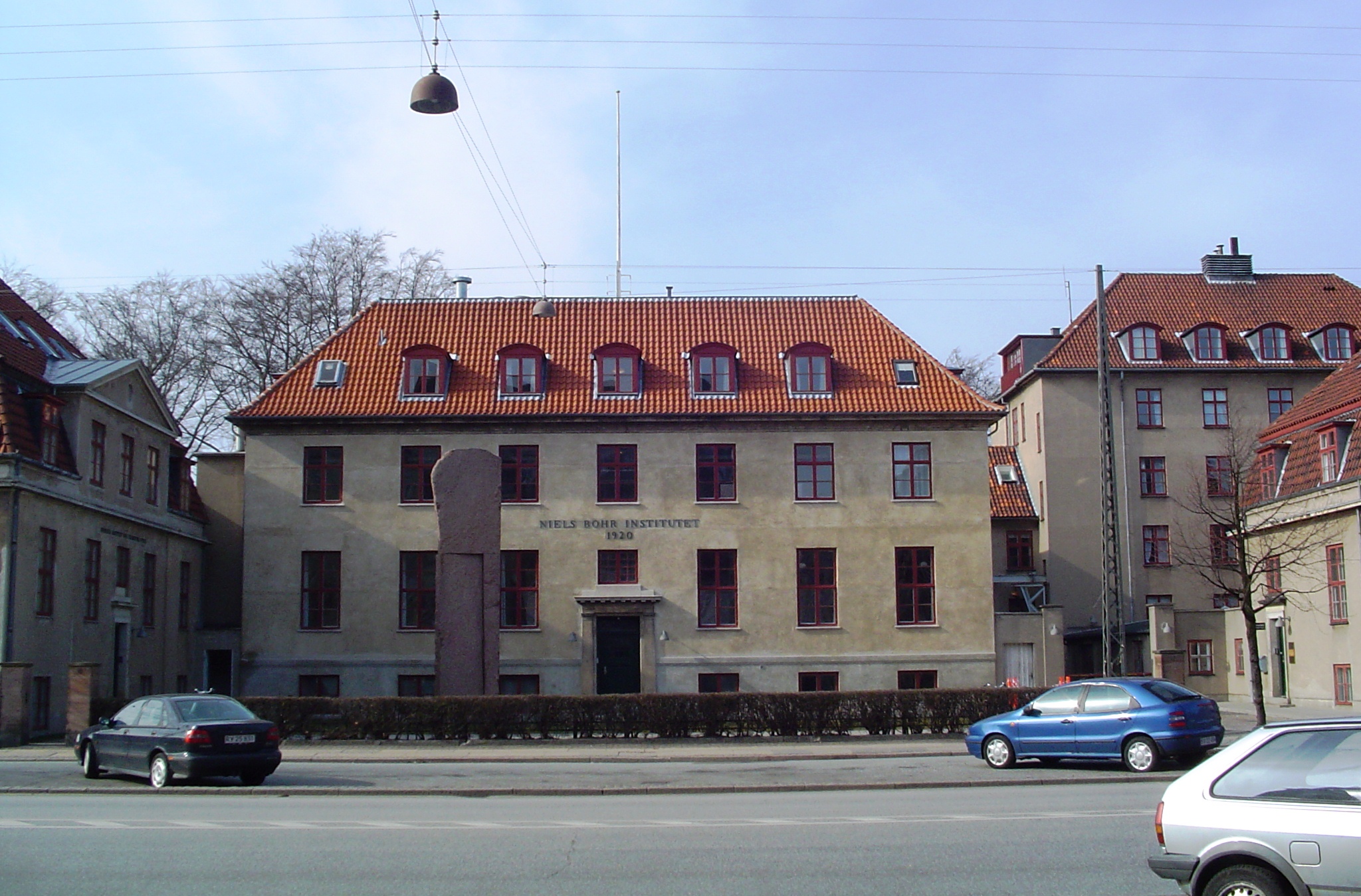
In 1927, Neils Bohr and others formulated what became known as the Copenhagen interpretation of quantum mechanics, in Copenhagen Denmark.  This week I am attending a workshop in Copenhagen at the Neils Bohr Institute on that same ground that attracted so many famous physicists so long ago.

It's also interesting to reflect how far quantum mechanics has come.  In 1927 physicists were still trying to formulate what kind of theory quantum mechanics even is.  Today, the workshop began with with a talk entitled "The Quantum Origin of the Universe."  We've gone from formulating a new physical theory to explaining the whole structure of the universe with it in less then a century!!!  

There were 3 main talks today and I summarize briefly:

Viatcheslav Mukhanov:  Gave the talk about the quantum origins of the universe.  He emphasized the importance of inflation and claimed all objections to inflation are now really starting to look silly.  People either attack a mechanism of inflation ("Dude, I don't like inflation cuz it is some ad hoc scalar field...") showing their ignorance not understanding that the effects of the theory are mechanism independent. (Example: you get primordial density perturbations no matter what the mechanism.)  Or, they come up with some metaphysical argument why they don't like inflation.  (How dumb would I look if I gave a philosophical argument why I don't think it makes sense that the Earth orbits the sun even though we see it in experiment?)

At this point he quoted a the physicist Nobel Laureate Steven Weinberg who said (discussing cosmology):
Our mistake is not that we take our theories too seriously, but that we do not take them seriously enough. It is always hard to realise that these numbers and equations that we play with at our desks have something to do with the real world.
Always remember that quote!

Anupam Mazumdar:  Talked about two things, first emphasized how much progress had been made showing inflation really does recover low energy physics and the second half talked about how gravitational waves, if detected, could revolutionize the field.  The stuff on gravity was was very interesting.

Alan Heavens: Discussed what we will learn about the universe from gravitational lensing over the next decade or so. It was very interesting.  Right now you are used to seeing pictures of stars and galaxies.  Fine, but with gravitational lensing, in the future, we will be able to map out the 3D structure of the Dark matter Halos stars and galaxies sit in.    Furthermore, the 3D lensing reconstruction will test aspects of cosmology in all new ways and will be become a very stringent test on General Relativity. (For instance, it may be cosmologists using lensing who discover the hierarchy structure of the neutrino masses!)

Friday, August 13, 2010

Carl Sagan And The Cosmos.


The Interestion posted this video with Sagan's accompanying first words for his TV series The Cosmos.  I would like to add the similar first three paragraphs of the his book, Cosmos, as I feel they do convey a healthy sense of wonder for the universe in which we live with a reminder that to understand such a majestic structure we need both imagination and skepticism.  
The Cosmos is all that is or ever was or ever will be. Our feeblest contemplations of the Cosmos stir us - there is a tingling in the spine, a catch in the voice, a faint sensation, as if a distant memory, of falling from a height. We know we are approaching the greatest of mysteries.
The size and age of the Cosmos are beyond ordinary human understanding. Lost somewhere between immensity and eternity is our tiny planetary home. In a cosmic perspective, most human concerns seem insignificant, even petty. And yet our species is young and curious and brave and shows much promise. In the last few millennia we have made the most astonishing and unexpected discoveries about the Cosmos and our place within it, explorations that are exhilarating to consider. They remind us that humans have evolved to wonder, that understanding is a joy, that knowledge is prerequisite to survival. I believe our future depends on how well we know this Cosmos in which we float like a mote of dust in the morning sky.
Those explorations required skepticism and imagination both. Imagination will often carry us to worlds that never were. But without it, we go nowhere. Skepticism enables us to distinguish fancy from fact, to test our speculations. The Cosmos is rich beyond measure - in elegant facts, in exquisite interrelationships, in the subtle machinery of awe.
Very few people can say it like Sagan could.

Friday, June 25, 2010

A Great History Of The Evidence For Dark Matter.

In the paper Dark Matter: A Primer Garrett and Dudagives give a nice historical background to the accumulating evidence for dark matter.  Lets go through the history they lay out.

1.  J. H. Oort:  Astronomers have come to tust what is known as the mass to light ratio, M/L, that does a good job telling you what the mass of luminous matter should be based off of the luminosity of that matter.  This relation is normalized such that for the sun, M/L = 1.  In the 1930, Oort found that the stars moving on the galactic plane were moving faster than the galaxy's escape velocity!  He knew what the mass of the visible matter should be from M/L and discovered stars in the galatic plane are moving too fast to be bound by that much mass.   He postulated more mass must be present in the galaxy than can be attributed to the visible matter.

2.    F. Zwicky:  Zwicky studied the Coma Cluster and found that the stars had much more kinetic energy than they should from the viral theorem, KE = - 1/2 PE, assuming that the cluster had te amount of mass predicted by M/L.  He then worked out how much mass this cluster must be to have that high of a kinetic energy and found the mass should be about 10 times more mass than the visible matter. (Again, from M/L measurements.)

3.  Vera Rubin:  Vera Rubin studied the rotation curves for 60 galaxies.  These curves should obey the well known relation v(r) = sqrt(G m(r)/r) where v is the velocity, r is the radius, m is the mass and G is the gravitational constant.  Instead, she found that the velocity was not consitant with the amount of mass seen in visable matter.  Instead, new unseen matter is needed to explain the rotation curves.  (See plot above.)

4.  D. Walsh et al:  in 1979, D. Walsh et al. were among the first to detect gravitational lensing.  They watched how the light was bent by certain distant galaxies.  The problem was that the galaxies had to have more mass to bend the light as profoundly as it did than come from the M/L relation.  Dark matter could explain this discrepancy.

5.  Microlensing:  Several MACHOS studies went into effect and all came to the same conclusion: the missing matter could not be attributed to brown dwarfs, neutron stars, black holes, planets or other "dark" objects made of matter that we are familiar with.  This extra mass had to be coming from some exotic type matter thus far unknown.

6.  BBN:  Big Bang Nucleosynthesis is one of the great achievements of modern cosmology.  It turns out, the Deuterium to Hydrogen ratio (D/H) is heavily influenced by the overall density of baryons in the universe.  Using D/H, one finds that the amount of baryons in the universe is much smaller than the total baryonic matter.  The rest must be coming from some extra dark matter.


7.  The CMB: The power spectrum taken from the Cosmic Microwave background is highly sensitive to the amount of baryonic matter in the universe.  See the plot above.  As the amount of baryons, \Omega_b, changes, so does the power spectrum... by a lot!  The red error bars show the measured value.  As can be seen, baryonic matter only makes up 4.6% of the universe.  From the same power spectrum on finds that the total matter in the universe is more like 25% of the universe indicating that the vast majority of the matter is matter we don't understand.

8:  N-Body Simulations and SDSS:  Numerical simulations of large structure formation have been performed.  Only those that include dark matter give results that match what we observe from large structure surveys such as the Sloan Digital Sky Survey.

9.  The Bullet Cluster:  "Smoking gun" evidence for dark matter, as some would say, came from a recent experiment involving the Bullet Cluster.  The Bullet Cluster recently collided with a larger galaxy.    In such a collision, dark matter should just pass through without interacting and the visible matter heated up giving a tremendous amount of X-Ray emissions.  It was clear that the matter causing the majority of the lensing was not centered in the same spots as the luminous matter.  This showed convincingly that the amount of baryonic matter in galaxies is not as large as the amount of dark matter.  Furthermore, in 2007 another team confirmed a ring-like structure of dark matter was found after the collision of two massive galaxies.

10.  Penny et al:  In 2009, Penny et al. found that a significant amount of dark matter would be needed to hold certain galaxies together that were experiencing a significant amount of tidal forces.  These galaxies were surprisingly stable given how little luminous mass they had.

As you can tell.  This is a great article and I recommend everyone read it.

All images taken from the article cited.

Katherine Garrett, & Gintaras Duda (2010). Dark Matter: A Primer Eprint arXiv: 1006.2483v1

Tuesday, June 22, 2010

Does Ignoring Small Scale Physics Hurt Cosmology? Probably Not.

When cosmologists study the universe they usually assume it is homogeneous and isotropic with linear perturbations.  On large scales this turns out to be a very good approximation.  Fortunately, these assumptions greatly simplify the math since:
  1. The equations are linear and therefore easily solvable.
  2. (Related to #1.)  Fourier modes decouple meaning you can solve for each mode independent of the others.
(If #1 and #2 above don't make sense it's fine.  Just know that the math becomes simple and solvable with the above assumptions.)

Recently, Baumann et al. asked a very interesting question: "Are we sure that small-scale non-linearities do not induce a large backreaction?"  In more lay terms: The physics on small scales is not linear, homogeneous and isotropic.  Are we ignoring important effects that physics on these small scales may place on the physics on large scales when we assume the universe has these nice properties on all scales?  

This isn't a new concept.  In particle physics one faces the same issue.  Physics that happens at high energies (or small scales) may have non-trivial effects on low-energy physics. (or large scales.)  These are often called non-perturbative effects and a good low-energy prediction must to take them into account.  "Integrating out" these small scale effects is at the heart of renormalization in particle physics.

Fortunately for cosmologists, Baumann et al. found that any back-reaction effects are very small.  Second, at most the these effects exert a slight positive pressure on the universe.  Therefore, backreaction effects cannot account for something like dark energy that has non-trivial negative pressure.  Lastly, they found the small scale effects completely decouple from large scales confirming that applying linear theory to large scales is well motivated.

Therefore, doing cosmology with the above simplifying assumptions appears to pass yet another important test.

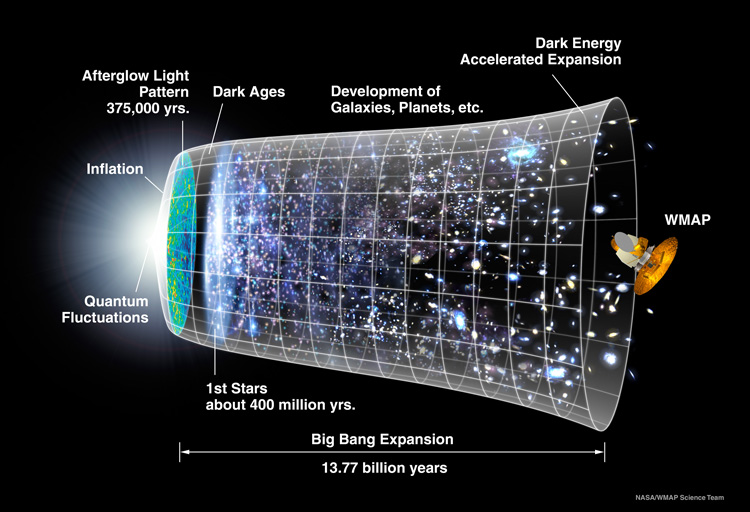
(Image: Credit: NASA / WMAP Science Team)

Daniel Baumann, Alberto Nicolis, Leonardo Senatore, & Matias Zaldarriaga (2010). Cosmological Non-Linearities as an Effective Fluid eprint arXiv: 1004.2488v1