Pages

Showing posts with label Theory of Relativity. Show all posts

Sunday, October 16, 2011

Big News: Einstein Is Still Right

A couple weeks ago I posted that the OPERA collaboration had measured neutrinos moving faster than the speed of light in violation of Einstein's theory of special relativity.  The experiment was very simple - neutrinos produced at CERN on the broader between Switzerland and France were shot towards a detector in Italy.  The time between the pulses' creation and detection was measured using atomic clocks and the distance traveled was measured using GPS satellites.  The result was that on average the neutrinos arrived 60 nanoseconds faster than if they moved at the speed of light.

It turns out that the problem wasn't too much Einstein but rather not enough.  A Dutch physicist named Ronald van Elburg found that the OPERA team made a small mistake in the way they applied special relativistic corrections due to the velocity of the GPS satellites.  This correction to the OPERA team's calculation should decrease the travel time of the neutrinos by 64 nanoseconds.  You can read the pre-print here.

In response, Einstein says:

Sunday, May 1, 2011

What do Conservatives have against the Theory of Relativity?

Recently I was looking at something on the internet and the whole science vs. religion question came up, and one thing led to another and eventually I ended up on Conservapedia. Normally I don't bother with that site but I decided to go on over and see if the list of counterexamples to relativity had grown any since I last looked at it about 2 years ago. Remarkably the list had grown, but so many of the things on the list were so high on the crackpot index that it made my brain hurt, and I was reduced to a sobbing mass of ... well ... er ... mass, despairing for the future of humanity. But I got over that and started thinking again and decided to write this post.

One thing that I noticed was that a number of "counterexamples" to the theory of relativity could be reduced down to the argument, "Relativity is false because it doesn't agree with quantum mechanics." After realizing this I thought, "Wait a minute! Why is quantum mechanics an acceptable theory but relativity isn't?" So I went and looked at the Conservapedia page on quantum mechanics and found it to be remarkably uncontroversial, though incredibly scant on details. Relativity on the other hand has three major pages (one for relativity in general, one for special relativity and one for general relativity) along with the page dedicated to "counterexamples" to relativity, and several other smaller more specific pages. So this made me wonder, what was it about relativity that prompted these "conservatives" to have such an almost dogmatic revulsion to relativity, and what was it about quantum mechanics that caused the same people to accept it or at the very least ignore it?

The Conservapedia page on Evolution is understandable due to its perceived infringement on religious creation dogma, but relativity? I was wondering just what it was about the theory of relativity that made it so controversial. Why would they expend so much energy and effort to disprove relativity but leave quantum mechanics alone, considering that quantum mechanics is much more controversial philosophically?

Upon closer inspection there are a few sentences, phrases and arguments on the Conservapedia pages that indicate that this extreme dislike of relativity has more to do with morality than with science. On the "counterexamples" page at the very top we find the sentence, "[The theory of relativity] is heavily promoted by liberals who like its encouragement of relativism and its tendency to mislead people in how they view the world."

From this we see that their main objection to relativity is not any scientific failing that it may have, but because it is associated (at least in their minds) with "moral relativism". Thus any argument that may be concocted to "disprove" relativity is in fact really attempting to undermine the concept of moral relativism. This makes me suspect that if Einstein had happened to call his theory "the theory of invariance" rather than "the theory of relativity" (or if he had referred to it as the principle of "Lorentz invariance", or even just "Einstein's pet theory") then there would not be a Conservapedia page today about counterexamples to Einstein's theory. In other words, the entire motivation for their objection to the theory of relativity is due to the fact that its name is very close to relativism, which is associated with moral relativism.

This of course reminds me of a certain song:

Now before we get too far into bashing this particular group of religious conservatives, we must also realize that this objection to relativity did not materialize in a vacuum. There were plenty of philosophers, commentators, pundits, busybodies, rabble rousers, scheming politicians, authors, crackpots and others who were more than willing to commit the same logical fallacy and insist that because of the theory of relativity (which has absolutely no moral implications whatsoever) they feel justified in making an argument about morality (or the lack there of). I have had people literally tell me that because Einstein's theory of relativity was true, that somehow justified their belief in moral relativism. So the fallacy goes both ways.

So why is this important, and how can we use this insight? One thing to note here is that for conservatives, at least those of the type that have a problem with relativity but not quantum mechanics, is to note that moral considerations and implications (or even just perceived implications) far outweigh scientific or experimental considerations. On the other hand there are those who have no interest in rectifying the misconceptions but only in perpetuating them so that they can have club to beat the opposite side with. In the end neither side is correct, and both use the same logical fallacy of convoluting an inherently amoral, mathematical theory, with the moral theory of moral relativism. This reminds me of another song,
So the next time you come across some conservative drivel about how the theory of relativity is false, take a moment, stop and think that the person writing that may ultimately be more concerned with morality and moral relativism than with whether or not GPS units actually use relativity or not. Also if you come across someone who is ridiculing religious conservatives because they are denying the theory of relativity, you can try to explain to them that the issue is much more complex than their simple characterization, and that the people they are criticizing are actually more interested in the moral implications than the scientific implications (this may be a hard one to explain, I know I've tried).

It may be very difficult and there may be a lot of misunderstanding along the way (if history itself is any indication), but there is much that we can do to overcome these misunderstandings and to help people see both points of view and understand the mindset of the person on the "other side". The end result is (hopefully) better understanding by everyone, and less false accusations, and less fallacious arguments.
Friday, January 7, 2011

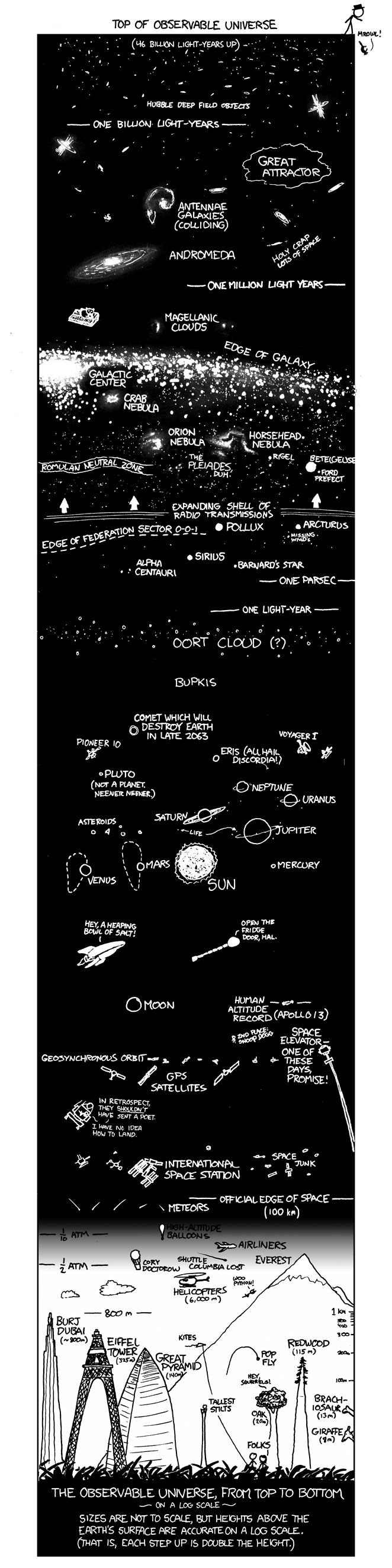
The Scale Of The Universe and And It's "Best Theory".


Many of you have heard the phrase "use the right tool for the right job", and when it comes to physical theories the story is no different.  For example, I often hear that quantum mechanics is more fundamental and thus a better theory than Newtonian physics.  But is it always the better theory?  For example, does quantum mechanics describe the solar system better than Newtonian physics?  For all practical purposes the answer is a big "No Way!".

And, further, can Newtonian physics describe the large scale properties of the universe as well and general relativity?  Again the answer is no.

Look at the flash game above.  As you move the cursor back and forth, you see the universe at different scales.  And for each separate scale, a different physical theory becomes the best theory to use to describe that scale.  It really is the case that scientists are well advised, when describing the universe, to use "the right tool for the right job."

Question: But aren't the more fundamental theories are telling more about what is really going on?

Actually, it's hard to say!  For example, I've already posted on how some of the theoretical machinery going into our most fundamental theories of nature could just be clever mathematical models that just so happen to fit nature.  Not necessarily what is actually going on.   Furthermore: I'll give another example: is spacetime really curved, like general relativity says, or is something else going on like the interaction of a spin-2 graviton?  (Or something else entirely and yet the math just happens to work out making them clever models as opposed to the true reality!)

So, my advice to those who want to classify (and many do!) which physical theory is most superior or "most correct": I advise you to first ask what scale of the universe you are trying to describe.  Because, it turns out that each scale of the universe has it's own best theory.

A best theory for describing the cosmos at large... a different best theory for describing how a planes and rockets fly through the air or how bridges stand... a different best theory for describing how elementary particles interact... a different best theory etc...

Finally: It is this observation that allows cosmologists to think there may be a better theory than general relativity for describing scales larger then have been examined thus far.   Or: one reason why string theorists have good case for why there might be a better theory than standard quantum theories for describing the smallest of scales.

In short: the idea of a best theory is really scale dependent!

Click on the image to the right from XKCD.

Wednesday, January 5, 2011

How Physics Changes With F(R) Gravity.

Einstein's general relativity rules the roost when it comes to gravity, but soon modifications to standard GR may detected on universal scales with new cosmological data. Fortunately, a realistic modified version of gravity, known as f(R) gravity, makes practical predictions that may be verified in the coming decades.

A recent paper by Motohashi, Starobinsky, and Yokoyama gives a good synopsis of the general predictions coming from f(R) gravity. But first, what is f(R) gravity? Well, (and if this sentence is too technical just ignore it and read the rest) it is a gravity defined by the following action:
This is identical to the Lagrangian used in Einstein's general relativity except for the addition of the second term on the second line. Therefore, normal GR is equivalent to f(R) gravity for the case when λ = 0.

New Predictions: With the definition out of the way let's get started.

The gravitational constant G: The plot above is of the gravitational constant coming from f(R) gravity, called Geff, divided by the same constant in GR (and Newton) evolving over time.(The variable z is known as the redshift and is a good measure of time for cosmologists and astrophysicists because it is logarithmic in nature and corresponds to the observed redshift of light.  See link for more details.)

What is important to note is that, unlike G for Newton and GR, the gravitational constant in f(R) gravity increases over time and evolves differently on different length scales! Thus, if the gravitational constant increases with time and evolves most significantly on the largest scales it could be a hint at f(R) gravity.

The dark energy parameter w:  If dark energy is the cosmological constant, than it is characterized by w=-1 in the equation that related the energy density to the pressure of the universe. (Energy density = -1 * Pressure)  And, all experiments so far confirm w = -1 so the case for the cosmological constant being dark energy is strong.

However, what could we say about dark energy if we find w does not always equal -1?  It turns out this is the case in f(R) gravity and even more peculiar is it crosses from being greater than -1 to less than -1 which throughout the history of the universe which is a fairly robust feature.  If this crossing could be observed in the future it would be a big win for f(R) gravity and could not be explained by the dark energy being the cosmological constant.
Okay, any tests on the theory today? Right now there aren't many because general relativity works so well it would only fail on the most extreme scales.  (Which we have a hard time probing.)  But the authors do include one interesting observation.

On the left is of the matter power spectrum assuming neutrinos are massless.  The green line is for standard GR and the others are different f(R) models.  The red error bars come from SDSS and show standard cosmology with GR is a good fit.  Now, the plot on the right shows the matter power spectrum assuming neutrinos are massive.  So if neutrinos are heavy, like for the black line, then f(R) gravity actually fits the data better than GR alone.

Conclusion:  f(R) gravity is not the only version of modified gravity that exists but it certainly makes practical predictions.  Also, not wanting to make this post 20 pages long, I did not report all predictions the theory makes.  However, these are the basic predictions for familiar physics provided by Motohashi et al. and I for one can't wait to see these f(R) theories tested in the coming years.

However, even if f(R) theories are verified, by examining the action above we can still conclude Einstein got the first and by far most dominant term in the Lagrangian right on the money!

ResearchBlogging.orgHayato Motohashi, Alexei A. Starobinsky, & Jun'ichi Yokoyama (2011). f(R) Gravity and its Cosmological Implications to be published. arXiv: 1101.0716v1

Thursday, December 30, 2010

The Effects Of Special Relativity On Planetary Orbits.

General relativity affects the orbits of planets in ways Newtonian gravity cannot account for. Interestingly, Lemmon and Mondragon explore if special relativity can account for the same behavior predicted by general relativity.   They find that qualitatively it can, but quantitatively it comes up a little short and so the full general relativistic treatment is still needed.

First a reminder: Precession:  Let's remind ourselves the effects coming from general relativity.  The first is the precession of the orbit demonstrated for Mercury in the image above.  The dotted curve shows what is expected from Newtonian gravity alone: an obit that stays fixed in an elliptical shape forever.  The solid line shows how this changes with general relativity: the orbit moves or precesses over time around the sun.

It may help to consider the gyroscope on the right: if you were to put a red dot on the edge of the spinning disk, and watched above, you would not see that it only traces out a circle as it spins, but a precession pattern like the one in the plot above.


Second reminder: A shrunken orbit:  The second effect general relativity makes is that of shrinking the orbit, illustrated in the plot above again for Mercury.  This is an image of Mercury's potential energy.  Planets want to minimize their potential energy and therefore, like a ball on a hill, "roll to the bottom" of their potential.  As can bee seen, the bottom of the potential for Newtonian gravity is at a larger radius than for general relativity.   Therefore, general relativity forces planets to have a smaller radius.

Note: Both of the effects above have been verified experimentally and are major reasons why general relativity was embraced in the first place.

But is full general relativity really needed? Turning back to the paper, the authors decide to work out these effects in special relativity alone.  First, we start with precession.  Using special relativity alone you get:

Where G is the gravitational constant, c is the speed of light, a is the semimajor axis and e is the eccentricity.  This rate of precession is equivalent to 7.16 arcseconds per century.  This should be compared to precession predicted by general relativity which is 43 arcseconds per century.  Therefore, special relativity undershoots by a factor of 6.

And what about the radius? For special relativity the change in radius is a similar story and becomes:
where 1/2ε is the correction. General relativity gives a correction of 3ε, and so therefore again special relativity comes up short by the same factor of 6.

Always the same factor of 6 huh? I guess so, and I don't off of the top of my head know why it should always been a factor of six.  Anyways, despite being off by this factor, it is very interesting that special relativity predicts the same qualitative behavior as general relativity which is absent in Newton.  Furthermore, since calculations in special relativity are significantly simpler than for general relativity, this special relativistic calculation is ideal if you are just trying to give a qualitative picture of what effects are relativistic.  Perhaps a good one for undergraduates?

Anyone want to take a stab at why it is always a factor of 6???
You can in the comments. :)

Tyler J. Lemmon, & Antonio R. Mondragon (2010). First-Order Special Relativistic Corrections to Kepler's Orbits Submitted to American Journal of Physics arXiv: 1012.5438v1

Wednesday, September 22, 2010

How The Twin Paradox Of Relativity Changes In An Expanding Universe.

I'm sure most of you have heard of the twin paradox "in which a twin makes a journey into space in a high-speed rocket and returns home to find he has aged less than his identical twin who stayed on Earth."  This paradox has been worked out for special relativity in Minkowski spacetime.  Recently, Boblest et al. worked out the details using general relativity for an expanding universe. (de Sitter spacetime.)

First a review of the standard Minkowski version:  In this case the whole universe is flat Minkowski spacetime and can therefore be handled with special relativity.
The twins in the paper have names: Eric and Tina. Eric stays on Earth while Tina accelerates away from Earth with constant acceleration α = 9.8 m/s2  until her clock shows 5 years have past.  Then she decelerates by the same magnitude coming to a complete stop after ten years then begins her journey back to earth accelerating then decelerating in the same 5 year intervals.  Finally, after 20 years has transpired on her clock she has returned to earth being now 20 years old.  The plot above might help make this more clear.  It shows how far she she is compered to Earth versus the time recorded on her clock.
This plot above shows the time on Eric's clock versus the time on Tina's clock.  As you see, Eric is nearly 350 years old when Tina returns.  Furthermore, he ages quickest relative to Tina when she is traveling at peak velocities.

Now consider an expanding universe:  For an expanding de Sitter spacetime, the universe is no longer flat and so the authors have to appeal to general relativity.  The Hubble expansion parameter, quantifying how fast the expansion is happening, is denoted by H.  For our universe, H =  H0 = 71 km/s/Mpc.  Larger H means faster expansion.
The plot above shows how the results change in an expanding universe.  Interestingly H must be greater than 107 H0 , before we see significant differences compared with the flat case.  One very important thing to notice is that, since the universe is expanding quickly, after 20 years Tina is not able to return home.  This should make sense since the distance she has to travel in an expanding universe is further then in the flat case.
This next plot above shows how Eric's clock changes compared to Tina's in the expanding universe case.  As you can see, Eric does not age compared to Tina nearly as much.  This should also make sense because the expansion of the universe inhibits Tina's relative velocity to become to significantly different from Eric's.

Now For A Proper Round Trip. Now let us demand Tina accelerates and decelerates in such a way that Tina is able to return home in 20 years.  Now Tina must turn around before the 10 year mark.  Here the authors compare three "trips" where the constant acceleration/deceleration is greater for each trip.  IE, Tina accelerates faster for trip 3 than trip 2 which is faster than trip 1.  In each case, H =  109 H0.
The plot above shows how Tina's position compared to earth changes with time in an expanding universe.
And lastly, the plot above shows how Eric's clock changes compared with Tina's for the three trips.

Conclusion:  This paper shows how the twin paradox is altered for an expanding universe.  Interestingly, the expansion of the universe lessons the distance Tina can travel in 20 years and makes it so that Tina's change in age changes much more closely to how Eric's age changes.  However, it should also be noticed that to see significant differences compared to the special relativity case the universe must be expanding significantly faster than our own universe is.

Sebastian Boblest, Thomas Müller, & Günter Wunner (2010). Twin Paradox in de Sitter Spacetime E-Print arXiv: 1009.3427v1

Monday, August 16, 2010

A New Generation Of Copenhagen Interpretations.

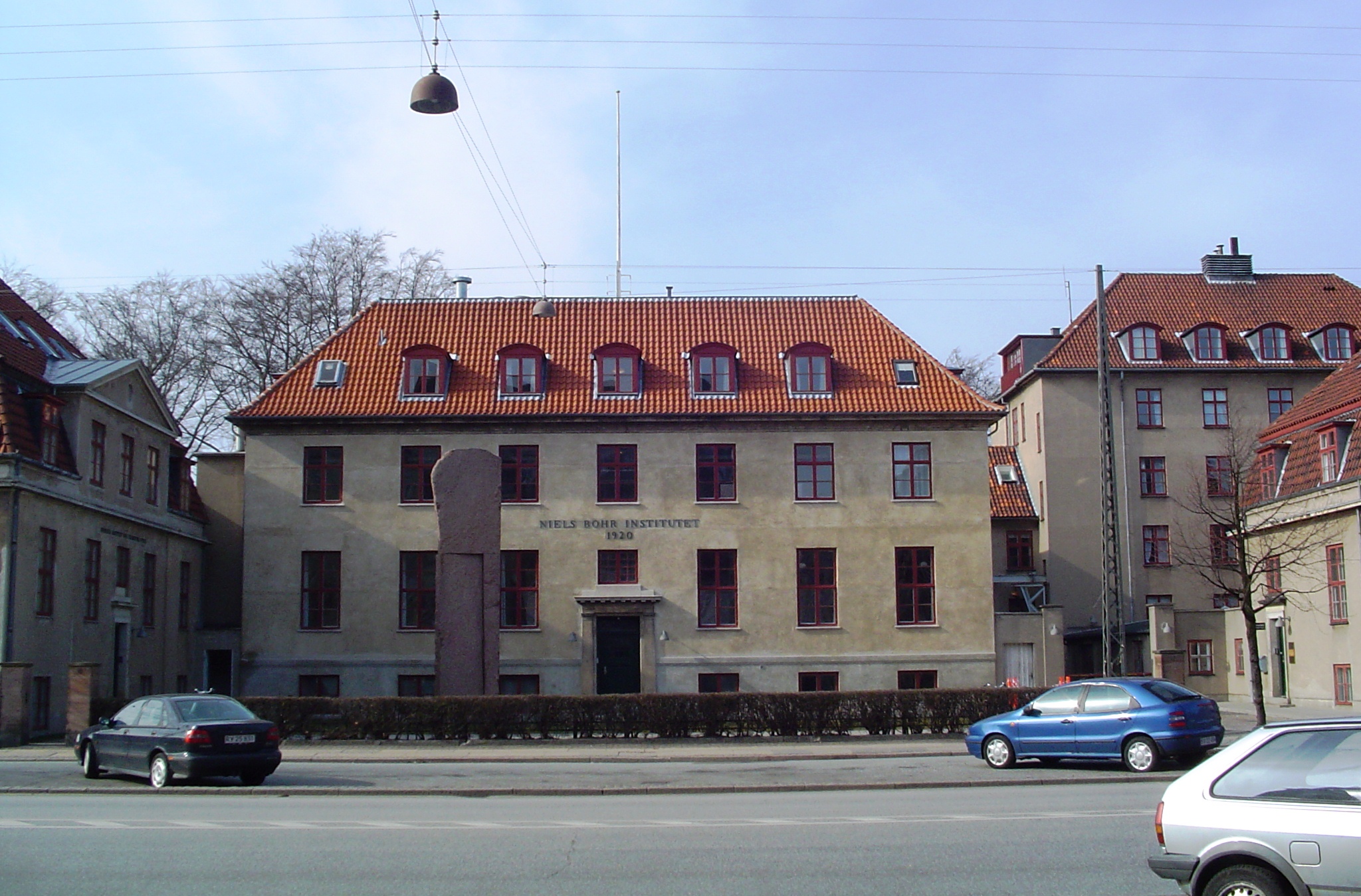
In 1927, Neils Bohr and others formulated what became known as the Copenhagen interpretation of quantum mechanics, in Copenhagen Denmark.  This week I am attending a workshop in Copenhagen at the Neils Bohr Institute on that same ground that attracted so many famous physicists so long ago.

It's also interesting to reflect how far quantum mechanics has come.  In 1927 physicists were still trying to formulate what kind of theory quantum mechanics even is.  Today, the workshop began with with a talk entitled "The Quantum Origin of the Universe."  We've gone from formulating a new physical theory to explaining the whole structure of the universe with it in less then a century!!!  

There were 3 main talks today and I summarize briefly:

Viatcheslav Mukhanov:  Gave the talk about the quantum origins of the universe.  He emphasized the importance of inflation and claimed all objections to inflation are now really starting to look silly.  People either attack a mechanism of inflation ("Dude, I don't like inflation cuz it is some ad hoc scalar field...") showing their ignorance not understanding that the effects of the theory are mechanism independent. (Example: you get primordial density perturbations no matter what the mechanism.)  Or, they come up with some metaphysical argument why they don't like inflation.  (How dumb would I look if I gave a philosophical argument why I don't think it makes sense that the Earth orbits the sun even though we see it in experiment?)

At this point he quoted a the physicist Nobel Laureate Steven Weinberg who said (discussing cosmology):
Our mistake is not that we take our theories too seriously, but that we do not take them seriously enough. It is always hard to realise that these numbers and equations that we play with at our desks have something to do with the real world.
Always remember that quote!

Anupam Mazumdar:  Talked about two things, first emphasized how much progress had been made showing inflation really does recover low energy physics and the second half talked about how gravitational waves, if detected, could revolutionize the field.  The stuff on gravity was was very interesting.

Alan Heavens: Discussed what we will learn about the universe from gravitational lensing over the next decade or so. It was very interesting.  Right now you are used to seeing pictures of stars and galaxies.  Fine, but with gravitational lensing, in the future, we will be able to map out the 3D structure of the Dark matter Halos stars and galaxies sit in.    Furthermore, the 3D lensing reconstruction will test aspects of cosmology in all new ways and will be become a very stringent test on General Relativity. (For instance, it may be cosmologists using lensing who discover the hierarchy structure of the neutrino masses!)

Thursday, March 11, 2010

Dark Energy As A Prediction Of General Relativity.

(This is the second post on my dark energy series.)

In physics, we have learned its best to write down theories in terms of Lagrangians or actions.  (See the GR one below).  We have also learned that you need to include every term in your Lagrangian consistant with the underlying symmetries of the theory.

For example, take the standard model of particle physics.  You take the known symmetries we observe in nature, SU(3)xSU(2)xU(1), and then write down every term comparable with this symmetry.  This is very important.  If you forget a term you get the wrong answer.

With this in mind, why would general relativity (GR) be any different?  Why would we not demand an action containing every term compatible with the underlying symmetries?

Going back to our paper we read:
The most general low-energy second order action for the gravitational field, invariant under the relevant symmetry (diffeomorphisms) is
And what is lambda?  Why, it is the cosmological constant.  The fact that you can add a constant means that you should expect too for the reasons stated above.

GR without a cosmological constant is what needs explaining, not GR with one.  And a cosmological constant gives rise to an effect completely akin to dark energy.  For this reason, a dark energy like effect should be thought of as a prediction of GR.
From the point of view of classical general relativity, the presence of the cosmological term is natural and a vanishing value for λ would be more puzzling than a finite value: the theory naturally depends on two constants; the fact that some old textbooks only stress one (G) is only due to the fact that the effects of the second (λ) had not been observed yet.
So if you accept GR, in a sense you should expect to see something resembling dark energy. Furthermore,
In gravitational physics there is nothing mysterious in the cosmological constant. At least nothing more mysterious than the Maxwell equations, the Yang-Mills equations, the Dirac equation, or the Standard Model equations. These equations contain constants whose values we are not able to compute from first principles. The cosmological constant is in no sense more of a “mystery” than any other among the numerous constants in our fundamental theories.
How true.  We play this same game with every other theory: we add every term, constant etc.., compatible with the underlying symmetries and and never complain.  Why complain that we would need to add one to GR?

Physically this is like asking: why are we therefore so surprised to see dark energy?

Friday, January 29, 2010

The Relativistic Roller Coaster

Since we have been discussing special relativity, I thought this video would be nice.

This video demonstrates what would happen if you rode a roller coaster where, in the slow parts, you traveled 10% the speed of light then accelerated in the fast sections to 80% the speed of light.

Notice a couple things:
  1. Colors get shifted all around by the Doppler Effect.
  2. Light rays appear bent, even wrap around!, as you accelerate back and forth between these speeds.
Anyways, if you would like to imagine what it would really look like to accelerate close to the speed of light, here you go:

Thursday, January 28, 2010

Special Relativity: It's All Just Rotations

I took a philosophy class where the teacher asked at one point "Have any of you heard of special relativity and can tell us what it says."

Without thinking what I was doing said: "Special relativity says that we not only rotate in space, but can also make rotations in time, as time is now on the same footing of space."

The teacher than said: "What are you talking about?  I was looking for something on length contraction or time dilation."

I smacked myself for giving such a confusing answer, but I was right!

Everything "special" about special relativity boils down to Lorentz transformations.  There are 6 generators of this "Lorentz Group".  Three spacial rotations (here is a rotation in the x-y plane):

And three boosts which represent boosting to a faster or slower speed (He is the one for the t-x plane.  Equivalent to boosting faster in the x direction):
Now look at the two objects above, they look very similar don't they?  That's because boosting is analogous to a rotation in the "time-x" plane.

How I think of it:
Everything is going the speed of light. (The magnitude of your 4-velocity is always the speed of light.)  If objects move faster in space, relative to you, this is because they have rotated themselves so that their velocity vector points more in the spacial dimension and less in the time dimension.  This is why time goes by more slowly for such and object, relative to you. 

Think I'm crazy? Here is a good back up by the Wikipedia:
The norm or magnitude of the four-velocity is always exactly equal to the speed of light. Thus all objects can be thought of as moving through spacetime at the speed of light. This provides a way of understanding time-dilation: as an object like a rocket accelerates from our perspective, it moves faster through space, but slower through time in order to keep the four-velocity constant. Thus to an observer, a clock on the rocket moves slower, as do the clocks in any reference frame that is not comoving with them. Light itself provides a special case- all of its motion is through space, so it does not have any "left over" four-velocity to move through time. Therefore light, and anything else traveling at light speed, do not experience the "flow" of time.
So there you go, I stand by my claim of what we fundamentally learn from special relativity: "we don't only make rotations in space, but can also make rotations in time, as time is now on the same footing of space."

Monday, March 5, 2007

Weinburg, Geometry and Physics

This from Not Even Wrong: Steven Weinberg wrote a GR book. It is actually very good. However Weinberg fears that geometry isn't how physics really works fundimentally but that it is a good approximation of real physics.(It's all quantum fields, just get over it!) This is a quote from his GR book:

However, I believe that the geometrical approach has driven a wedge between general relativity and the theory of elementary particles. As long as it could be hoped, as Einstein did hope, that matter would eventually be understood in geometrical terms, it made sense to give Riemannian geometry a primary role in describing the theory of gravitation. But now the passage of time has taught us not to expect that the strong, weak and electromagnetic interactions can be understood in geometrical terms, and too great and emphasis on geometry can only obscure the deep connections between gravitation and the rest of physics.

Friday, November 24, 2006

Introduction


My name is Joseph Smidt and this is my first blogging experience. I have named the blog "The Eternal Universe" since I am on the road to becoming a cosmologist and my favorite model for the universe is the Eternal Inflation Model. Decades of ever increasing experimental evidence concur that the observable universe as we know it sprang from an incredibly small, hot and dense region of space. In fact, there is substantial experimental evidence that, about 13.7 billion years ago, the entire observable universe was smaller than a baseball and inflated into what we see today. According to classical general relativity, the results we see lead inevitably to the conclusion that the universe sprang from an initial singularity. We call this the "Big Bang."

If however classical general relativity is extended to a quantum theory of gravity, then it is possible that the universe inflated from a very small quantum patch, not a singularity. Where did this quantum patch come from? The Eternal Inflation Model predicts it resided in another universe from which this universe emerged. It turns out, if you do the quantum math, that if you allow the universe enough time to exist, a small patch of the quantum fields that exist throughout the universe will eventually inflate and create a new universe. After the quantum fields inflate to sufficient sizes, they actually have the ability to gravitationally collapse and form galaxies, stars and planets which allow life to form and exist. It truly is a wondrous thing and the cycle continues in one big eternal round.

I really think I will find blogging a pleasurable experience. I will admit however that I know it can be a little dangerous. It seems when people share their opinions publicly, they are setting themselves up to offend someone or something. Hopefully I will be able to avoid such calamities.

Again, I wanted to start a blog because I think it will be fun. I will enjoy posting things and hope to build some good friendships with people around the web. May we all remember that we live in this great eternal universe together, so lets make the most out of it. May everyone have a great Thanksgiving weekend.

-- Joseph Smidt


Picture on Top: Our Universe. Yes all the dots are galaxies, our universe is that big, and even bigger. :)

Picture on Bottom: image of atoms taken by IBM.

The inflated quantum fields not only gave rise to the the vast cosmos that we see in telescopes, they also form the atoms are bodies are composed of!