Pages

Showing posts with label Answers. Show all posts

Friday, February 5, 2010

Constraining Inflationary Models II: The Tensor-To-Scaler Ratio.

Spacetime is described by the metric tensor which has several "degrees of freedom".  Conveniently, these degrees of freedom can be separated into what are labeled scalar, vector and tensor modes.  These modes act independent of each other.  It is therefore helpful to break up the degrees of freedom of the tensor in this way.

Because this can be done, perturbations to spacetime due to inflation can be measured separately from each other as scalar, vector and tensor perturbations.  The scalar perturbations are the easiest to measure and have been measured with success since COBE.  The vector perturbations are unstable so we have no hope of detecting those today.  However, what remains to be detected are the tensor modes.

The tensor perturbations of the metric are those that can be described by a symmetric traceless tensor.  It turns out these were caused by a physical process that also can be described by a symmetric traceless tensor: gravity waves.

Whoever first detects these tensor modes may win a Nobel Prize.  In many ways this is the only remaining prediction of inflation not yet verified. (The COBE team, who first measured the scalar perturbations, got their Nobel Prize.)  Furthermore, a detection of the tensor modes would be an indirect detection of gravitational waves.

With all this said, the ratio between the tenor and scalar modes, r,  is predicted to be different by different inflationary theories.  The above chart shows constraints on r by the WMAP 7 year data.  (Same picture as before, I know.)  This parameter therefore is another that can be used to distinguish between inflationary models.

Saturday, December 19, 2009

Primer On WIMP Dark Matter.

First, let's state that dark matter could be all sorts of things, but there is a lot of motivation to believe they are weakly interacting massive particles. (WIMPS)  It turns out our own Jonathan Feng at UC Irvine is considered one of the world's greatest experts on WIMPS and has some accessible review articles on dark matter collider physics here and here.  (The first especially should be assessable all physicists. I took images from them.)

I Think Therefore I Am


The fact that a particle exists should tell you it must somehow interact with other particles.  All particles are created and destroyed in interactions with other particles.  It turns out, using arguments from cosmology taking the expansion on the universe into account, how abundant a particle is is directly related to it's typical cross section, or likelihood that it interacts with other particles.  (See equation above.)


The graph on the right demonstrates this.  The higher the cross-section, the lower its abundance in the universe.  If it interacts too much, it won't be abundant enough.  It it interacts too little, it will be too abundant enough.

However, if a non-relativistic particle interacts with typical weak scale cross sections, its relative abundance to rest of the matter is just right to be dark matter.  This is called the "WIMP Miracle".

How Can We Detect it?


We know the the particle has to be non-relativistic because dark matter must be cold.  The typical non-relativistic weak scale cross section is given in the equation above.  Alpha is the hyperfine structure constant, m is the mass and k is a parameterizing allowed small deviations from from the weak scale to still work.  The graph on the right shows masses that work.

In some sense that's it!  If we can find any non-relativistic particle dominated by weak interactions with the right mass, 100 GeV - 1TeV, supersymmetric or not, we can feel fairly confident we have discovered dark matter.

At this point you may ask: "Wait, we know of particles whose dominate interaction is at the weak scale, like say neutrinos.  Why aren't they the dark matter?".  Well, the relativistic nature of these particles changes enough so that they don't work anymore.  (For example they have a different cross section.)

But How Do We Know If It Is Supersymmetric?


(I think) Most non-collider surveys will have a hard time answering this question.  They can answer the more important question: "Is this a non-relativistic particle dominated by weak interactions with a mass on the order of 100 GeV -1TeV?".  If yes, we have our dark matter.


Every different dark matter candidate, such as the supersymmetric ones, have specific ways they interact with other particles.  These ways are described by Feynman Diagrams.  The plot to the right shows the interactions specifically for the neutralino.  Colliders can test these diagrams better than anything else.

So here is the oversimplified formula:

  1. Find a particle dominated by weak interactions.  (Like a neutrino except non-relativistic.)
  2. Ensure the mass is on the order 100 GeV -1TeV. (You've discovered dark matter!!!)
  3. Run an experiment at the LHC for a particle of just that mass interacting mostly through weak interactions. 
  4. Compare the findings with the proposed models of such particles.
  5. If one lines up perfectly you know what particle you are dealing with. (Ie... some like a supersymmetric neutralino)
Smarter people than me may be able to pinpoint the exact particle without a collider, but as far as I know it may take the LHC to do this.  It's initial discovery however should be able to be accomplished without the LHC however.

Tuesday, October 6, 2009

Be Prepared For Posts On Dark Matter.


I am not finished with all evidence for the Big Bang but I decided to start another series on dark matter. I will still finish the Big Bang stuff but, to be honest, as a blogger you have to write about the things most on your mind at the moment otherwise your posts begin to reek. (Sorry if they already do.)

First I want to talk about what the evidence is for dark matter.  Specifically I want to discuss:
  1. Galactic rotation curves.
  2. Clusters and lensing.
  3. The power spectrum of the Cosmic Microwave Background.
  4. The formation of large scale structure.
  5. The famous Bullet Cluster collision.
I then want to go over the best candidates for dark matter:
  1. Neutrinos
  2. The lightest supersymmetric particles (LSP).
  3. Axions
  4. Machos
  5. Wimps in general
Just to preempt future posts, dark matter is almost assuredly real.  In fact, the picture above  is the famous Bullet Cluster collision where dark matter was extracted from the rest of the visible matter.  The blue region you see is the gravitational lensing of the dark matter which has separated from the visible baryonic (normal) matter shaded red.

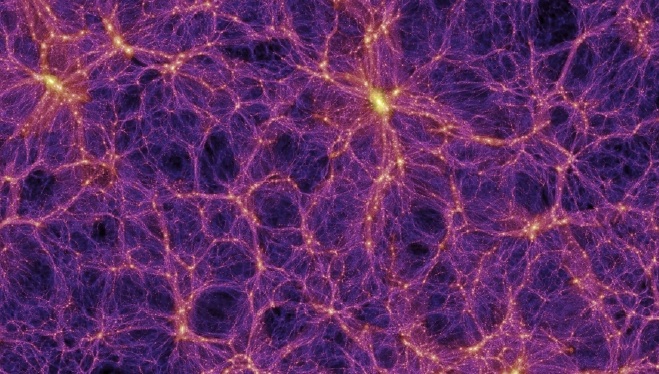
Though we don't know exactly what dark matter is, we know it is some type of matter that is effectively collisionless and doesn't have a lot of kinetic energy (It moves slowly).  Through numerical simulations we know if we could see it, on really large scales, we would see this:


What is amazing about this picture is this is exactly the cob-web pattern we see galaxies forming into in the real universe.  This is evidence that the dark matter, more than anything else, governs how large scale structure such as clusters and galaxies form.

Anyways, I have skipped over all the details but just know future posts will make up for it.  Dark matter is cool, and if nothing else you will see interesting pictures/plots and have any questions you are will to ask answered. (So please ask.)

Therefore, please start leaving questions so I know what needs to be covered specifically.

Monday, September 7, 2009

Big Bang Prediction #2: How Do We Determine The Elemental Abundances?

Dear science community,

The Big Bang predicts that the percentages of the various elements in the universe have to be very strict ratios. (Ie. how much hydrogen versus helium versus Lithium, versus etc... has to be exact.)

This calculation is straight forward.  This is how you do it:

1. Realize You Start With A Plasma.  Using basic thermodynamics you show that the universe cools as it expands.  Therefore our past was much hotter.  If you go back far enough in time, you come to situation where the universe is so hot that the energy literally rips the atoms apart into their fundamental components.  This is called a plasma.

2. Run The Tape Forward.  This nearly homogeneous and isotropic plasma cools as the universe expands.  The fundamental quarks that form protons and neutrons begin doing so.  However, they must  conform to the laws of physics.  If you use some highfalutin math, like relativistic Boltzmann equations, you find that a quark soup cooling in an expanding universe would produce ~12% neutrons and ~88% protons.

3. Elemental Production Gone Wild.  At this stage, armed with protons, neutrons and a cooling universe, elemental production goes crazy.  It turns out elements want to be at the top of this chart to the left (click to see) for physical reasons I don't want to get into now.  Hydrogen quickly forms and two neutrons grab two protons and form Helium, and then they try to start Lithium and then....

4. Universe's Expansion Immediately Ruins The Party.  As soon as these elements begin forming, the quick expansion of the universe pulls these atoms too far apart to form the heavy elements at the top.  Sure the helium and hydrogen atoms want to further combine to form such atoms but the universe's expansion pulls them too far apart to do so.

5. What We Are Left With?  I mentioned ~12% of the mass was neutrons and that the first thing they do is pull in two other protons to form Helium before the party is crashed.  Since protons are about the same mass as neutrons, this means ~24% of the mass of the universe should be Helium.  The rest should essentially all hydrogen since the next elements on the list didn't have time to really form before expansion took over. 

 So this is the prediction: ~24% Helium, ~76% Hydrogen and trace amounts of other things such as Lithium.

The chart to the right highlights all this even better.  The red strip is the prediction by the Big Bang Threory.  The boxes show the measured values with experimental error factored in.

As you can see, this prediction of the Big Bang is confirmed every well by experiment.

Moreover, a hot cooling plasma in an expanding universe is the only known mechanism to produce such abundances!  First, If we didn't start with a hot cooling plasma we wouldn't get 12% neutron production by mass.  Second, if these reactions were not going on in an expanding universe then all the elements at the top of the first chart would have been eventually produced.

To explain what is observed you need both a hot dense plasma and an expanding container/universe: the Big Bang.

Nick can post later how this works in stars and you will find that, since there isn't an expansion inside stars ruining the party, the heavy elements above are able to form. (See picture at top.)

Tuesday, August 25, 2009

What is Homogeneity And Isotropy?

My last post talked about the geometry of the universe needing to have homogeneity and isotropy.  These are two very important concepts in cosmology and experiments show the universe has near perfect homogeneity and isotropy.  (Like ~0.001% error on this statement.  Very important that error is there however.)

For a precise definition: homogeneity means the universe has translational invariance and isotropy means it has rotational invariance.

In more lay terms: homogeneous means you can move from one random point in the universe to another and everything looks exactly the same.  Look at the sky at night with all the stars and galaxies that dot the sky.  If you moved to any other random place in the universe, the odds are it would look very similar. This experimentally verified fact means the universe is nearly homogeneous.

In lay terms, isotropy means you could turn any direction and the universe looks exactly the same.  Look at the sky in the Northern, then Southern Hemisphere and statistically they look nearly identical.  Look in the USA, look in China, etc... 

The cylinder above is another example of being homogeneous.  If the cylinder was infinity long, every point would look like any other.  However the cylinder is not isotropic.  If you look down one direction you would see space extends to infinity.  In the other direction space extends only 2*pi*R.  The cylinder is homogeneous and not isotropic whereas are universe is nearly both.
Is there a space that is isotropic and not homogeneous?  The answer is no, isotropy implies homogeneity so I can't give a cool example of this unfortunately.

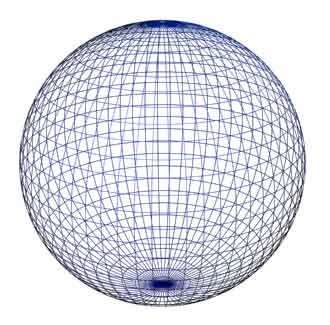
The surface of a sphere, however, is perfectly homogeneous and isotropic so it makes sense when deriving the geometry of the universe to start with that then generalize in a way that matches relativity.  This is often what is done.

Any questions?

Saturday, August 22, 2009

How Should We View The Universe's Expansion?

Dear Science community,

The universe appears to only have 3 dimensions, yet relativity says it is 4 dimensional. (With time on the same footing as space.)  Moreover it is expanding and we are told it has no center.  How are we to visualize all of this?

It turns out if you find a good graduate level cosmology textbook, like Weinberg 2007, you will find that you derive the geometry of the universe starting with a normal sphere.  (Think surface of a balloon to make sure we are on the same page.)  You then generalize this sphere to having four dimensions, consistent with Einstein's equations, and find that this new "generalized" sphere models our universe exceptionally well.  In fact, this geometry is the only one consistent with  isotropy and homogeneity, things I will blog about later.


Therefore, in a very real sense you should visualize our universe as the surface of a "generalized", higher dimensional, balloon or sphere.

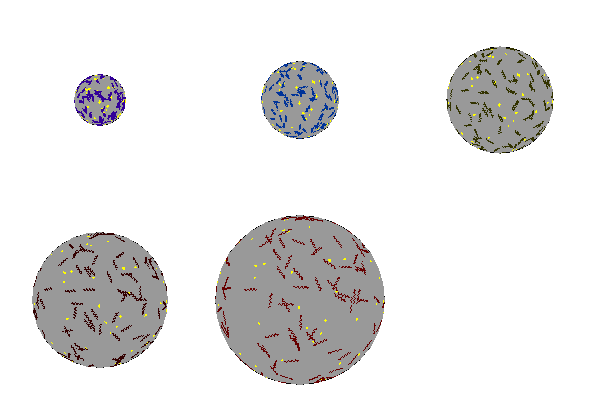
Pretend we were 2 dimensional creatures living on the surface of a normal balloon.  Even though the balloon fills a 3 dimensional space, we on the surface would only view it as 2 dimensional. If the balloon expands, what would we see?  We would see exactly what the picture describes below:

 As time marches on, all the other 2-D galaxies would be moving away from us.  Where would the center of our universe be?  There is no center of the surface of a balloon.

The same goes for us.  Though spacetime is a 4 dimensional object, we being trapped on the surface of this "generalized" balloon means that we only see three dimensions. Moreover there is no center of the universe any more than there is a center to the surface of a balloon.  (The Big Bang could be viewed as the center.  I'll let you think about that.)  And lastly, galaxies moving away from us is mostly due to the space between us expanding, not their actual velocities.  (Dots on a balloon move away from each other as the balloon expands even though they themselves aren't moving.)

Now, notice I keep saying "generalized".  That is very important.  A normal balloon surface, or 2-sphere to be technical, only has one type of curvature.  In higher dimensions a "3-sphere", like what we have, can be generalized to have 3 types of curvatures consistent with Einstein's equations that give rise to an open, closed and flat universe. (More on this later.)

Okay, hopefully that solves a lot of visualization problems.  Please ask questions!

Thursday, August 20, 2009

Stars 101: The Fundamentals

Stars are perhaps the most fundamental building blocks of the universe. Without stars our universe would be a dark, cold (a few degrees above absolute zero) mixture of 72% hydrogen, 28% helium, and less than a tenth of a percent lithium. Period.
Stars are also where the four fundamental forces in the universe come together to fight for celestial supremacy. In one corner, coming in as the weakest force in nature - but the only one that can work on astronomical scales - is gravity which tries to crush the star down into a black hole. Gravity is responsible for bringing together clouds of gas and dust that collapse down to what are known as proto-stellar nebulae. Eventually as gravity compresses the cloud it will become hot and dense enough in the middle to bring the other major contender into the ring and a star will be born.

In the other corner, coming in as the unification of all of the other fundamental forces in nature, is the triple-threat of electromagnetism, the weak nuclear force, and the strong nuclear force. Despite being vastly more powerful than gravity, these three forces can only wield their full power at very small scales. They need environments where pressure and temperature become high enough to bring atoms close enough for these forces to work. The “Big Three” lead to nuclear fusion, which tries to blow the star apart and will eventually be the death of all stars. Let the battle begin.

So if stars are simply the result of the battle between gravity and the Big Three, what makes one star different from another? Every known celestial object is electrically neutral, so electromagnetism can’t produce differences between stars. The nuclear forces only care about the types of elements present (via the protons and neutrons in the nuclei) and since all stars are born form the Big Bang’s leftovers, they are all made of essentially the same two elements - hydrogen and helium - in the roughly the same proportions. That leaves gravity as the one thing that can be changed. The more massive a star is the stronger gravity pulls, resulting in higher pressures and temperatures in the core of the star, which increases the rate at which fusion occurs, bringing the forces back into balance and making the star burn hotter and brighter.

So in a rough sense, stars are who they are because of their mass and a balance between the most basic forces in nature.

Tuesday, August 18, 2009

Big Bang Prediction #1: Is The Universe Expanding?

Dear science community,

Albert Einstein proposed the general theory of relativity in 1915. When the Catholic Priest Georges Lemaître discovered the Big Bang was the solution you get when you apply general relativity to cosmology he quickly informed Einstein. He also pointed out this solution predicts the universe is expanding in a fashion now known as Hubble's Law.

When Einstein learned of this he said "Your math is correct, but your physics is abominable." Einstein did not like the idea that the universe was expanding since everybody knew that the universe was static, infinite and eternal. In fact, Einstein then added a constant to his equations to try to force general relativity to predict a static universe. After evidence the universe was expanding emerged, Einstein said the addition of this extra constant was the greatest blunder of his life and removed it. (Actually, removing it may have been the greatest blunder of his life because we know it it is real and drives the acceleration of the universe.)

Two years later, in 1929, Edwin Hubble (on left) published a paper that showed the universe was expanding. He discovered this by red shifts which works just like the doppler shift you can use to tell if a car is coming closer or going farther away. Think of when a car passes you going very fast. It makes a zaaaooommm sound right? Higher pitched when it is approaching and lower pitched when it is going away. The "lower pitch" happens with light too and scientists say the light is red-shifted. (Lower wavelengths are red.)

Hubble used the redshift in the light from the galaxies to determine how fast they are moving away from us. He then used that to discover Hubble's Law: the further away a galaxy is from you, the faster it is moving away from you. The Plot above was Hubble's original plot. 1 Mpc, or Megaparsec is ~3.26 million light years away.

This was a legitimate prediction of the Big Bang confirmed! Nobody had ever guessed the universe is expanding. Lemaître not only predicted the universe was expanding, but that it was expanded in a way that yields the exact law Hubble later discovered. It is a prediction that continues to be confirmed today. The plot to the right is a more modern plot showing just how exactly Hubble's Law, a real prediction of the Big Bang, is followed.

Click on the plots if they are hard to see. Again questions and interesting observations or additions to the story welcome!

Sunday, August 16, 2009

What Major Problems In Physics Were Resolved By The Big Bang?

(Someone following the blog felt that more than LDS people are interested in these questions and that the title "Letters To The LDS Community" seemed as if I was only concerned about answering LDS' peoples questions. Because of this, and not wanting to give a feeling of exclusion to non-LDS people, I am changing the title of these things to "Answers To Science Questions". LDS people can still take comfort in the fact that this title echos a series by a man named Joseph Fielding Smith. :) Almost the perfect name to have.)

Dear science community
,

If there were infinitely many stars in the universe that has existed forever, as physicists used to believe, major problems occur. There are three issues I want to discuss that were very troubling before the Big Bang was proposed:

1. Olbers' paradox. The night sky should not be dark but very bright! Every single direction you look you should see a star since a.) given an infinite number of stars there should be one there and b.) even if light has a finite speed, given "forever" the starlight should have arrived here by now. The top picture describes what you should see. As time progresses, more and more starlight from an infinite number of stars should shine on the earth producing a blazing night sky to gaze at, not a dark one.

Another way to think about this is mathematical: Set up an infinite sky with infinitely many stars shining brightly forever and ask how many photons should be at any given point. The answer is every point in the universe should eventually be flooded with photons from every direction so that there isn't a dark spot anywhere.

The Big Bang made us give up the idea that the number of stars is infinite and that the universe, in the form it is today, has been around forever solving Olbers' paradox.

2.) Universe Is Not In Thermodynamic Equilibrium: Take a pan of cold water and throw a hot object inside and what will happen? Given enough time, the pan of water and the object will become the same temperature. This is called thermodynamic equilibrium.

If the universe has existed forever it should be in thermodynamic equilibrium by now. Infinitely many stars producing heat for an infinite amount of time would heat up the whole universe to be the same temperature as themselves. However, the majority of the universe is cold, not hot like the stars.

Take away the infinite time, as the Big Bang does, and the thermodynamic equilibrium problem goes away.

3. Stars are no more than 12-13 billion years old. We have ways of measuring how old stars are. (Will blog on this later.) Surprisingly, we can't find any stars older that 12-13 billion years old. Maybe you say stars like creatures die and give rise to new stars. Okay, where are the infinity many dead stars, and why are all the "dead stars" we know about still no older than 12-13 billion years old?

It turns out the Big Bang should have happened ~13.7 billion years ago and it would take ~1 billion years for most types of stars to form after such an event. Thus the Big Bang resolves this problem with physics too.

Now, I don't believe I touched on every problem solved by the Big Bang. (Minus the predictions.) I'm sure others will know more problems so please share them in the comments.

If there are any questions about this please ask.

Tuesday, August 11, 2009

What Is The Big Bang?

Dear science community,

Now that I have had a very kind introduction, I think it's time to answer the first question: What is the Big Bang? Given that early universe physics and the accompanying high energy physics is my level of expertise, I will be answering many questions relating to the Big Bang. (This will take several weeks and you will all be experts.) If anyone has any questions at all just ask, and I will write a specific blog post for your question. (Unless it is inappropriate.) We will then move on to other science.

The Big Bang was proposed by Catholic Priest named Georges Lemaître who discovered it as a solution to Einstein's Equations of General Relativity. (I will blog about many details of this later so stay tuned.) He discovered, with some very reasonable assumptions, that General Relativity predicted the universe had a finite age and began in a very hot and dense state before expanding into the majestic structure we see today.

Like all good scientific theories, the early Big Bang model cleared up many known inconsistencies in physics and at the same time made some distinct predictions that scientists had never before considered. (Again, I will blog more about each inconsistency and prediction later.) The three main "new" predictions the original big bang models made were:
  1. The universe was expanding.
  2. The percentages of the various elements in the universe had to be very strict ratios. (Ie. how much hydrogen versus helium versus Lithium, versus etc... had to be exact.)
  3. That there should be some relic photons or light left over from the early universe with microwave size wavelengths and an average temperature of ~3 degrees Kelvin. This is called the Cosmic Microwave Background Radiation or CMB.
Needless to say, all three of these predictions were discovered within the first few decades of Big Bang research. In modern times we get all sorts of other phenomena that is surprisingly explained by the Big Bang and it's more modern additions like inflation.

Now, do not let anybody confuse you. The physical effects predicted by the Big Bang are real and the Big Bang is the only known physical theory that predicts these phenomena. Moreover, the Big Bang is consistent with every experiment we throw at it, something very few theories live to boast about. The Big Bang is on very solid ground scientifically.

It should also be said that the Big Bang was met with much skepticism by early scientists. In fact, the name "Big Bang" was coined by Fred Hoyle, who opposed the theory, to scare and or shock people. Nevertheless, because of the above reasons, the Big Bang seems here to stay as a pillar of modern physics.

Joseph Smidt

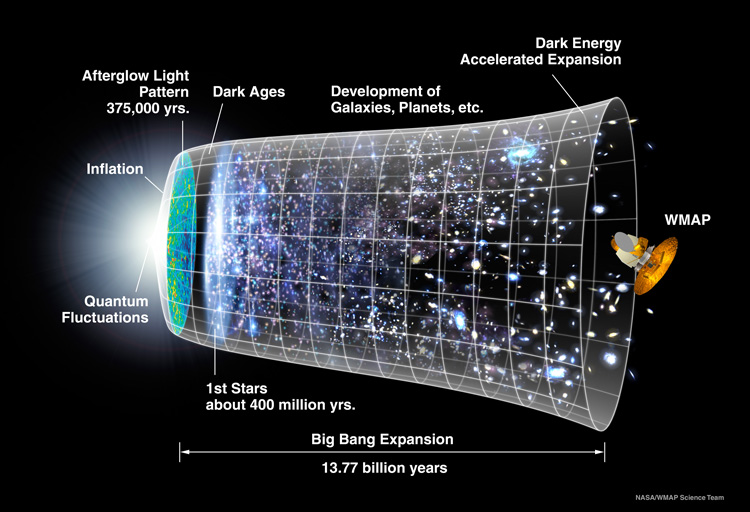
PS: Click on picture to see a timeline.

Sunday, August 9, 2009

Answers To Science Questions.

Dear science community,

As an scientist I am frequently asked questions like this: Is there really evidence for the big bang? How do you know black holes exist? How big are quarks? Why do scientists insist evolution is true? Etc...

As a result, I am going to publish an ongoing series I am calling Answers To Science Questions with the intention of answering such important questions. I will try to respond to frequently asked questions such as the above at least once a week.

Furthermore, with these Answers I will state what scientists actually know about these topics. There need not be any fear that I will be just another person watering down/spinning science to fit some pet theory. What I write will be just as mainstream as anything you will find in the peer reviewed literature.

With that being said, I also hope these Answers will be very enlightening, thought provoking and bring joy about the wonders of science to the scientific community.

Joseph Smidt

PS. If anyone has a particular question you want answered just let me know. Below I will try to stay current on topics covered thus far.

Big Bang: