Pages

Showing posts with label universe. Show all posts

Wednesday, May 5, 2010

The CMB Is A Perfect Black Body Spectrum.

What is black body radiation?  I think the most helpful definition is: "the black-body... may be thought of as... a gas of photons."

Water vapor is a gas of water molecules.  The helium gas that you blow up balloons with is a gas of helium particles.  So what do you call a "gas" (in equilibrium) consisting of light particles or photons?  You call it black body radiation. (See more here.)

It shouldn't be hard to imagine that the Cosmic Microwave Background Radiation (CMB) should be a black body: The universe can be thought of a giant container.  In the early stages of the universe, photons were emitted at every point and were free to flow throughout the universe like helium gas is allowed to freely move throughout its container.  Hence, if early universe physics was true, we should expect the CMB to be a perfect black body.

Those are not the 1-sigma error bars, those are the 400-sigma error bars!


Look at the plot above. The black line is the theoretical curve for a black body spectrum. The error bars from actually measuring the CMB have been multiplied by 400. That's right, the errors on the CMB being a perfect black body spectrum are so small that you have to multiply them by ~400 just to see them!

That's one perfect back body spectrum, and yet again shows the data backs the theoretical predictions of early universe physics.

Saturday, September 5, 2009

The Astronomy Picture Of The Day.

For those of you who don't know, you may be interested in checking out the Astronomy Picture Of The Day, run by NASA, from time to time.


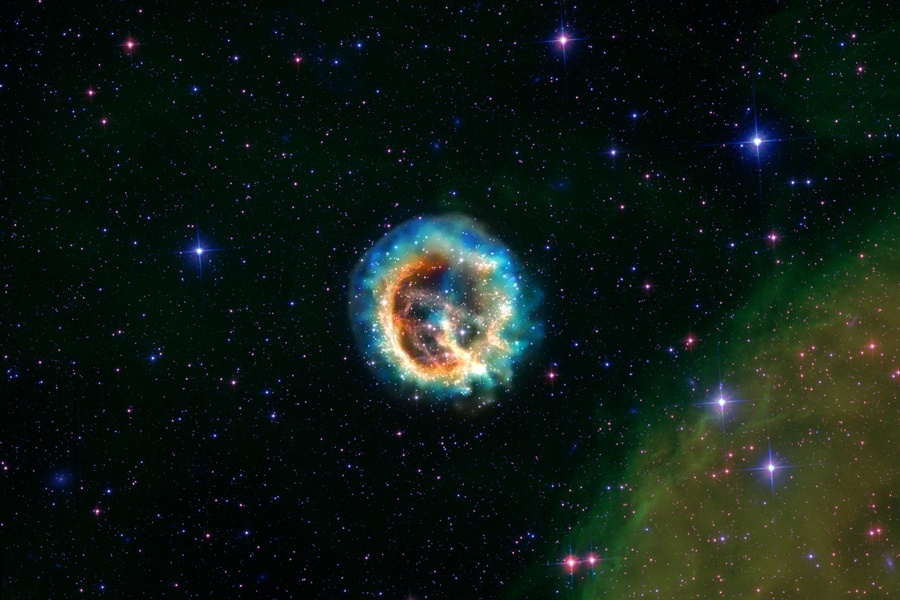
Every day this site posts a new picture, often very breathtaking, with a short description at the bottom of what you are seeing. The descriptions are always really good too. The picture above is today's picture which is of the debris left over after a star explodes. (Or supernova.)

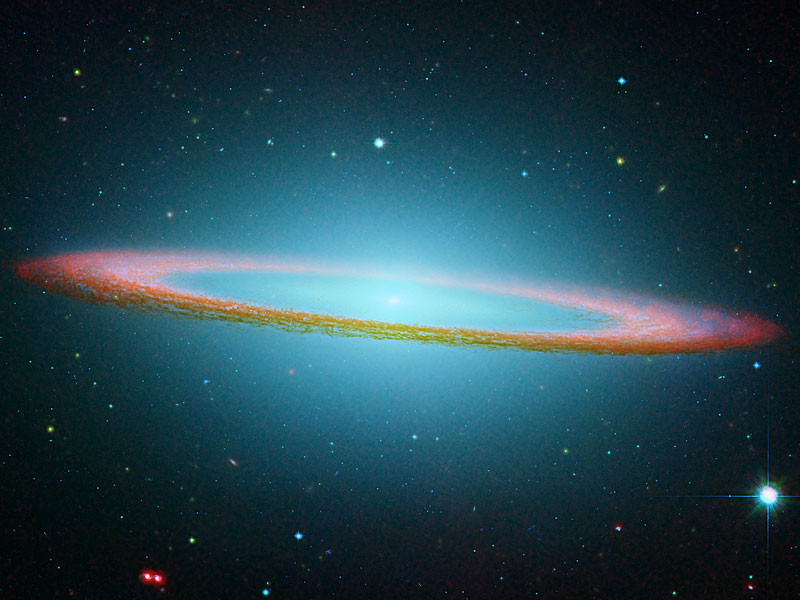
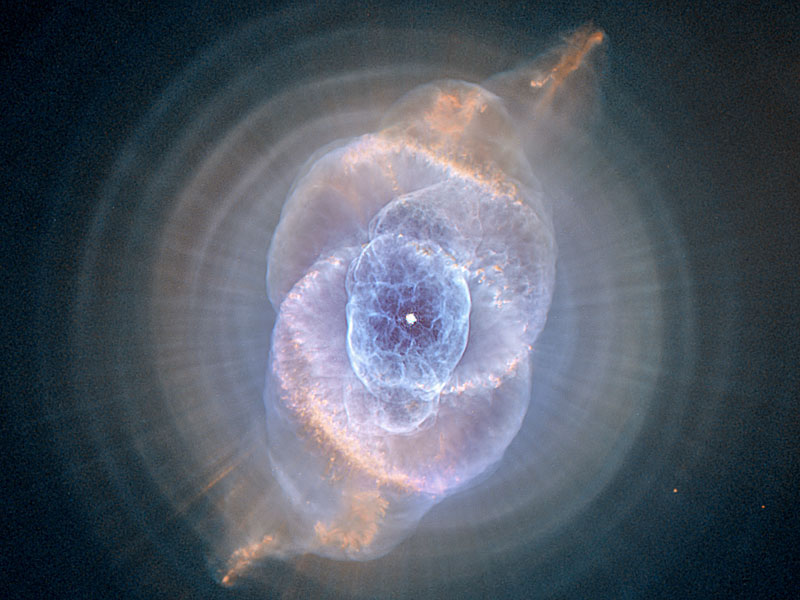
Another great thing I enjoy about the site it that is is searchable. Below are three examples I found searching.  They are the Sombrero Galaxy, Cats Eye Nebula, and Hubble Ultra Deep Field respectively.   I hope you enjoy this site, often referred to as APOD, as much as I have over the years.


Saturday, August 22, 2009

How Should We View The Universe's Expansion?

Dear Science community,

The universe appears to only have 3 dimensions, yet relativity says it is 4 dimensional. (With time on the same footing as space.)  Moreover it is expanding and we are told it has no center.  How are we to visualize all of this?

It turns out if you find a good graduate level cosmology textbook, like Weinberg 2007, you will find that you derive the geometry of the universe starting with a normal sphere.  (Think surface of a balloon to make sure we are on the same page.)  You then generalize this sphere to having four dimensions, consistent with Einstein's equations, and find that this new "generalized" sphere models our universe exceptionally well.  In fact, this geometry is the only one consistent with  isotropy and homogeneity, things I will blog about later.


Therefore, in a very real sense you should visualize our universe as the surface of a "generalized", higher dimensional, balloon or sphere.

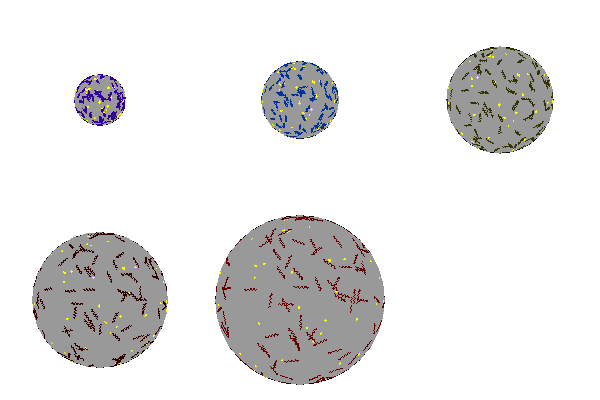
Pretend we were 2 dimensional creatures living on the surface of a normal balloon.  Even though the balloon fills a 3 dimensional space, we on the surface would only view it as 2 dimensional. If the balloon expands, what would we see?  We would see exactly what the picture describes below:

 As time marches on, all the other 2-D galaxies would be moving away from us.  Where would the center of our universe be?  There is no center of the surface of a balloon.

The same goes for us.  Though spacetime is a 4 dimensional object, we being trapped on the surface of this "generalized" balloon means that we only see three dimensions. Moreover there is no center of the universe any more than there is a center to the surface of a balloon.  (The Big Bang could be viewed as the center.  I'll let you think about that.)  And lastly, galaxies moving away from us is mostly due to the space between us expanding, not their actual velocities.  (Dots on a balloon move away from each other as the balloon expands even though they themselves aren't moving.)

Now, notice I keep saying "generalized".  That is very important.  A normal balloon surface, or 2-sphere to be technical, only has one type of curvature.  In higher dimensions a "3-sphere", like what we have, can be generalized to have 3 types of curvatures consistent with Einstein's equations that give rise to an open, closed and flat universe. (More on this later.)

Okay, hopefully that solves a lot of visualization problems.  Please ask questions!

Saturday, August 25, 2007

Big Empty Cold Spot Found in the Universe

From the BBC:

Astronomers have found an enormous void in space that measures nearly a billion light-years across.

It is empty of both normal matter - such as galaxies and stars - and the mysterious "dark matter" that cannot be seen directly with telescopes. The "hole" is located in the direction of the Eridanus constellation and has been identified in data from a survey of the sky made at radio wavelengths. The discovery will be reported in a paper in the Astrophysical Journal.
Previous sky surveys that have traced the large-scale structure of the nearby Universe have long shown, for example, how the clustering of galaxies is strung into vast filaments and sheets that are separated by great gaps.

But the void discovered by a University of Minnesota team is about 1,000 times the volume of what would be expected in typical cosmic gaps. "It's hard even for astronomers to picture how big these things are," conceded Minnesota's Professor Lawrence Rudnick. "If you were to travel at the speed of light, it would take you several years to get to the nearest stars in our own Milky Way galaxy; but if you were to go to this hole and enter one side, you'd have to travel for a billion years before you would get to the other side," he told BBC News. The void is roughly 6-10 billion light-years away and takes a sizable chunk out of the visible Universe in its direction.

There is more to the story. It goes on to explain that they found this because it corresponds to a "cold spot" from the CMB. They pointed the VLA towards this spot and were unable to detect any matter, light or dark. They think it has to do with dark energy. The originating paper that will be published in the Astrophysical Journal. You can find it here (arXiv).

Monday, May 28, 2007

No Evidence Of Big Band In 100 Billion Years?

This from the Scientific American:

Cosmologists have put themselves in the shoes of their future counterparts by pondering the consequences of dark energy, an enigmatic force discovered in 1998 that seems to be pulling galaxies apart at a steadily increasing clip. Eventually, this accelerating expansion of space will yank galaxies away from each other faster than light can travel between them, leaving our galaxy and its immediate neighbors isolated in a vast darkness.

In the process, all current evidence for the big bang would either vanish or become so diluted as to be imperceptible, says cosmologist Lawrence Krauss of Case Western Reserve University, who has studied the idea with Vanderbilt University physicist Robert Scherrer. "It will lead them to the wrong conclusion about what the universe is doing. The universe will look static, and that's vastly wrong, because the universe is expanding so fast they can't see it."

Take the expansion itself, first identified by Edwin Hubble in 1929 from the red tinge of distant supernovae. As space puffs up like a balloon, it stretches the wavelength of light from the bluer side of the spectrum toward the red. Krauss says that in 100 billion years or so the light from receding galaxies will have been stretched like taffy to a wavelength longer than our galaxy (100,000 light-years) and, therefore, be impossible for telescopes to detect.

The cosmic microwave background radiation, a residue of matter's first flash of light following the big bang, will suffer a similar fate. As its wavelength expands, Krauss says, the radiation will start to be soaked up by interstellar dust, potentially becoming indistinguishable from other light sources...

Friday, November 24, 2006

Introduction


My name is Joseph Smidt and this is my first blogging experience. I have named the blog "The Eternal Universe" since I am on the road to becoming a cosmologist and my favorite model for the universe is the Eternal Inflation Model. Decades of ever increasing experimental evidence concur that the observable universe as we know it sprang from an incredibly small, hot and dense region of space. In fact, there is substantial experimental evidence that, about 13.7 billion years ago, the entire observable universe was smaller than a baseball and inflated into what we see today. According to classical general relativity, the results we see lead inevitably to the conclusion that the universe sprang from an initial singularity. We call this the "Big Bang."

If however classical general relativity is extended to a quantum theory of gravity, then it is possible that the universe inflated from a very small quantum patch, not a singularity. Where did this quantum patch come from? The Eternal Inflation Model predicts it resided in another universe from which this universe emerged. It turns out, if you do the quantum math, that if you allow the universe enough time to exist, a small patch of the quantum fields that exist throughout the universe will eventually inflate and create a new universe. After the quantum fields inflate to sufficient sizes, they actually have the ability to gravitationally collapse and form galaxies, stars and planets which allow life to form and exist. It truly is a wondrous thing and the cycle continues in one big eternal round.

I really think I will find blogging a pleasurable experience. I will admit however that I know it can be a little dangerous. It seems when people share their opinions publicly, they are setting themselves up to offend someone or something. Hopefully I will be able to avoid such calamities.

Again, I wanted to start a blog because I think it will be fun. I will enjoy posting things and hope to build some good friendships with people around the web. May we all remember that we live in this great eternal universe together, so lets make the most out of it. May everyone have a great Thanksgiving weekend.

-- Joseph Smidt


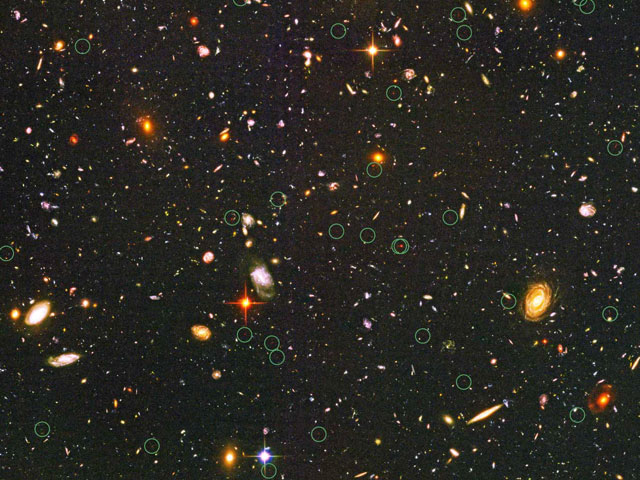
Picture on Top: Our Universe. Yes all the dots are galaxies, our universe is that big, and even bigger. :)

Picture on Bottom: image of atoms taken by IBM.

The inflated quantum fields not only gave rise to the the vast cosmos that we see in telescopes, they also form the atoms are bodies are composed of!