Experts can correct me if I'm wrong, but I believe the below is correct.
As said before, loop quantum gravity supporters, and many quantum gravity people in general, argue a major problem with string theory is that it isn't background dependent. Physically, they argue, this is bad since from GR we learn gravity doesn't propagate through spacetime but in fact is the spacetime.
However, I believe this critique may be unfounded. It turns out, curved spacetime in string theory is a cohert state of gravitons, not just some ad hoc background space for strings to move through. (As our LQG friends world have us believe.)
Here's how to see it. Again from David Tong's wonderful lecture notes:
The string action in curved space: (Capital G is the "background space").
The trick is to put G into the form: (We do this all the time. Nothing fishy here.)
Now, throw that puppy into the path integral, and we have:
Where S_Poly is string theory without curved space and V is:
But V is just the vertex operator for a graviton!
For those who don't know, inserting a single vertex operator V in the path integral corresponds to the introduction of a single graviton state. Inserting e^(V) in the path integral corresponds to a coherent state of gravitons!
So, the background in string theory does not appear to be some ad hoc background the strings are magically propagating in. It appears to be a coherent state of the gravitons themselves.
Hence, I believe the critics are wrong: Curved spacetime in string theory appears to be nothing more than gravitons after all. Just like GR.
Pages
Showing posts with label Loop Quantum Gravity. Show all posts
Monday, March 8, 2010
Monday, February 22, 2010
Issues With Loop Quantum Gravity.
This is the last post on the LQG series.
I will now present the main issues with the theory:
That being said, loop quantum gravity has enough issues that it shouldn't be too surprising why theorists aren't jumping all over it.
I will now present the main issues with the theory:
- Even though it prides itself in "preserving the fundamentals" we learn from GR ("cough..back ground independence.. cough") loop quantum gravity doesn't even recover GR in the low energy limit. (Talk about embarrassing!)
- Like string theory, it's been around for a long time now and seems to have trouble making testable predictions.
- It has a parameter, the Immirzi parameter, that has to be set in an ad hoc way to make things work out. Theorists don't like parameters that have to be fine tuned.
- By it's own admission during formulation: it does not lead to unification. This isn't appealing on aesthetic grounds.
That being said, loop quantum gravity has enough issues that it shouldn't be too surprising why theorists aren't jumping all over it.
Friday, February 19, 2010
Loop Quantum Gravity: Fasciantion With Background Independance.
(Third post in the loop quantum gravity series.)
For centuries after Newton, physics was formulated where objects moved through space and time. Space and time was something in which the dynamical quantities we measure, like protons and forces, move through.
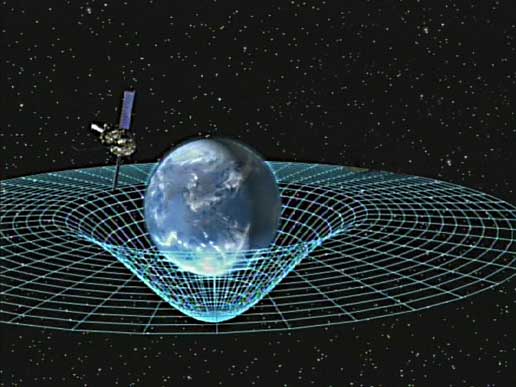
However, Einstein discovered that gravity isn't moving through space and time: gravity was space and time. Gravity is just a manifestation of how space and time or spacetime is bent and curved by mass. (See figure.) General relativity is a theory of gravity that is background independent in that gravity is not moving in some separate spacetime. It is the same thing.
This leads to a critique of string theory raised by many in the loop quantum gravity camp: String theorists are trying to combine general relativity and quantum mechanics by removing the idea that gravity doesn't propagate through spacetime but in fact is the spacetime. (I'm sure real string theorists will debate this critique, but right now I am giving the LQG side of the argument.)
Requiring spacetime to be something that emerges from gravity through quantized loops, as opposed to gravity moving through space, has a few consequences:
For centuries after Newton, physics was formulated where objects moved through space and time. Space and time was something in which the dynamical quantities we measure, like protons and forces, move through.
However, Einstein discovered that gravity isn't moving through space and time: gravity was space and time. Gravity is just a manifestation of how space and time or spacetime is bent and curved by mass. (See figure.) General relativity is a theory of gravity that is background independent in that gravity is not moving in some separate spacetime. It is the same thing.
This leads to a critique of string theory raised by many in the loop quantum gravity camp: String theorists are trying to combine general relativity and quantum mechanics by removing the idea that gravity doesn't propagate through spacetime but in fact is the spacetime. (I'm sure real string theorists will debate this critique, but right now I am giving the LQG side of the argument.)
Requiring spacetime to be something that emerges from gravity through quantized loops, as opposed to gravity moving through space, has a few consequences:
- Excitations of the gravitation field give rise to the notion of length, are and volume ie.. spacetime. (Just like excitations of other quantum fields give rise to things like particles.)
- Space and time is composed of little "quanta" that, in the literature I read, is described as really small grains of spacetime.
- The loop quantization of gauge fields discussed in the last post in a continuous background gives rise to infinities that plague many quantum theories. However, when spacetime is quantized into discrete packets, these infinities go away since these loops no longer are bunched together in a continuum. (The continuum gives rise to the infinity.)
- (Repeating myself for emphasis.) What is space and time?: it emerges from the excitations of the gravitational field that is quantized trough loop operators. These loop operators do not exist in space and time but give rise to the existence of spacetime.
- Since these are loops quantizing the field, they give rise in a technical sense, to the notion of spin networks. These spin networks have "world histories" described by what is called a spin foam. (See figure on the left.)
Wednesday, February 17, 2010
Loop Quantum Gravity: Fasciantion With Field Lines.
(The second post of the LQG series. )
The founders of electromagnetic theory made a remarkable discovery: forces seem to be related to field lines that begin and end on charges. (See figure to the right.) In fact, Faraday thought of these field lines as 'lines for force' that were really propagating through space.
Furthermore, it has been discovered that all "gauge-theories" such as electricity and magnetism or Yang-Mills theories can be described by field lines that represent "the holonomy" of the gauge potential of the theory. Holonomy is a fancy way of classifying the structure of the gauge potential that is related to the exponential of the line integral along some loop alpha of the gauge potential.
For example, for electricity and magnetism that has gauge potential A, the holonomy along some loop alpha is this:
Where U is the holonomy.
Non-canonical quantization.
Now, in a canonical quantization of a theory we create what are called raising and lowering operators that give rise to the different states in the theory. Objects in your theory become excitations of your field. These excitations are related to how many creation or annihilation operators are needed to create the state.
In the "holonomy" approach to quantization, instead of quantizing the theory using canonical raising and lowering operators, you quantize by promoting the holonomy to an operator. These operators act on each state creating a new state in the same way creation and annihilation do the job in the canonical approach to quantum mechanics.
This means, excitations of the field quantized in this way give rise to "loop states". (Hence the name loop quantum gravity.) Hence, imagining filed lines looping around emerging from charges may not be such a bad way to think about things after all. Loops of field lines are the excitations of the field.
Take away message if you fell asleep:
Quantum theories can be thought of as excitations of some underlying quantum field. The excitations are related to operators that quantize the theory. It turns out, we can quantize theories by using the holonomy or field lines of the gauge potential. (The things in the figure above.) By quantizing a theory in this way, as is done in loop quantum gravity, what emerges is idea that excitations of the underlying quantum field are actually loops. (Loops much like the field lines imagined by the founders of the electromagnetic theory.)
So, loop quantum gravity is in fact a loopy theory.
The founders of electromagnetic theory made a remarkable discovery: forces seem to be related to field lines that begin and end on charges. (See figure to the right.) In fact, Faraday thought of these field lines as 'lines for force' that were really propagating through space.
Furthermore, it has been discovered that all "gauge-theories" such as electricity and magnetism or Yang-Mills theories can be described by field lines that represent "the holonomy" of the gauge potential of the theory. Holonomy is a fancy way of classifying the structure of the gauge potential that is related to the exponential of the line integral along some loop alpha of the gauge potential.
For example, for electricity and magnetism that has gauge potential A, the holonomy along some loop alpha is this:
Where U is the holonomy.
Non-canonical quantization.
Now, in a canonical quantization of a theory we create what are called raising and lowering operators that give rise to the different states in the theory. Objects in your theory become excitations of your field. These excitations are related to how many creation or annihilation operators are needed to create the state.
In the "holonomy" approach to quantization, instead of quantizing the theory using canonical raising and lowering operators, you quantize by promoting the holonomy to an operator. These operators act on each state creating a new state in the same way creation and annihilation do the job in the canonical approach to quantum mechanics.
This means, excitations of the field quantized in this way give rise to "loop states". (Hence the name loop quantum gravity.) Hence, imagining filed lines looping around emerging from charges may not be such a bad way to think about things after all. Loops of field lines are the excitations of the field.
Take away message if you fell asleep:
Quantum theories can be thought of as excitations of some underlying quantum field. The excitations are related to operators that quantize the theory. It turns out, we can quantize theories by using the holonomy or field lines of the gauge potential. (The things in the figure above.) By quantizing a theory in this way, as is done in loop quantum gravity, what emerges is idea that excitations of the underlying quantum field are actually loops. (Loops much like the field lines imagined by the founders of the electromagnetic theory.)
So, loop quantum gravity is in fact a loopy theory.
Monday, February 15, 2010
Series On Loop Quantum Gravity.
I am going to write a small series on loop quantum gravity: a possible alternative to string theory. (For the quantization of gravity.)
I've discussed various aspects of string theory from time to time but I've never discussed loop quantum gravity. There is essentially two reasons for this:
According to one of its main founders, Carlo Rovelli, there are five main assumptions that go into the formulation of to loop quantum gravity:
I've discussed various aspects of string theory from time to time but I've never discussed loop quantum gravity. There is essentially two reasons for this:
- It seems, to me, the majority of the theoretical physics community feels it is much more likely that string theory is the way to go. They seem to convey the idea that loop quantum gravity is interesting but is more problematic and not nearly as promising as string theory.
- Though I'm not a string theorist, at least I've had enough exposure to string theory that I can make comments about various aspects of it. To the contrary, I've had almost no formal exposure to loop quantum gravity so it is more difficult for me to discuss it.
According to one of its main founders, Carlo Rovelli, there are five main assumptions that go into the formulation of to loop quantum gravity:
- Quantum mechanics and general relativity: Quantum mechanics suitably formulated to be compatible with general covariance, along with the notions of space and time coming from general relativity are assumed to be correct.
- Background independence: The gravitational field is the spacetime, so the notion that a gravitational field propagates is some background spaectime is not allowed. (As it is in string theory.)
- No unification: Many hope quantizing gravity will lead to a unification of physics. This is not a goal of loop quantum gravity.
- Four spacetime dimensions: Higher dimensions than the four we experience are not required for this theory. (Different than the 10+ required for string theory.)
- No supersymmetry: Unlike string theory, you do not need supersymmetry. This is nice for the same reason #4 is: despite our best efforts there is no evidence that nature is this way.
Subscribe to:
Posts (Atom)