Pages

Showing posts with label Gravitational Waves. Show all posts

Tuesday, September 21, 2010

How To Possibly Detect Graviton Mass With Gravity Waves/Pulsars.

ResearchBlogging.orgGravitons are the particles that mediate the force of gravity in the analogous way that photons are responsible for the electro-magnetic field.  And like photons, gravitons are thought to be massless.  In fact, assuming general relativity is correct, the mass of the graviton has an upper bound of 7x10-32 eV which is really small. (See bold text at bottom.)  However, for alternative gravity theories this upper bound no longer holds.

Two neutron stars rotating rapidly around one ...                               Image via Wikipedia
Lee et al. have recently developed a new way to place a bound on the graviton mass that is general enough that it constrains this mass even in alternative theories to gravity.  This technique involves measuring correlations in the gravitational waves from the timing residuals of pulsars.

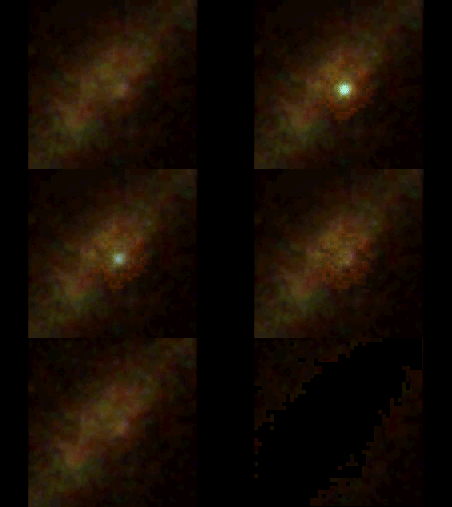
Just a reminder: fluctuations in the curvature of spacetime propagate as waves which are called gravity waves.  The top right picture shows the gravity waves given off by two neutron stars orbiting each other.  Pulsars, are "highly magnetized, rotating neutron stars" that emit a beam of light that can appear to flash the earth in very regular intervals like a lighthouse. See the lower right animation to see the "cycle of pulsed gamma rays from the Vela pulsar".

Back to the article.  Here is how the authors put it:
The pulsar timing array is a unique technique to detect nano-Hertz gravitational waves by timing millisecond pulsars, which are very stable celestial clocks. It turns out that a stochastic gravitational wave background leaves an angular dependent correlation in pulsar timing residuals for widely spaced pulsars (Hellings & Downs 1983; Lee et al. 2008). That is, the correlation C(θ) between timing residual of pulsar pairs is a function of angular separation θ between the pulsars. One can analyse the timing residual and test such a correlation between pulsar timing residuals to detect gravitational waves (Jenet et al. 2005). We find in this paper that if the graviton mass is not zero, the form of C(θ) is very different from that given by general relativity. Thus by measuring this graviton mass dependent correlation function, we can also detect the massive graviton.
So basically the correlation function between gravity waves and pulsar timing residuals puts a constraint on the graviton's mass.

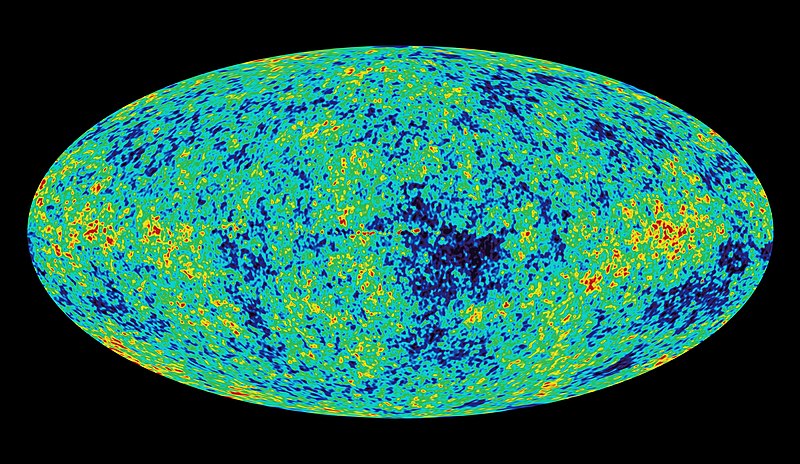
Another aside: Thinking of the power spectrum of the CMB, and taking a minute to play this game may be helpful.  The power spectrum of the CMB is a correlation function of temperature fluctuations of the CMB. As that game shows, this correlation function changes significantly for changes in the amount of dark matter, dark energy, regular matter, etc...  Therefore, the shape of the power spectrum tells you a lot of physics.

Lee et al. are doing the same thing with correlation functions of gravity waves with pulsar timing residuals.  The shape of this power spectrum, which they denote as C(θ), changes significantly with graviton mass.  The plot above shows this change.  The plot on the left shows how C(θ) would look after 5 years of a bi-weekly observation and the plot on the right shows what C(θ) would look for a 10 year bi-weekly observation.

Using this technique and future gravity wave interferometers the authors claim that with 5 years of data they can place an upper bound on the graviton mass of 1x10-22 eV and after 10 years they can place an upper bound of 3x10-23 eV.

Now, even if the graviton does have mass, to put into preservative how light this particle must be if its mass is around these numbers, I will remind people that the mass of the electron is 510,998 eV! So a mass on the order of 10-23 eV is mind-blowingly tiny!

Kejia Lee, Fredrick A. Jenet, Richard H. Price, Norbert Wex, & Michael Kramer (2010). Detecting massive gravitons using pulsar timing arrays Accepted by ApJ arXiv: 1008.2561v2

Monday, November 27, 2006

What Would I Like to See in Graduate School?

As many of you may know I hope to be off to graduate school next year. If I am like the average graduate student I will be there 5-6 years meaning I may be there until 2012-2013.(Yikes!) I happen to be going at perhaps the best time in history. In the next 5-6 years we may come up with some of our most profound discoveries ever. Here is what I hope to see.

1. The Higgs field and Supersymmetry: We all have been thankful for the success of the Standard Model, but I believe we are ready to move on. One major particle that I am desperately hoping CERN finds is the Higgs Boson. Come 2007, the LHC, at CERN will be operating at energies higher then currently being achieved anywhere else; on the order of of 14 TeV. In addition to finding the Higgs, I am really crossing my fingers that we will find strong evindence for supersymmetry. Not only will supersymmetry give us a huge slew of new particles to explore, it will hopefully resolve some of our issues such as the vacuum energy problem and candidates for dark matter.

2. Gravitational Waves: Being able to detect light we cannot see visually, like infrared and microwaves, has greatly furthered our understanding of nature. I hope we will soon add to that gravitational waves. Gravitational waves will greatly enhance our ability to study the universe. We will better understand centers of Galaxies, neutron stars and black holes. In addition, many are very excited on what light gravitational waves will shed on the initial stages of the universe. That will help us further understand not only large stellar objects, but also the small particles which formed in the early stages of the universe. Hopefully LIGO and LISA will be successful which I am at graduate school.

3. Neutrino Background: Many are familiar with the CMB or cosmic microwave background radiation but not as many people are familiar with the theoretical neutrino background. It turns out, there should be a huge collection of neutrinos left over from the big bang era which haven't interacted with anything. We should be able to study this collection much as we can study the CMB to determine truths about the universe. Surely there will be much learned from the neutrino background, and this is yet another discovery I hope we make soon.

4. Pop III Objects: Stars and planets today have lots of elements heavier then hydrogen and helium. During the initial stages of the universe, it was practically all hydrogen and helium. Because of this the physics of the cosmos was very different then it is today. These differences make all the difference in the world if you are trying to understand the universes history. Understanding the universe's history is very important in uncovering how and why the universe is the way it is. Hopefully the Hubble, or more realistically the new James Webb Telescope which will launch in 2013, will detect these objects.

5. Dark Matter and Dark Energy: This may be asking a little much, but with some luck the above things will set straight what is dark matter and dark energy. Maybe supersymmetry is responsible, or maybe something else.

6. The Stage Set for the Theory of Everything: Okay, I have to realistically believe quantum gravity, etc... will not be solved in the next 5-6 years. However, if we can understand the basics of supersymmetry, information coming from gravitational waves, the neutrino background, early population III objects and the higgs field, we might be able to have enough cosmological data to really get somewhere. I've said it before, and I will keep saying it, string theorists are demanding particle accelerators the size of the solar system to test things that will result in understanding quantum gravity. We may never have such accelerators, but we do have an event about 13.7 Billion years ago with energies high enough that if we could examine it close enough we may be knocking on the door to understanding quantum gravity and more. These are the events I hope to see which I believe will lead up to that.